The Renaissance gave us graceful Madonnas, heroic gods, flawless perspective, and some of the most beautiful paintings in art history.
But it also gave us vegetable heads, giant strawberries, flying witches, impossible sea monsters, skeletons putting themselves back together, and satyrs being skinned alive while a dog laps up the blood.
Renaissance artists could get seriously weird.
Some of these paintings were meant to frighten or amuse. Others were elaborate visual puzzles stuffed with symbols that contemporary viewers would have delighted in deciphering. And a few are so baffling that, centuries later, art historians still can’t agree on what the artist was trying to say.
So forget serene Raphaels for a minute. Here are some of the weirdest paintings of the Renaissance that simply make you wonder: what on earth is going on here?
Eccentric Renaissance Paintings
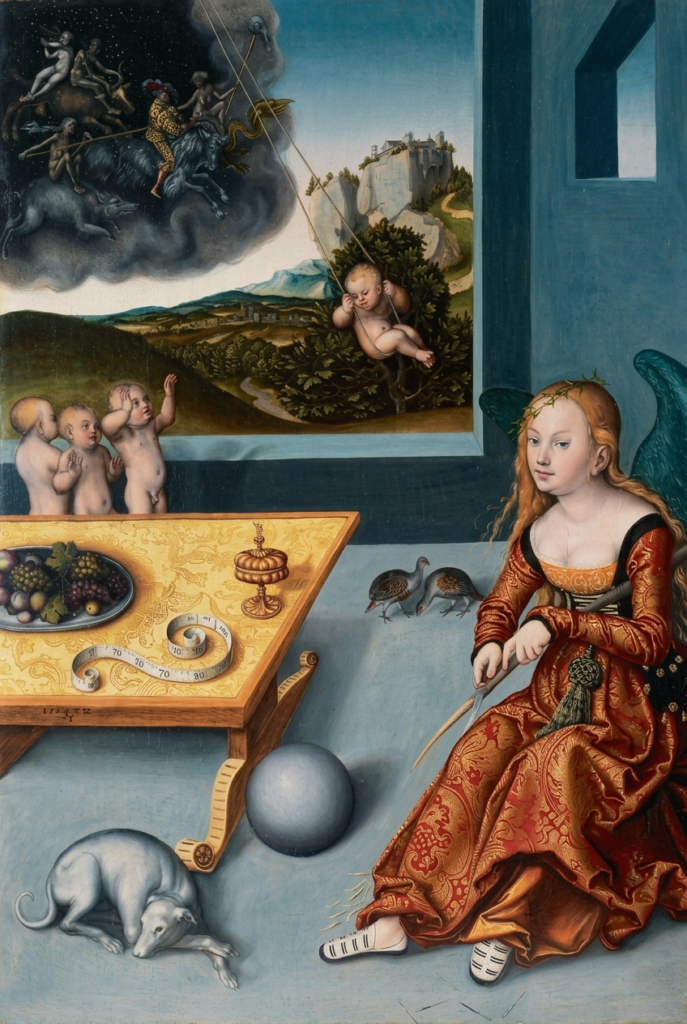
Cranach the Elder, Melancholy
📍Musée Unterlinden, Colmar France
This wonderfully bizarre Renaissance painting is Cranach’s Melancholy.
It’s absolutely bonkers when you start looking at it: the winged woman in red, three putti playing, the big gray sphere, the dog, the birds, and then that ominous black cloud full of witches and supernatural riders charging across the sky.
At first it looks merely eccentric. Then you notice the naked babies, sphere, emaciated dog, woman whittling a stick and the demonic airborne hunting party emerging from a black cloud.
It was inspired by Dürer’s Melencolia I, but Cranach rendered the idea much more strangely. He interprets the imagery partly through Luther’s view of melancholy as a state that left a person susceptible to Satan. Egads!

Bosch, Garden of Earthly Delights
In The Garden of Earthly Delights triptych, Bosch creates an indecipherable freakish world overflowing with temptation, pleasure, and punishment. It’s likely a creation and damnation image, and is populated by naked figures, hybrid creatures, amorous acts, and hallucinatory horrors.
It’s safe to say it wasn’t an altarpiece. And the longer you look, the weirder it gets. That’s why there’s always a line at the Prado to look at it.
There are giant strawberries, people trapped inside transparent bubbles, humans emerging from enormous pieces of fruit, bizarre hybrid animals, and creatures that seem to have escaped from a fever dream.
Then you reach the hell panel, where Bosch really lets loose. A gigantic bird-headed monster devours people and excretes them into a pit. Musical instruments become torture devices. Bodies are crushed beneath enormous lutes and harps. A hollow tree-man with a human face watches over the chaos.
Scholars have picked apart the imagery for centuries. The strawberries scattered throughout the central panel, for example, may represent fleeting sensual pleasure or serve as a seductive “love fruit.”
In fact, attempts to decode every detail may be part of the fun. More than 500 years later, The Garden of Earthly Delights remains one of the strangest paintings ever created, Renaissance or otherwise.
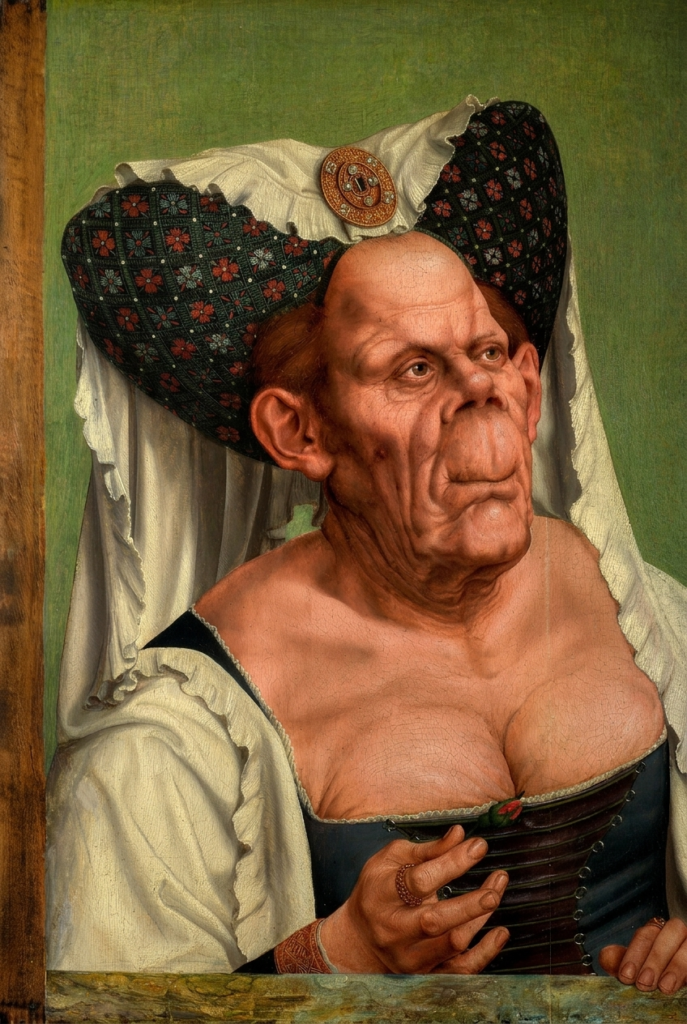
Quentin Matsys, The Ugly Duchess
Quinten Matsys’ The Ugly Duchess is weird on sight. The woman has a bulging forehead, deeply set eyes, a snub nose, hairy mole, wrinkled neck, and prominent chin. She also appears to have lost all her teeth.
Yet she’s dressed like an aristocratic beauty, with an elaborate horned headdress and a scandalously low-cut gown that was already decades out of fashion when Matsys painted her. She holds a rosebud, a symbol of love and sexuality, apparently hoping to seduce the elderly man in the painting’s companion piece.
The contrast is deliberately absurd. Matsys exaggerates her features while dressing her as a fashionable young seductress, creating a satire of vanity, aging, and inappropriate desire.
But there’s another reason she belongs on this list. Matsys was experimenting with the “grotesque,” which originally meant something strange, exaggerated, playful, or fantastical rather than simply ugly.
The painting only acquired its famous nickname, The Ugly Duchess, much later. She isn’t actually a duchess at all. The title came from her resemblance to John Tenniel’s famously grotesque Duchess in Alice’s Adventures in Wonderland.
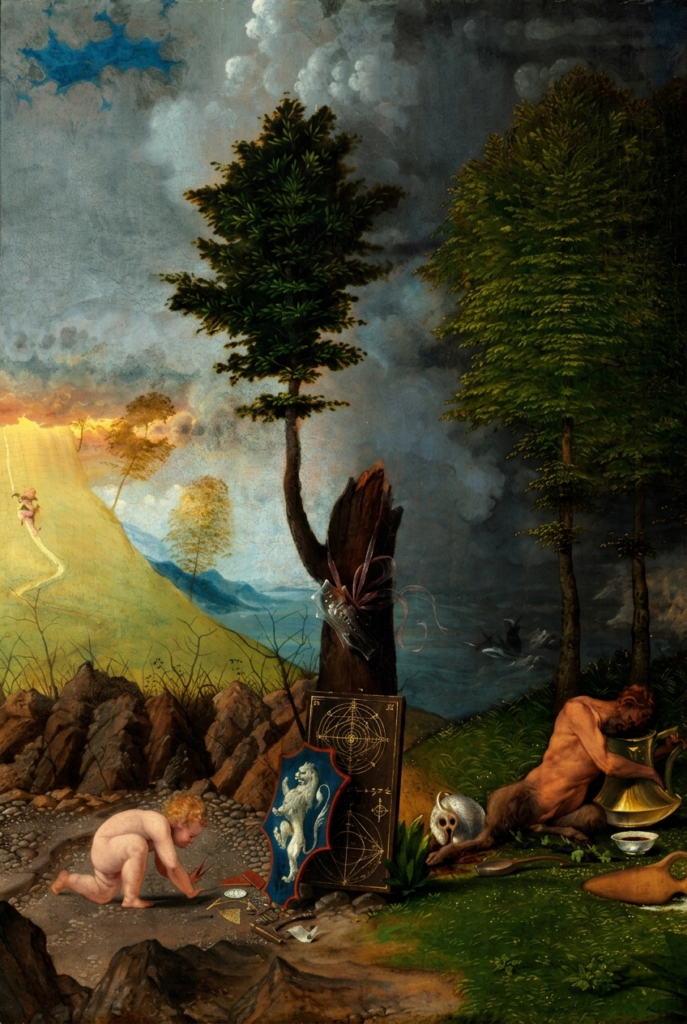
Lorenzo Lotto, Allegory of Virtue and Vice
📍National Gallery of Art, Washington
What is this Lotto painting exactly? It’s looks like a strange dreamscape with a drunken satyr, shipwreck imagery and an oddly disturbing mood.
The painting is a moral allegory. It’s a visual metaphor for the contrast between virtuous and sinful living.
The painting has an unusual composition. At its center is a tree branch. One green branch symbolizes life, while the dried up version signifies death.
The panel is not symmetrical or balanced in any way. The vice side is dark and story. The virtue side is orderly and bright without any stormy elements.
Small details are densely crammed into a small space, each with its own meaning. Unlike many allegories, it’s not straightforward. It feels like a poetic, almost cryptic version.
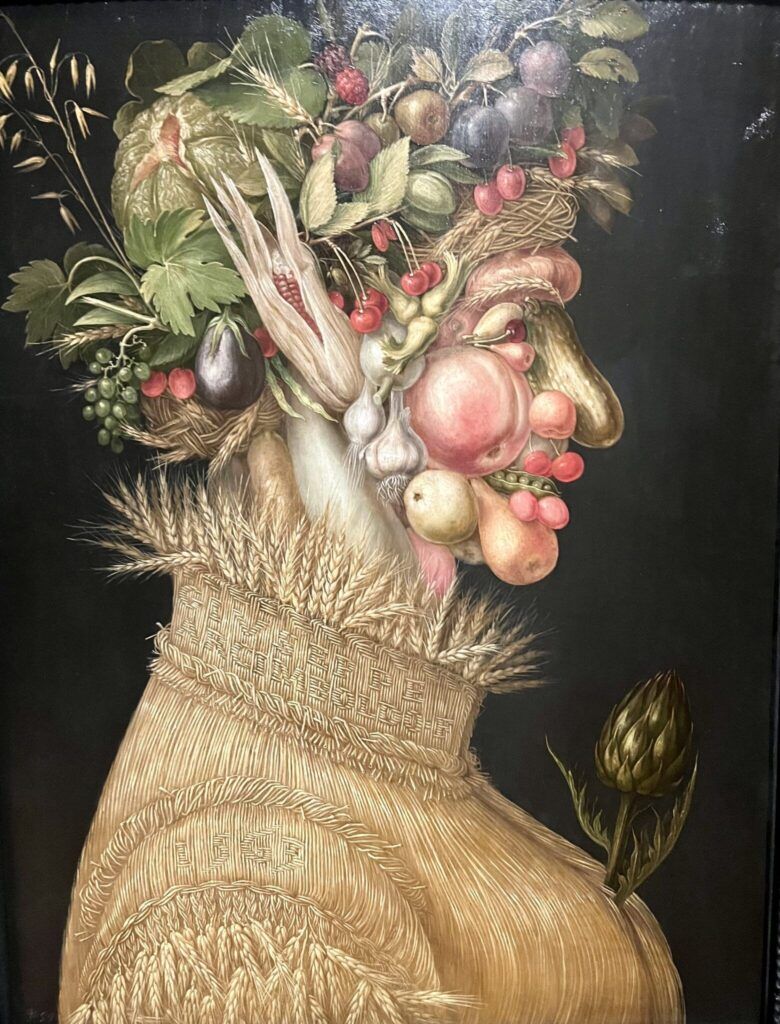
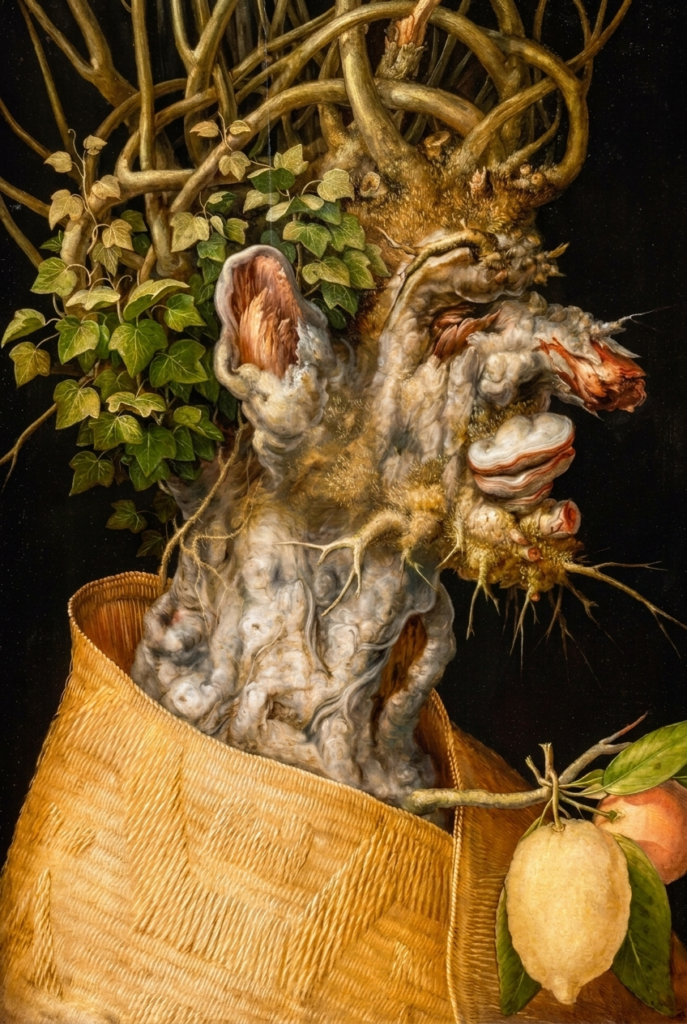
Giuseppe Arcimboldo, Four Seasons
Giuseppe Arcimboldo was an Italian Renaissance painter and imperial court artist in Vienna. But he didn’t paint conventional court portraits. He made wonderfully weird faces out of fruit, vegetables, flowers, animals, books, and just about anything else he could dream up.
One of his most famous series is the Four Seasons, in which each season takes the form of a human portrait. Only two of the original paintings survive, Summer and Winter, and both are in the Kunsthistorisches.
Summer looks like the profile of a man until you get closer. His cheek is a peach, his nose a cucumber, his ear an ear of corn, and his entire head and torso are assembled from the season’s produce.
Winter is even stranger. A gnarled tree stump becomes an elderly man, with broken branches for hair, bark for wrinkled skin, and fungi forming his mouth.
That’s what makes Arcimboldo so wonderfully bizarre. Your brain recognizes a perfectly convincing human face even though there isn’t actually a real face there. The paintings hover somewhere between portraiture, still life, visual puzzle, and Renaissance practical joke.
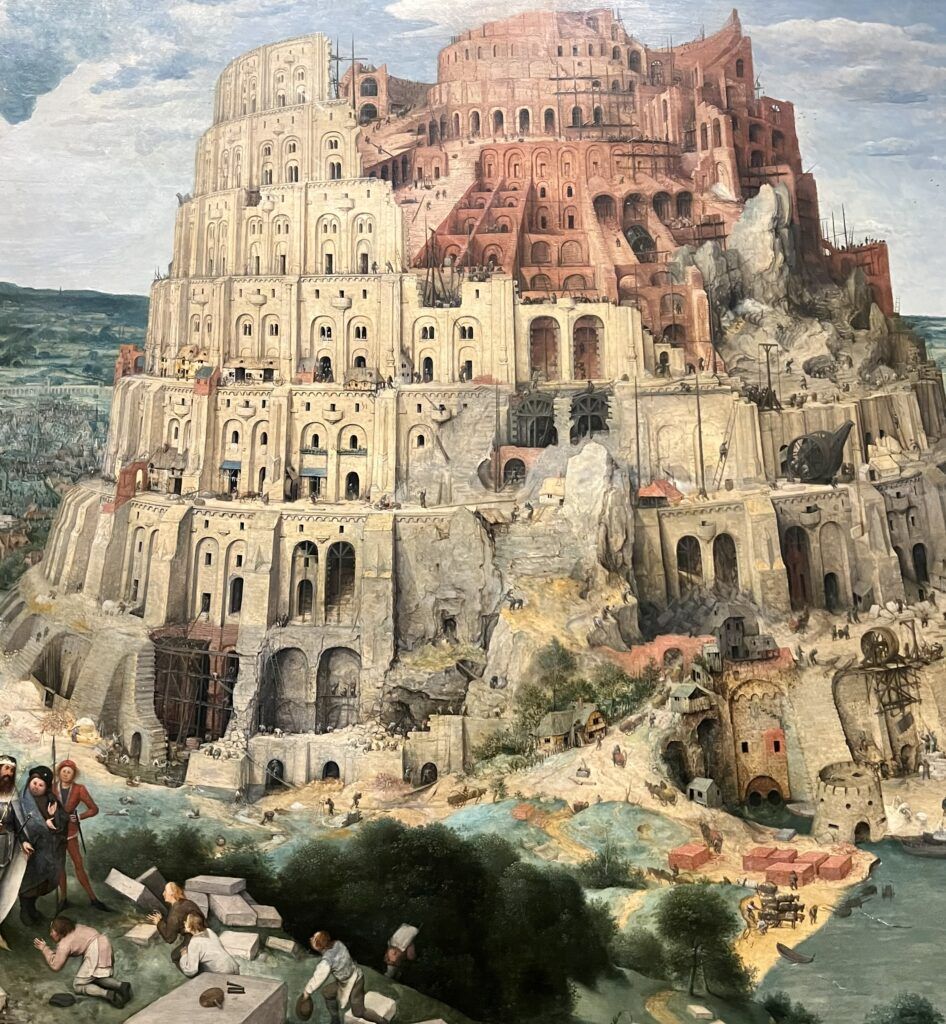
Pieter Bruegel the Elder, Tower of Babel
Bruegel is celebrated for his meticulously detailed paintings of 16th century life. The Tower of Babel is one of his most iconic masterpieces.
It depicts the Old Testament story of humanity attempting to build a tower that could reach heaven. The enormous spiraling structure was inspired by the Colosseum in Rome. But Bruegel transforms it into an architectural fantasy, so colossal that it seems to swallow the city around it.
What makes the painting so strange is how convincingly real he makes the impossible seem. Tiny workers swarm over ramps and scaffolding. Cranes haul materials upward.
Arches, workshops, and half-finished rooms fill the structure. It looks less like a biblical fantasy than an enormous Renaissance construction site.
There’s no lightning bolt or other obvious warning that divine punishment is coming. But look closely and you can see that the tower is already doomed.
Floors don’t quite line up, parts of the structure lean precariously, and the foundations appear incapable of supporting its enormous weight. Humanity doesn’t need God to knock it down. Bruegel has already engineered its collapse.

Piero dela Francesca, Flagellation
📍National Gallery of the Marches, Ducal Palace Urbino
The Flagellation of Christ is one of Piero’s greatest and most mysterious paintings. Art historian Kenneth Clark famously called it “the greatest small painting in the world.”
But no one really knows what this enigmatic little painting is about.
The composition itself is downright strange. Piero violates a cardinal rule of Christian narrative painting by shoving the supposed main event into the background on the left.
Christ is tied to a column and whipped before Pontius Pilate. Piero surrounds the scene with pristine Classical architecture, perfect perspective, and a golden statue perched atop the column.
Meanwhile, three unidentified men dominate the foreground on the right. They stand around calmly, seemingly oblivious to the torture taking place behind them.
Scholars still can’t agree on who they are or what they represent. Theories have connected them to dynastic murder, Italian politics, the fall of Constantinople, and members of the Montefeltro court.
Even stranger is the painting’s mood. Nobody seems particularly upset about anything. Christ is eerily composed, his tormentors appear almost mechanical, and the three men in front remain cool and detached.
It’s a gruesome biblical event transformed into a silent, perfectly ordered mathematical world. The painting is so precise and serene that it almost makes the violence more unsettling. More than 500 years later, we still don’t know exactly what it was.

Bronzino, An Allegory With Venus and Cupid
📍National Gallery, London
This racy painting has fascinated art historians for centuries. It’s a frankly erotic painting and, at first glance, almost looks like a glossy fashion spread.
Then you notice that Venus is passionately kissing her son Cupid.
As a painting intended for a sophisticated court audience, it was almost certainly designed as a visual puzzle. Identifying the mythological figures and untangling their symbolism was part of the fun.
Venus, goddess of love, is identified by the golden apple in her hand. She steals an arrow from Cupid as he embraces her. Their pale, elongated bodies are as smooth and cold as enamel, set against an almost electric ultramarine blue.
Things get progressively weirder around them. A laughing child showers the couple with rose petals while stepping on thorns.
Behind him lurks Deceit, who looks like a beautiful girl until you notice her scaly body, animal-like paws, and hidden sting. On the other side, Jealousy howls in apparent agony.
And looming over the entire scene is a muscular, winged Father Time, identifiable by the hourglass behind him. He’s pulling away the blue curtain to expose Venus and Cupid’s illicit embrace. Opposite him, the mask-like figure of Oblivion seems to be trying to cover everything back up.
It’s an extraordinarily strange mixture of beauty, incestuous desire, pleasure, deception, pain, and time. The exact meaning is still debated. But the basic warning seems clear enough: lust may look gorgeous, but trouble is lurking everywhere.
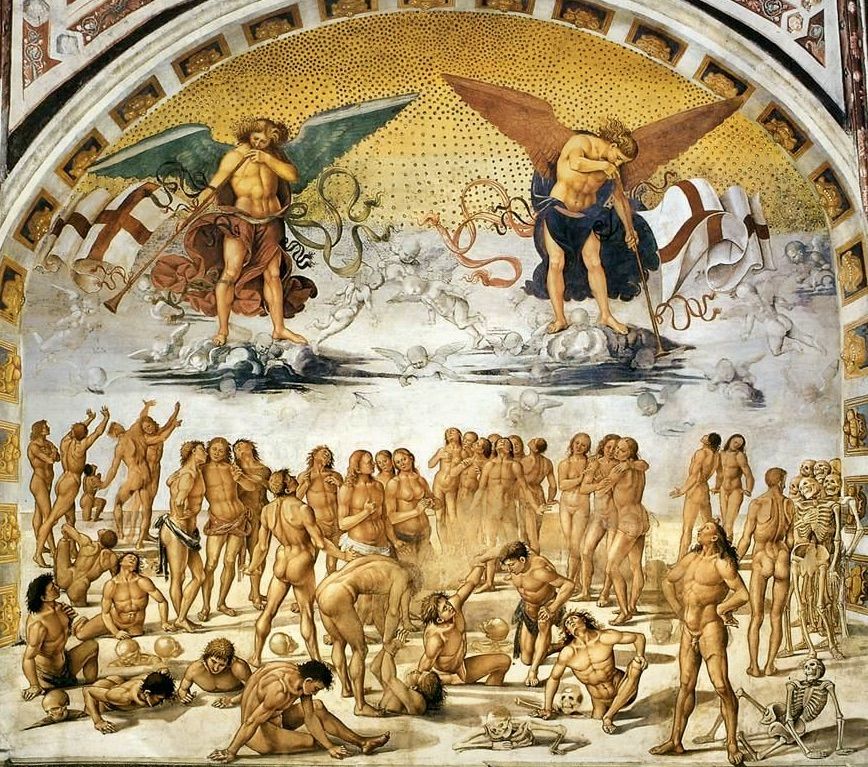
Luca Signorelli’s Resurrection of the Flesh
📍San Brizio Chapel in Orvieto Cathedral
In The Resurrection of the Flesh, the dead awaken at the sound of two archangels’ trumpets. But Signorelli takes the idea of bodily resurrection almost unnervingly literally.
Skeletons crawl out of the earth. Bones reassemble. Muscles reform. Skin returns. Bodies seem to rebuild themselves before your eyes.
It’s a bizarre anatomical assembly line. Some figures are still skeletons, others are halfway back to being human, while the fully restored stand around naked, looking startled, confused, or simply trying to figure out what just happened.
There’s surprisingly little sense of triumph. Resurrection looks less like a glorious reward than a strange and disorienting reckoning.
Signorelli’s obsession with anatomy is everywhere, and it influenced Michelangelo. The newly resurrected bodies are muscular, weighty, and almost aggressively physical. Rather than painting ethereal souls floating toward heaven, he gives us flesh, bones, muscles, and sinew.
The result is simultaneously theological, macabre, and wonderfully weird.
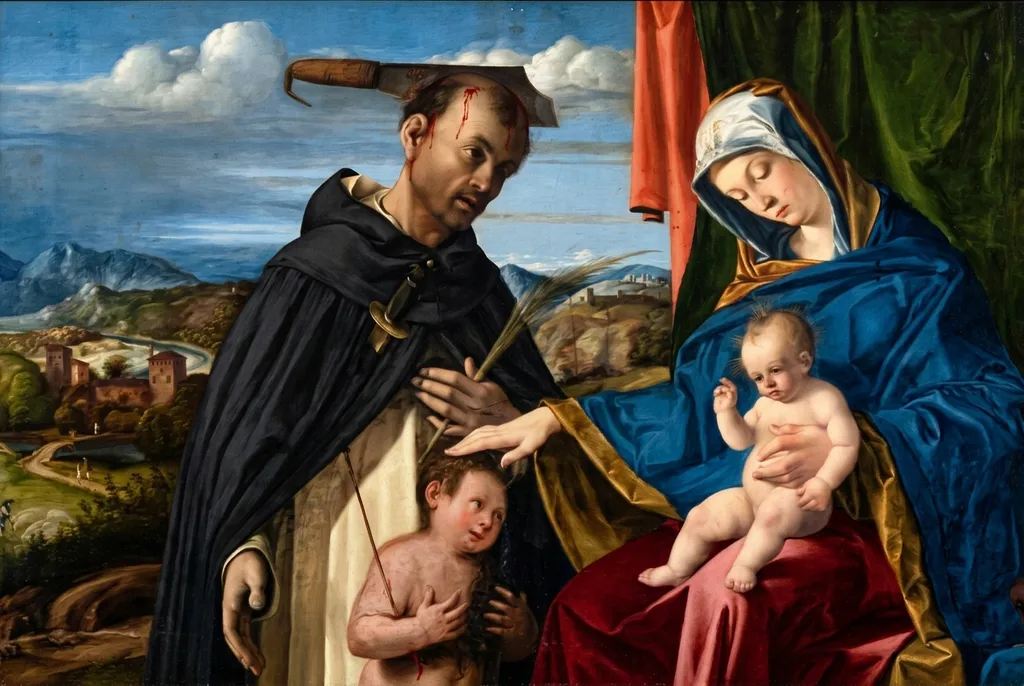
Lorenzo Lotto, Madonna and Child with St. Peter Martyr
Lorenzo Lotto was a Venetian Renaissance painter known for giving his religious figures a surprising dose of personality, drama, and sometimes outright strangeness. This canvas was commissioned by a bishop who survived an assassination attempt, which makes the subject matter feel especially pointed.
The painting includes one of the most unmistakable saints in Christian art: St. Peter Martyr. Artists usually identify him with a discreet wound or streak of blood on his head. Lotto didn’t bother with subtlety.
Here, Peter appears with a blade buried in his skull and a dagger lodged in his chest. According to legend, the Dominican preacher was ambushed and murdered outside Milan while traveling between towns.
And yet nobody seems especially alarmed. The Virgin calmly rests a hand on the wounded saint’s head. The Christ Child sits placidly on her lap.
The other saint looks solemnly downward. Peter himself, despite the hardware sticking out of his body, appears remarkably composed.
That disconnect is what makes the painting so wonderfully odd. Lotto combines gruesome violence with the serene format of a traditional Madonna and Child.
The result is startling, slightly surreal, and very Lotto. A brutal assassination somehow becomes a strangely tranquil devotional scene.

José de Ribera, Bearded Woman
📍Prado Museum, Madrid
This Ribera painting, which veers into the early Baroque, is quite startling. 52 year old Magdalena Ventura stands with an enormous dark beard, her breast exposed as she nurses an infant.
Her husband lurks rather forlornly behind her. Ribera paints the whole thing with the solemn monumentality of a royal portrait.
But there’s an important distinction with this one: Magdalena was a real woman, not Ribera inventing a grotesque or fantasy figure. According to the inscription on the painting, she began growing a beard at age 37, after having already borne three sons.
That makes the weirdness more about the painting and its presentation than about Magdalena herself.
Ribera was commissioned to paint her as a marvel of nature, reflecting the 17th century fascination with physical anomalies and curiosities. Yet he doesn’t really caricature her.
He gives her extraordinary dignity and gravity. And then there are the deliberate contradictions: beard and breast, masculine clothing and breastfeeding, husband and wife, maternal tenderness and stern formal portraiture.
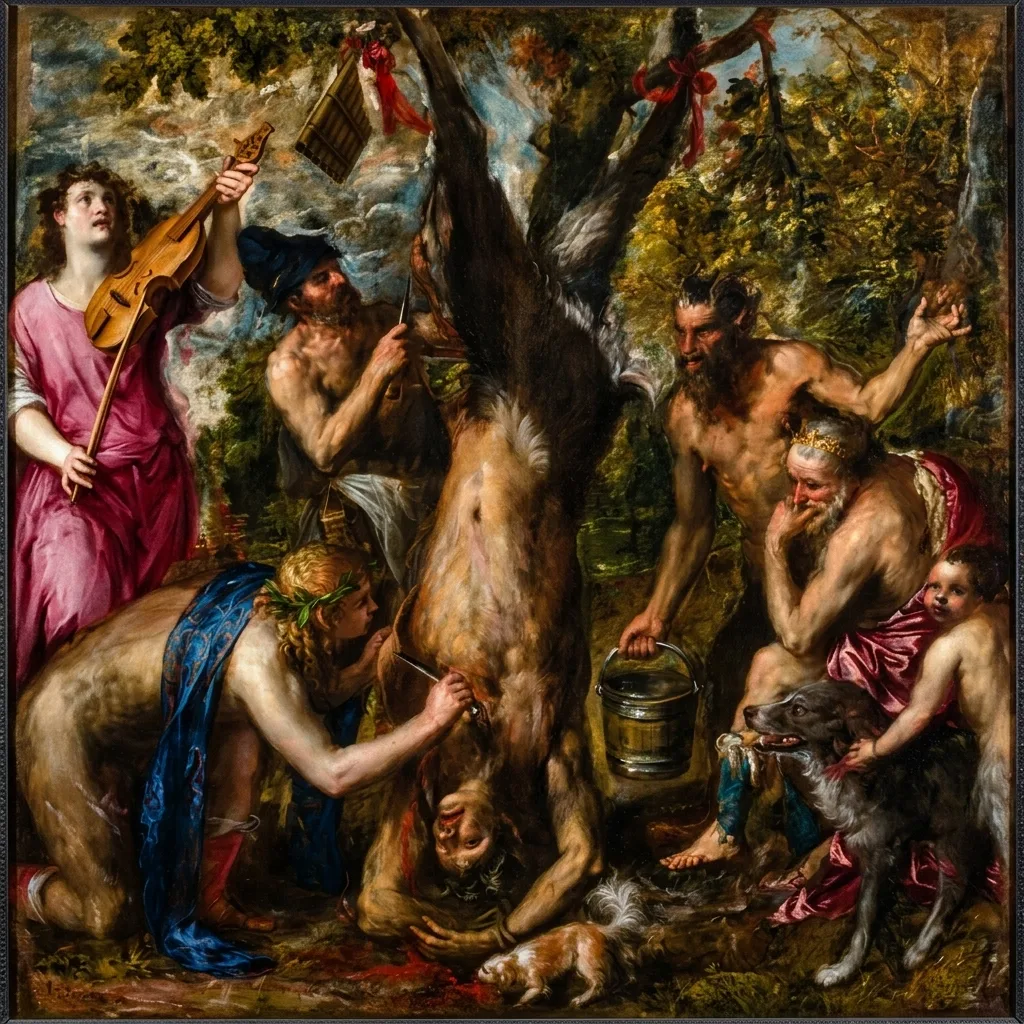
Titian, The Flaying of Marsyas
📍Archbishop’s Palace, Kromeriz, Czech Republic
Titian’s The Flaying of Marsyas is one of his strangest and most disturbing late works.
The story comes from Ovid. Marsyas, a satyr and gifted musician, foolishly challenges Apollo, god of music, to a contest. Apollo wins and chooses a particularly gruesome punishment: Marsyas will be skinned alive.
Titian shows the punishment already underway. Marsyas hangs upside down from a tree like an animal being butchered while Apollo calmly cuts away his skin. Another figure works on his leg, a satyr approaches carrying a bucket, and a small dog laps up blood from the ground.
But the really weird thing is how calm everyone seems.
There’s no frenzy or horror. Apollo goes about his work almost methodically. The surrounding figures watch or assist. Even Marsyas seems strangely resigned to his fate. It feels less like a murder than some bizarre ritual or medical procedure.
Off to the right, King Midas sits with his head resting on his hand, quietly contemplating the scene. Some scholars believe Titian gave Midas his own aging features, effectively inserting himself into the painting as a melancholy witness.
It’s a deeply unsettling painting. But the strangest part isn’t that a satyr is being skinned alive. It’s that everyone behaves as though this is a perfectly ordinary way to spend the afternoon.
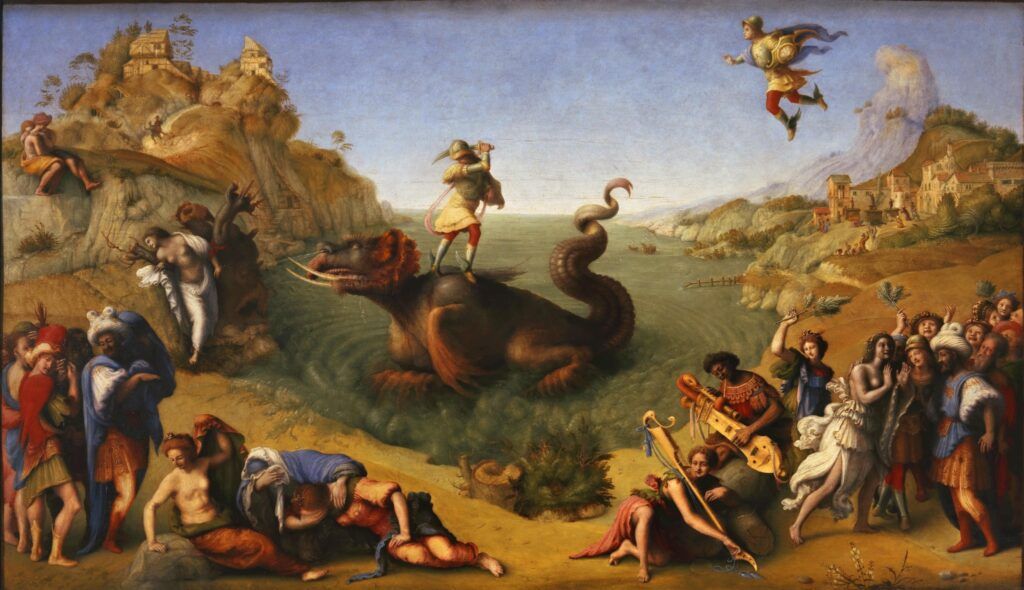
Piero di Cosimo, Perseus and Andromeda
The story is standard Ovid, but Piero’s painting is anything but. There’s a peculiar mismatch between subject and mood.
Andromeda has been chained up as a sacrifice to a sea monster because Poseidon is furious with her boastful mother Cassiopeia. Perseus happens to fly by, sees Andromeda, kills the monster, rescues her, and eventually marries her.
But Piero turns it into something resembling a Renaissance fantasy movie.
The monster is fantastic. It’s enormous, squat, scaly and amphibious, with a huge mouth, strange curling tail and water apparently blasting from its nostrils.
And it doesn’t behave like a normal painting where you get one dramatic moment. Piero gives you the whole movie at once.
Perseus appears multiple times: flying through the sky, attacking the monster, and later celebrating the rescue. Andromeda likewise moves through different stages of the story. The narrative essentially circles around the panel.
Then there are all the wonderfully extraneous details. People in exotic costumes wail dramatically on one side.
Everyone is already partying. Musicians play bizarre-looking instruments, people waving branches, sacrifices being prepared, and a little fantasy city in the distance.
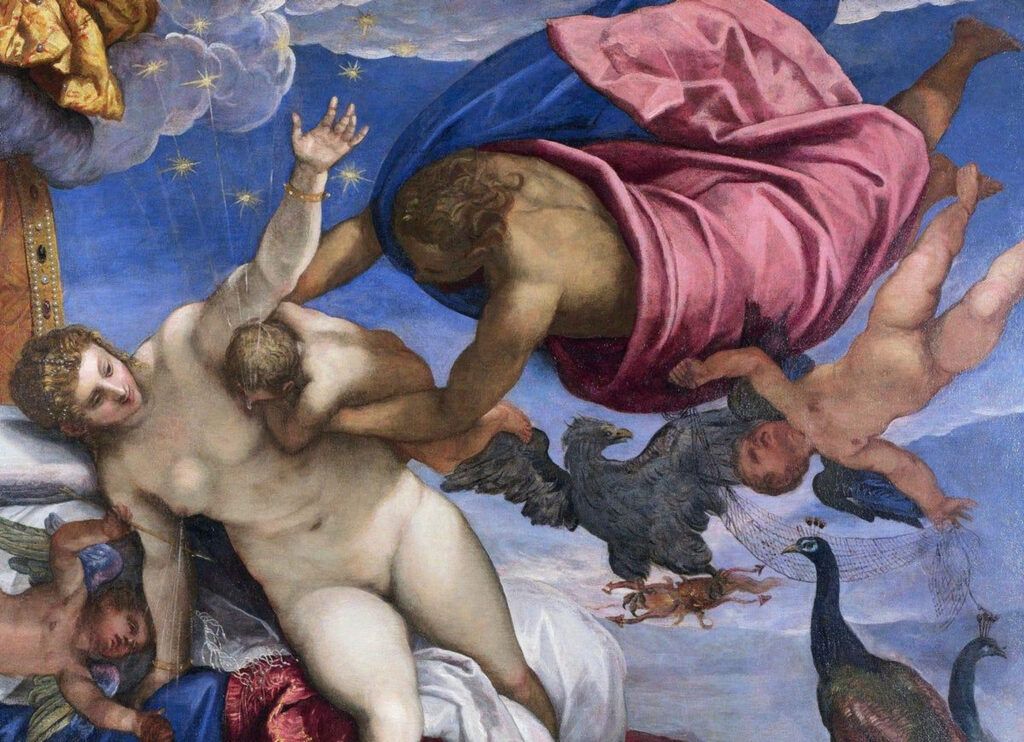
Tintoretto, Venus and Mars Surprised by Vulcan
📍Alte Pinakothek, Munich
Tintoretto produced some weird Renaissance works as well. In this painting, Venus is having an affair with Mars.
Her husband Vulcan comes home suspicious and finds Venus lying naked on the bed. Instead of giving us some grand mythological confrontation, Tintoretto turns the whole thing into something resembling a Renaissance bedroom farce.
Vulcan bends over Venus and rather comically lifts the cloth covering her lower body, apparently looking for evidence of what she’s been doing.
Meanwhile, Mars is hiding under a table. And he’s doing a terrible job of it.
His helmeted head is visible beneath the furniture, and the couple’s little dog has spotted him and is enthusiastically investigating his hiding place. Vulcan, wonderfully, hasn’t noticed him yet. Cupid is asleep in a cradle in the background, apparently exhausted by all this adultery.
The museum interprets this partly as Tintoretto showing off and parodying the erotic female nudes that were enormously popular in Venice.
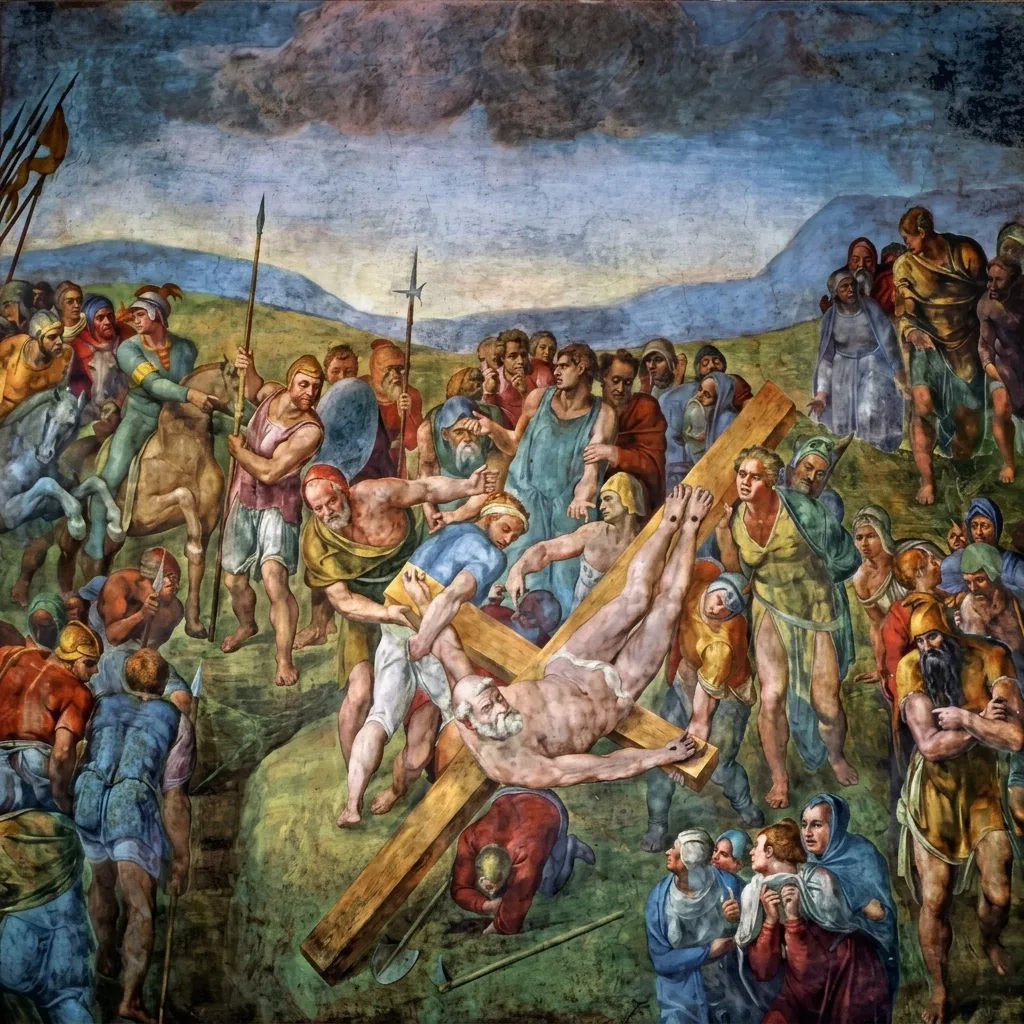
Michelangelo, Crucifixion of St. Peter
📍Pauline Chapel, Vatican Museums
This Michelangelo painting is hidden away in the Pauline Chapel of the Vatican. He’s not the first artist who comes to mind when you think of weird Renaissance paintings. Still … just look at this.
Why did he paint a violent nightmare populated by strangely colored, bulky people who don’t quite belong in the same space?
It’s one of Michelangelo’s final, darker frescoes. And it’s strange in ways that go beyond the subject matter.
The palette is bizarrely unexpected: acidic turquoise, minty greens, lavender-pinks, mustard yellow, rust, that almost electric blue-green on the central figure. Against the stormy blue-gray sky, everybody looks slightly feverish.
The colors aren’t just an artifact of a crappy reproduction either. When the Vatican restored the Pauline Chapel, they were surprised by what emerged. They expected Michelangelo’s late frescoes to be dark and gloomy.
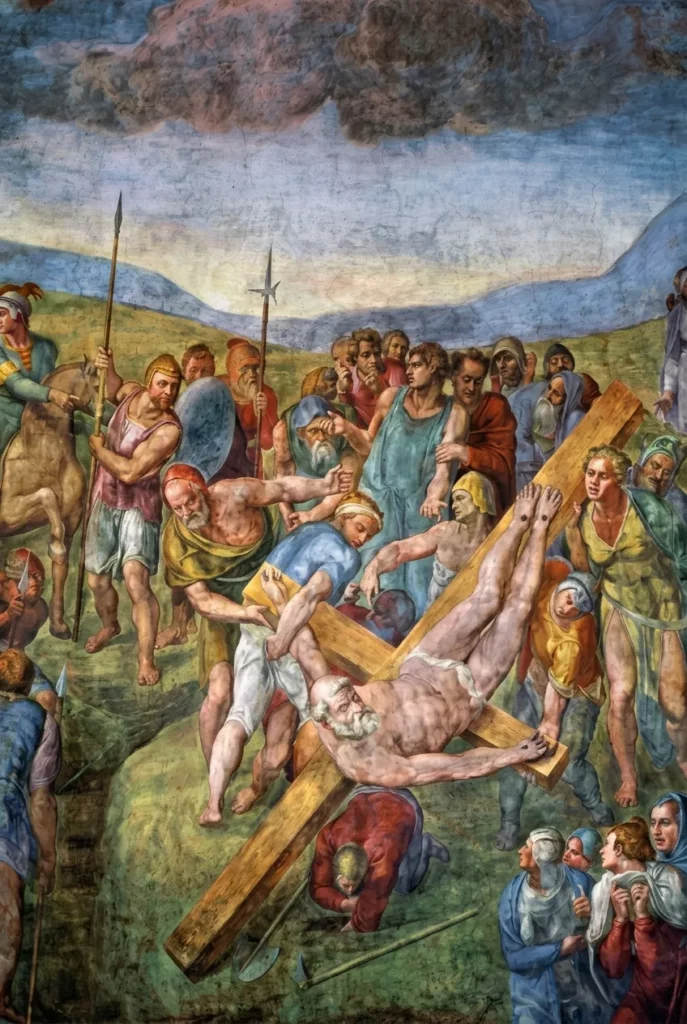
Instead, cleaning instead uncovered much stronger, more urgent color. The Vatican specifically described the restoration as revealing vivid colors along with distorted faces, strange poses, violence and an almost desperate humanity.
The composition is weird too. Peter isn’t already hanging neatly upside down in the familiar iconography. He’s caught in this awkward intermediate moment while a bunch of laborers wrestle his enormous cross into position.
His body is twisted toward us and he gives the viewer a remarkably hostile stare. The cross slices diagonally through this oddly flattened, crowded landscape, and people seem to be milling around in disconnected clumps rather than participating in one coherent Renaissance scene.
There’s even scholarship arguing that the deliberate awkwardness and flattened space mark a startling break from Renaissance classicism, anticipating Mannerist art.
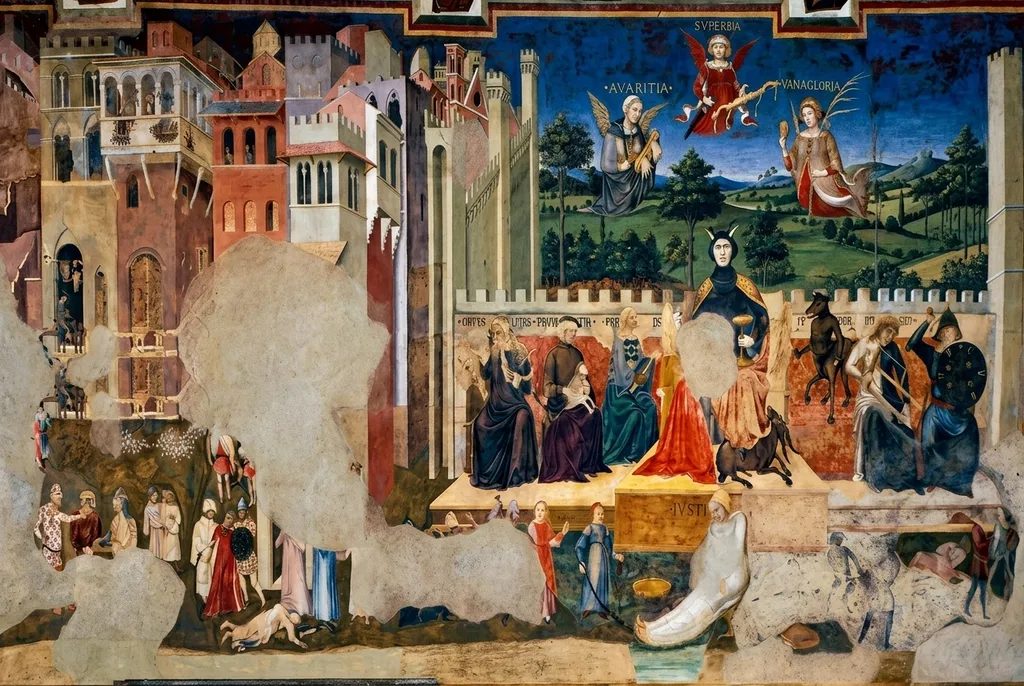
Lorenzetti, Allegory of Good and Bad Government
Few proto-Renaissance artworks feel as blunt, ambitious, or unsettling as Ambrogio Lorenzetti’s Allegory of Good and Bad Government.
Government policy doesn’t usually make for riveting art. But Lorenzetti apparently disagreed.
His sprawling fresco cycle turns civic government into a strange morality play. Good Government is populated by enormous personifications of virtues, floating allegorical figures, and dancing citizens.
Bad Government gets much freakier. A horned, fanged Tyranny presides over a sinister court of Cruelty, Treason, Fraud, Fury, Division, and War, while Justice lies bound at his feet.
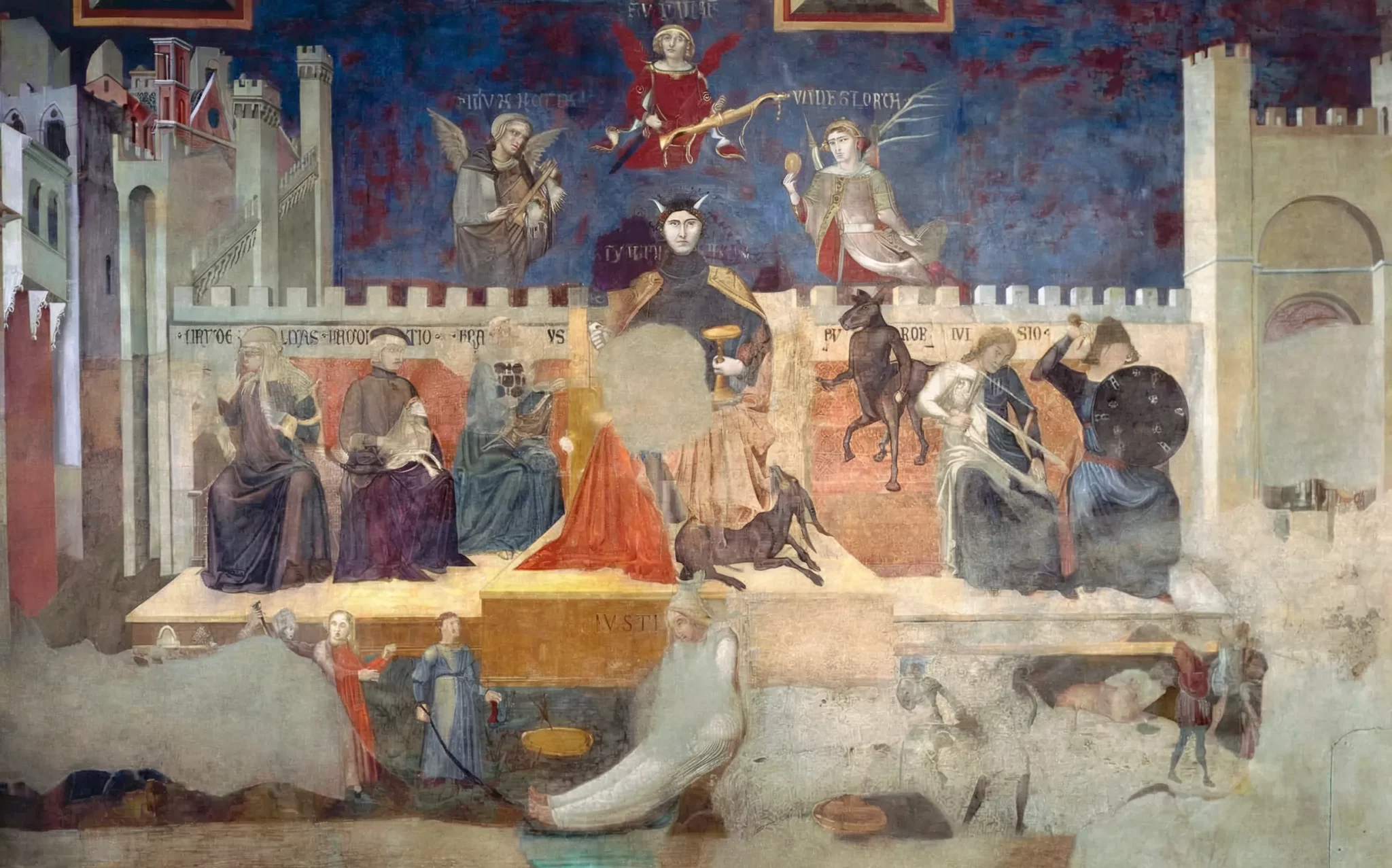
Lorenzetti wasn’t being weird just for fun. The frescoes were a warning about what happens when government goes off the rails.
Even the good government side has wonderfully peculiar details: personified virtues floating in the sky, enormous allegorical figures, strange scale shifts, and that wonderful procession of dancing women in the city.
The whole thing reads almost like an illustrated flowchart explaining how government works.
I hope you’ve enjoyed my guide to weird Renaissance paintings. You may enjoy the other art history guides:
- Top Renaissance paintings
- Top 20th century paintings
- Top Post-Impressionist paintings
- Top paintings in the United States
- Famous Mannerist paintings
- 75 masterpieces in Europe
- Paintings with hidden meanings
- Shocking Art Heists In History
Pin it for later.