The Basilica of San Petronio is one of Bologna’s defining landmarks.
Unlike most major Italian churches, it was conceived as a civic temple rather than a cathedral. It’s dedicated to Saint Petronius, the city’s patron saint.
Its construction was financed largely by the citizens and government of Bologna, which helps explain why the basilica became such a powerful expression of civic pride.
Its immense scale and distinctive architecture set it apart from most churches.
In fact, it’s a bit preposterous in size. And, if the Bolognese had their way, it would’ve been even grander, rivaling St. Peter’s Basilica.
And yet San Petronio was never finished. Money ran short, plans changed, and later tradition even blamed papal interference for curbing Bologna’s ambitions.
The result is part of its appeal: a monumental church whose unfinished facade has become as famous as the building itself.
Quick Tips:
- Dress conservatively or you won’t be allowed to enter. If you arrive underdressed, you may see vendors in the piazza selling wraps, but I wouldn’t count on that.
- Entry to the main basilica is free.
- The basilica is open daily from 10:00 am to 6:00 pm, with last entry at 5:50 pm.
- Pay the €5 for the special chapel route. It includes the Bolognini Chapel, San Sebastiano Chapel, and San Vincenzo Ferrer Chapel. For an art lover, the Bolognini Chapel alone makes it worthwhile because that’s where you see Giovanni da Modena’s extraordinary Last Judgment.
- Give yourself at least 45–60 minutes if you want to look properly at the chapels, meridian, Jacopo della Quercia portal, and interior rather than just walking through.
- Website
Guide To San Petronio: What To See
Unfinished Facade
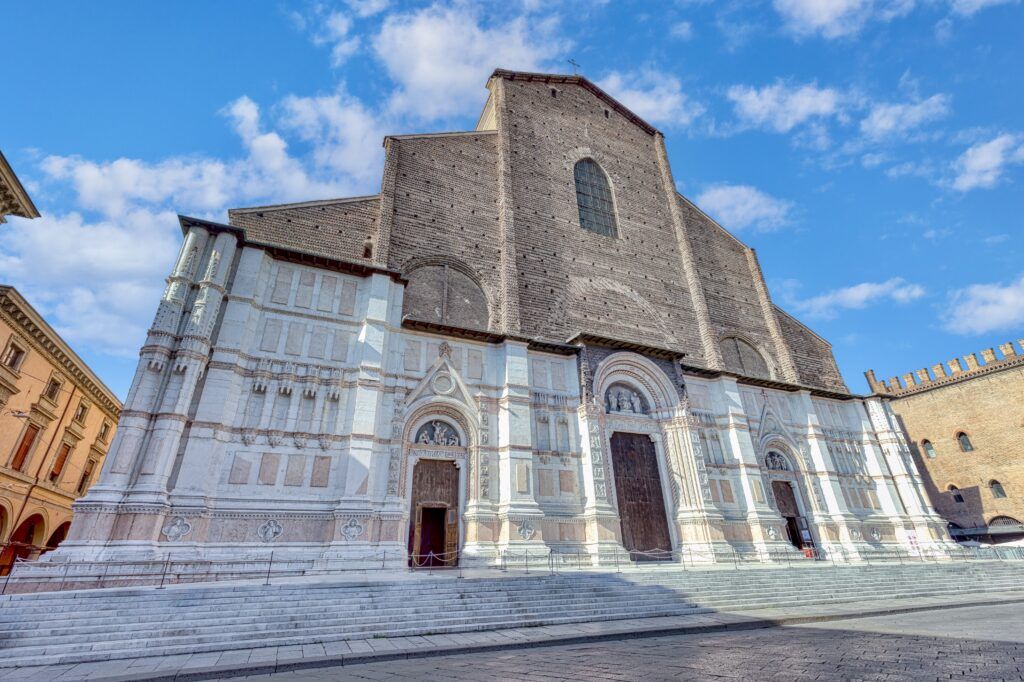
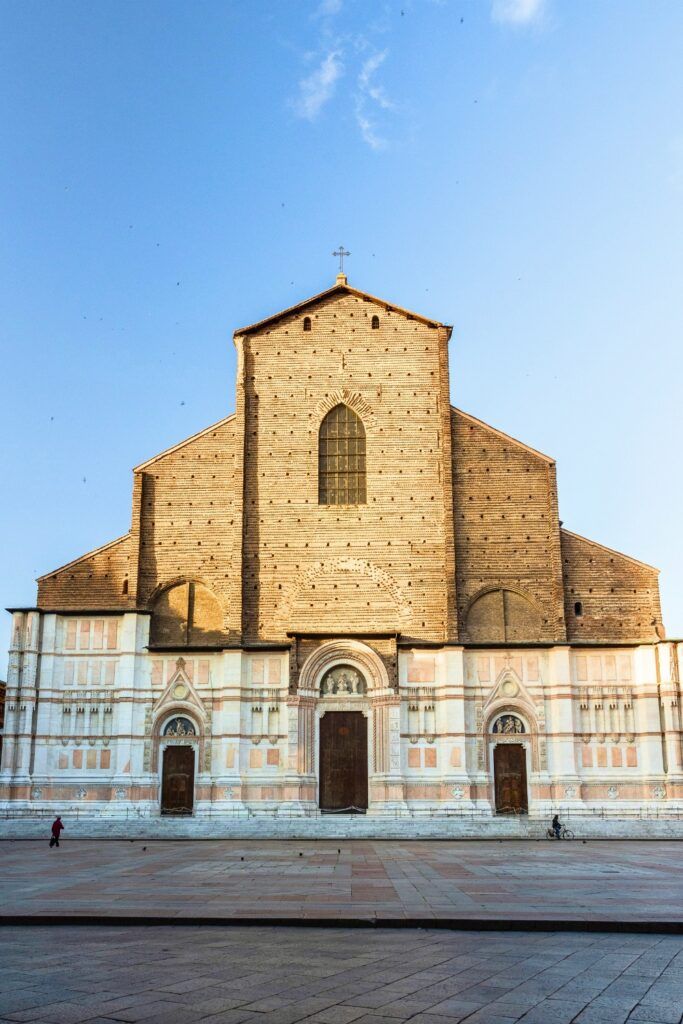
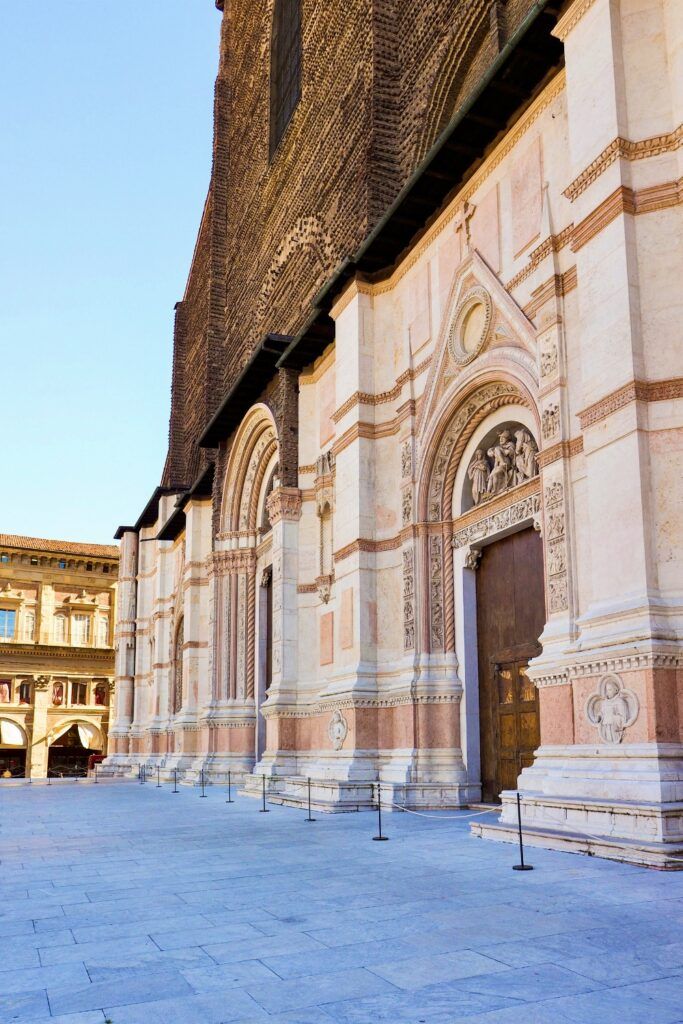
Be sure to stop and study the unfinished facade before entering. The contrast between the sumptuous marble lower half and the raw brick above is one of the things that makes San Petronio so visually memorable.
The whole facade was intended to be faced in marble. But the decoration only climbed partway up, leaving the upper section as bare brick.
You can still see the projecting bricks that were meant to help anchor the missing marble revetment.
For centuries, architects wrestled with the question of how to finish it. Vignola, Palladio, and others proposed schemes. But none was adopted. In the end, the unfinished state became part of San Petronio’s identity.
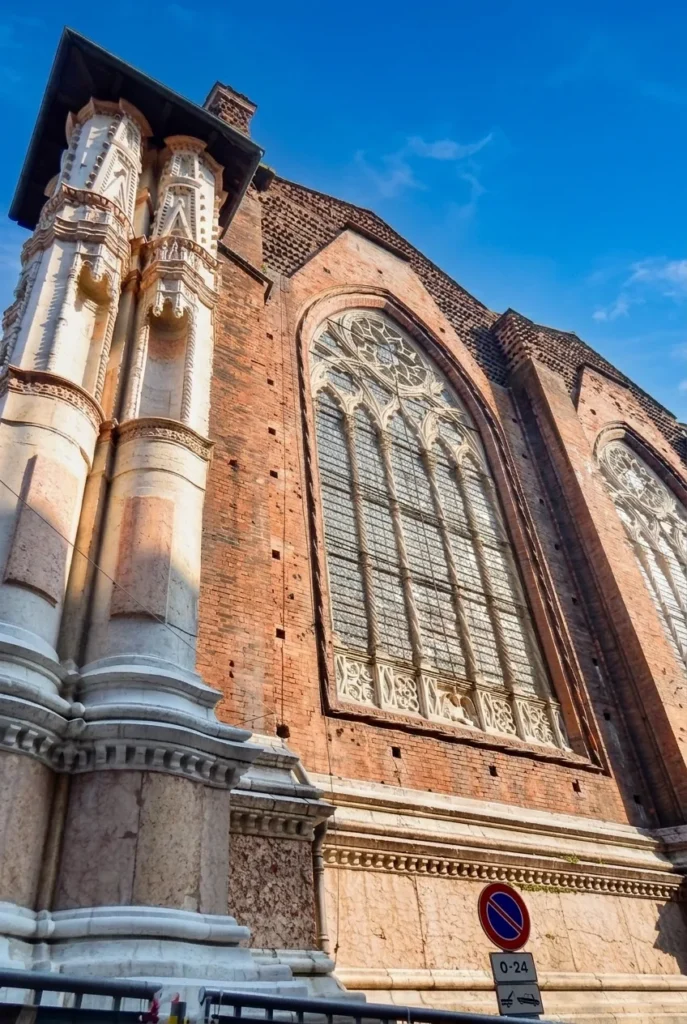
And perhaps that was for the best. The church is already rather block-ish, and a fully striped marble exterior might have looked slightly eccentric.
I can imagine it looking a little like Florence Cathedral, which is sometimes jokingly described as a “cathedral wearing pajamas.”
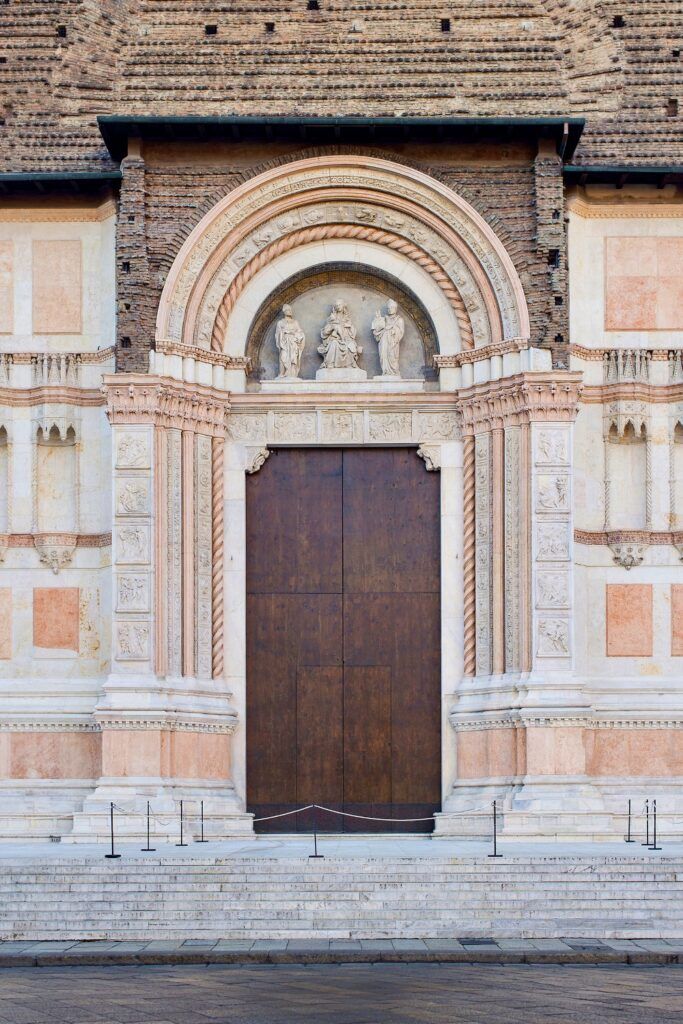
The facade does, however, have a magnificent centerpiece: Jacopo della Quercia’s Porta Magna, begun in 1425.
Its reliefs include scenes from Genesis and other biblical episodes, crowned by a stately Madonna and Child. The sculpture is a major landmark of the early Renaissance, comparable in ambition and importance to Ghiberti’s Baptistery doors in Florence.
Interior
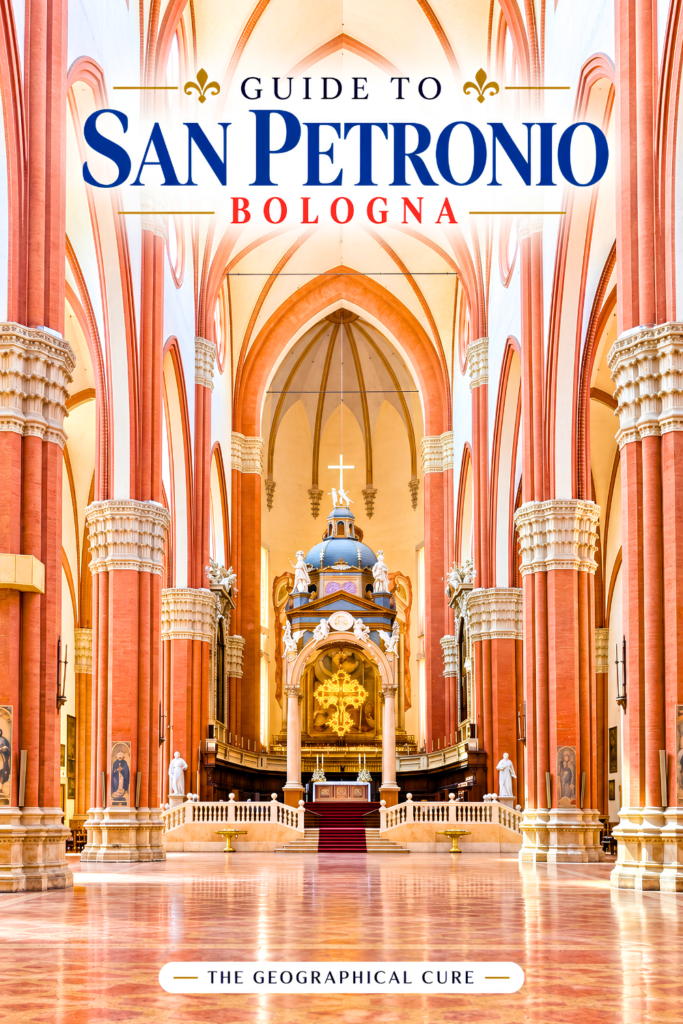
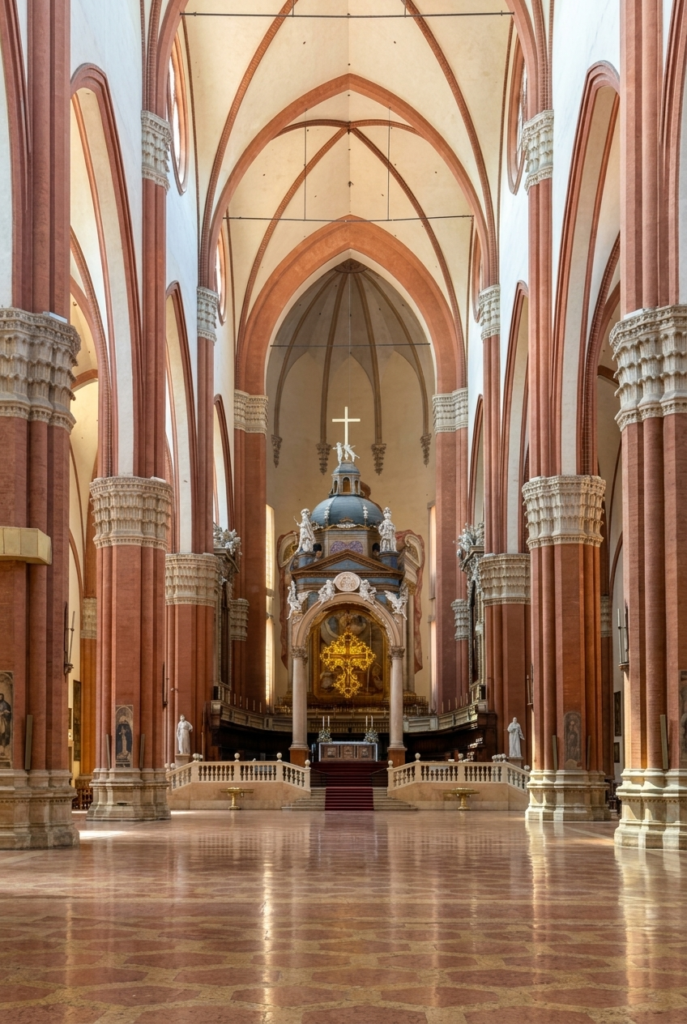
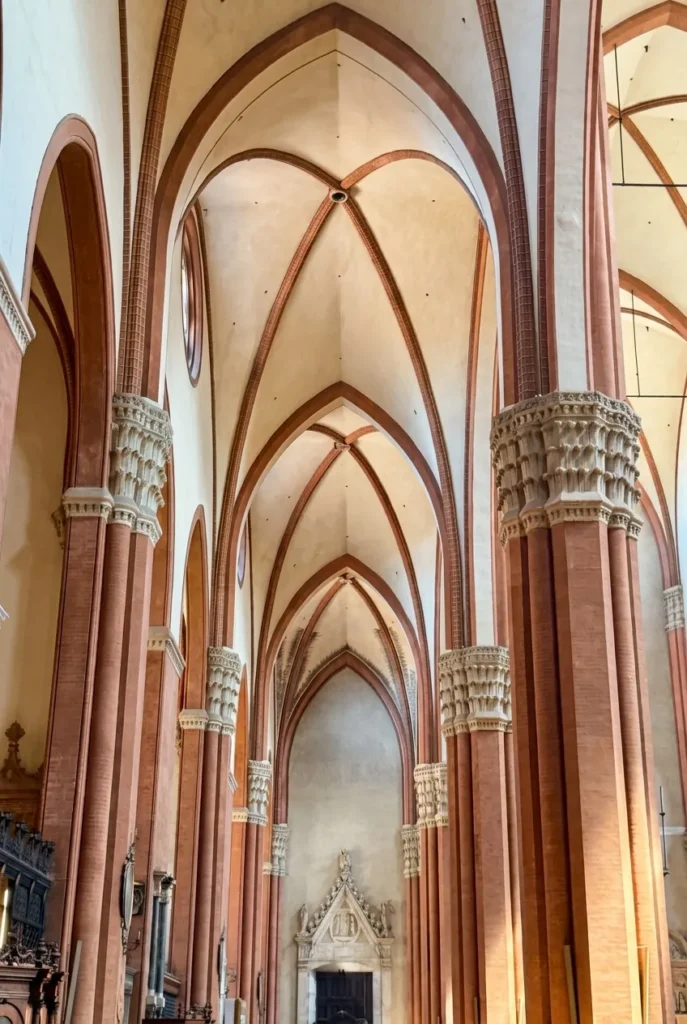
As you would expect from a building this enormous, the interior of San Petronio feels lofty and almost cavernous. The basilica measures about 433 feet long and 217 feet wide, with the central vault rising roughly 148 feet overhead.
Yet despite its massive proportions, it doesn’t feel especially heavy. High windows and large oculi wash the nave in a surprisingly even, diffuse light.
The vast three nave interior is divided by ten massive clustered brick piers with carved sandstone capitals. They support a rhythmic procession of pointed arches and ribbed vaults that draws your eye straight toward the high altar.
The repetition gives the church a strong sense of forward movement and makes its extraordinary length even more apparent.
San Petronio also witnessed one of the great political spectacles of Renaissance Europe. On February 24, 1530, Pope Clement VII crowned Charles V Holy Roman Emperor here.
It was the last time a Holy Roman emperor would be crowned by a pope. Charles actually put on his imperial mantle in the Chapel of Sant’Abbondio before the ceremony.
As you walk through the side aisles, look for four ancient stone crosses mounted on Roman columns.
According to tradition, Saint Ambrose or Saint Petronius placed them at the edges of early Bologna between the fourth and fifth centuries as a kind of spiritual shield around the city. They remained at their original locations for centuries before being moved inside San Petronio in 1798.
High Altar
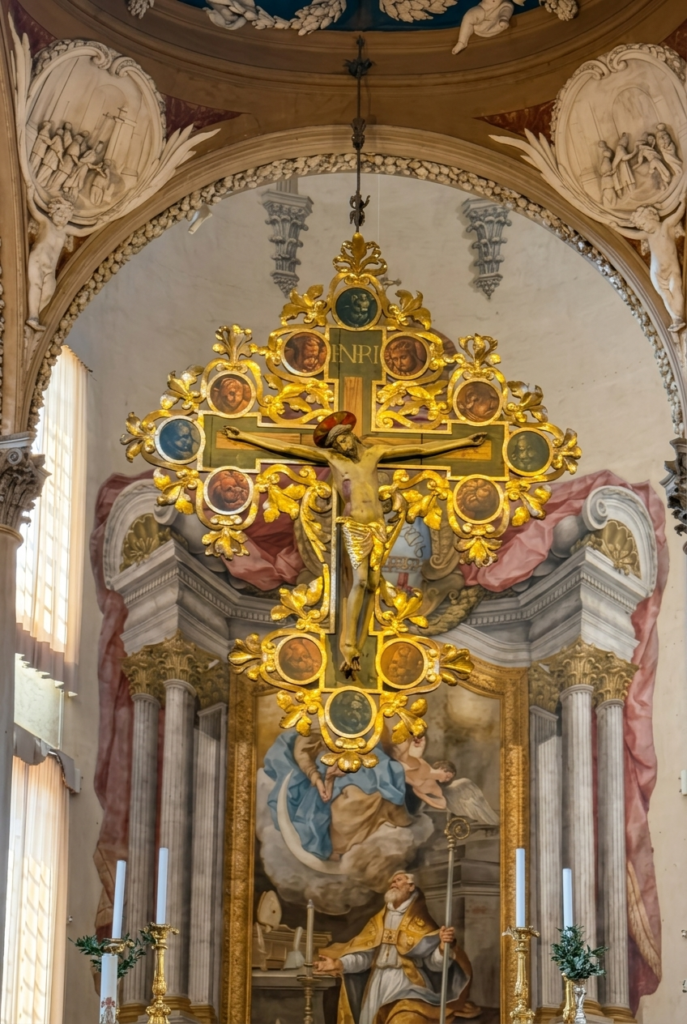
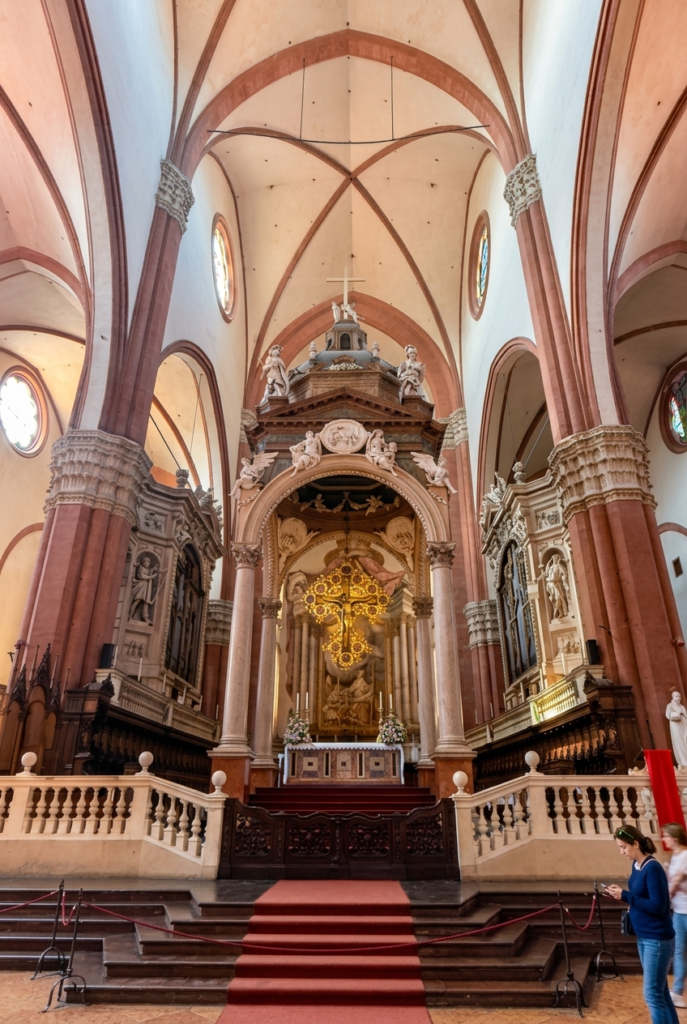
The high altar provides a burst of Renaissance and Baroque splendor at the end of San Petronio’s otherwise rather austere nave.
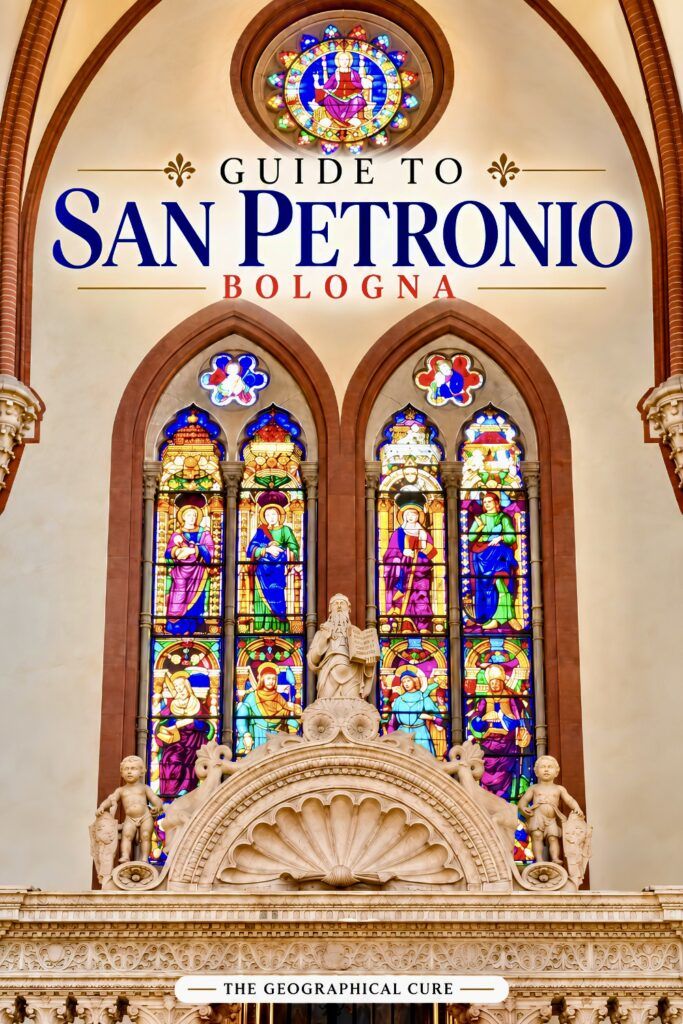
At its center is a 15th century wooden crucifix, surrounded by an elaborate gilded framework of curling foliage and painted medallions. Behind it, a later fresco of the Madonna with Saint Petronius adds another layer of color and drama.
The ensemble sits beneath a monumental ciborium designed by Jacopo Barozzi da Vignola in 1547. With its classical architecture, gilding, and suspended crucifix, it creates an almost stage-like focal point at the far end of the enormous church.
Meridian
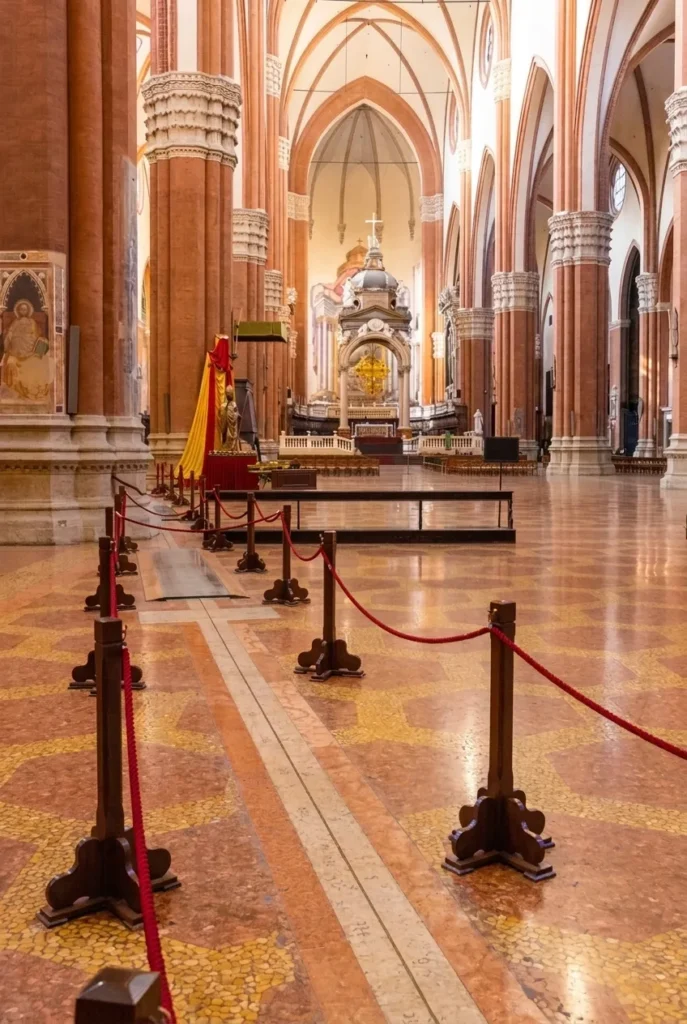
In 1655, astronomer Giovanni Domenico Cassini transformed San Petronio into a giant solar observatory. He traced an enormous meridian line across the basilica floor and placed a tiny aperture high in the vaulting, about 27 meters overhead.
At local noon, a beam of sunlight passes through the hole and projects an image of the sun onto the pavement. As the seasons change, the image moves along the 66.8 meter line and changes in size. It’s essentially a monumental camera obscura and one of the largest astronomical instruments ever built inside a church.
Cassini’s extraordinarily precise observations helped confirm Kepler’s second law of planetary motion and allowed astronomers to measure the sun’s apparent diameter, atmospheric refraction, and changes associated with Earth’s elliptical orbit.
The meridian became a sightseeing attraction in its own right. Charles Dickens noticed it when he visited Bologna, writing of “the great Meridian on the pavement of the church of San Petronio, where the sunbeams mark the time among the kneeling people.”
Chapels
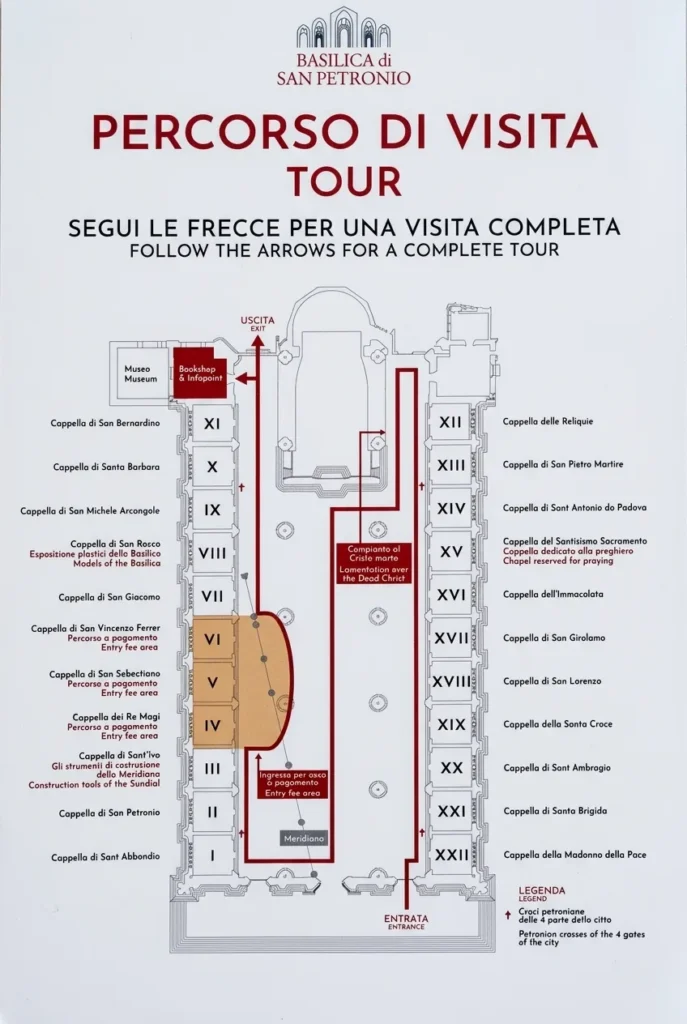
The basilica has 22 side chapels, many packed with surprisingly good art. They’re all the same basic size, but their decoration ranges from late Gothic to Baroque.
Chapel 1, the Chapel of Sant’Abbondio, is associated with Charles V’s coronation in 1530. He donned his imperial mantle here before the ceremony.
The chapel also has some exceedingly strange symbolic frescos by Giovanni da Modena, including the Triumph of the Church over the Synagogue and an Allegory of Redemption.
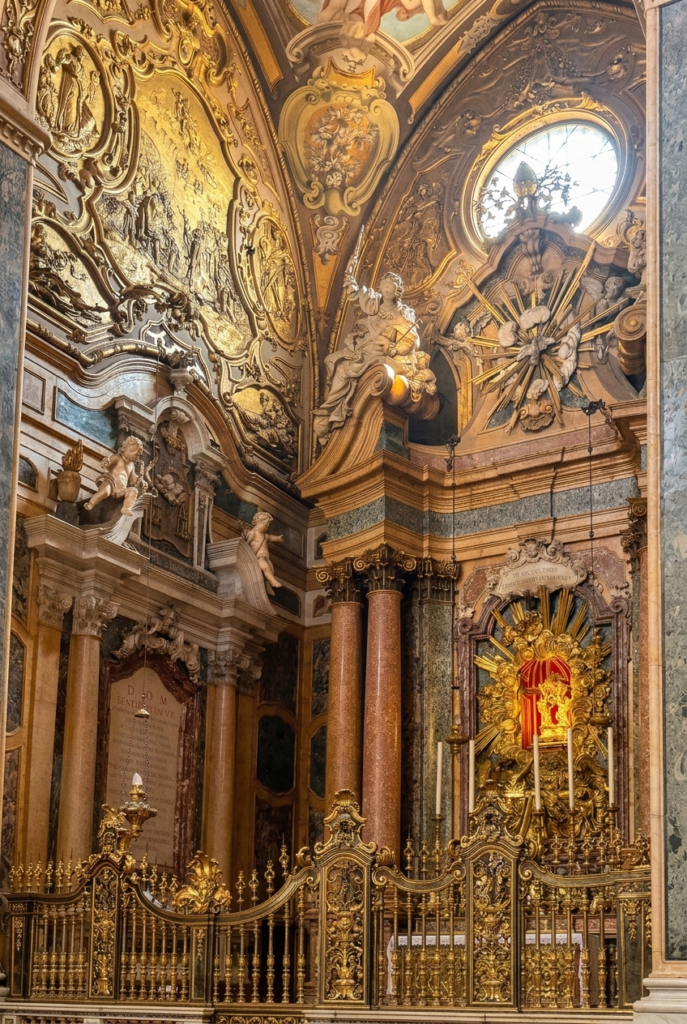
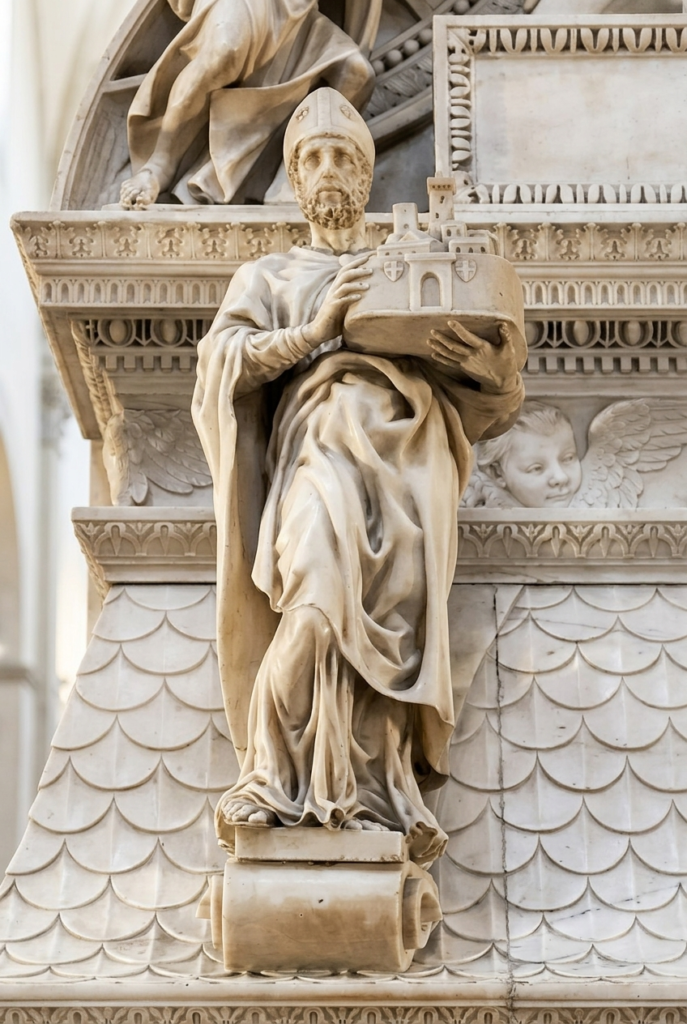
Chapel 2, dedicated to Saint Petronius, was designed to house the saint’s relics.
Today, both his head and body are preserved here. The head is kept in an elaborate silver, gilt, and lapis lazuli reliquary set within a gilded bronze glory above the altar.
Chapel 3, the Chapel of Saint Ivo, has paintings by Gaetano Gandolfi and Alessandro Tiarini, along with sculptures by Angelo Piò.
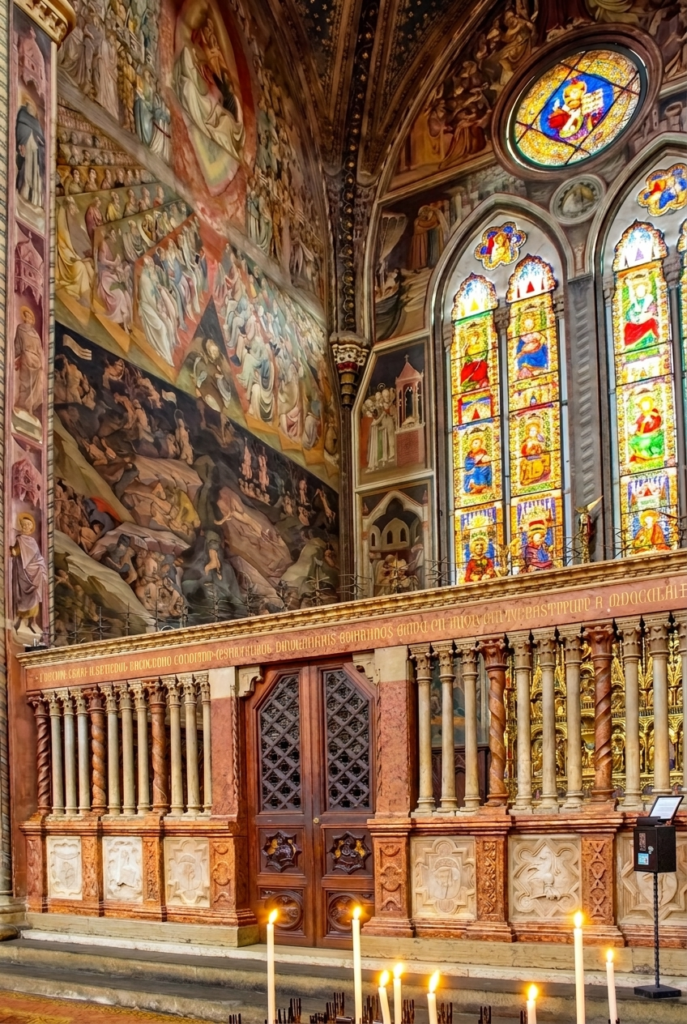
Chapel 4 is the famous one, the Bolognini Chapel or Chapel of the Magi. Even before you go inside, look for the enormous fresco of Saint Christopher on the pier between Chapels 3 and 4, attributed to Giovanni da Modena.
The chapel itself is unusually intact and still preserves much of its early 15th century decoration.
A red Verona marble screen closes it off from the nave, while the altar has a large wooden polyptych with 27 painted and carved figures by Jacopo di Paolo. He also designed the chapel’s stained glass.
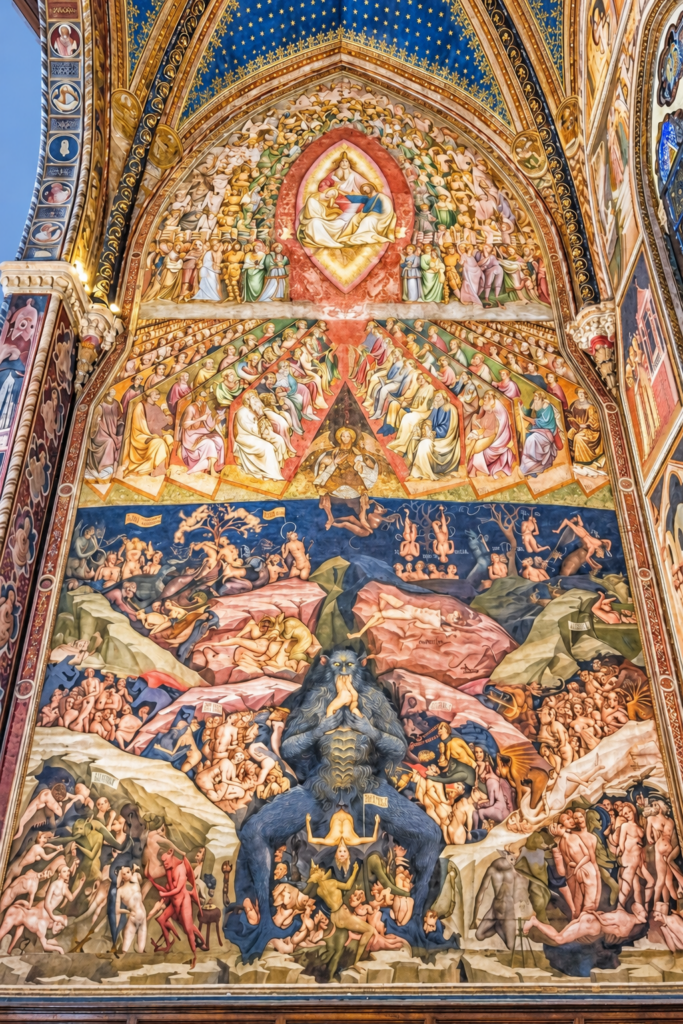
But the real draw is Giovanni da Modena’s fresco cycle, commissioned by the wealthy merchant Bartolomeo Bolognini.
One wall tells the story of the Magi. The other is given over to Paradise and Inferno, one of the most dramatic medieval visions of the Last Judgment I’ve seen.
The lower half is the showstopper. Giovanni da Modena turns Hell into a gruesome, carefully organized world of punishment dominated by an enormous chained Satan.
Around him, the damned are packed into rocky compartments according to their sins. The lower section is organized around the Seven Deadly Sins, each identified by a small painted label.
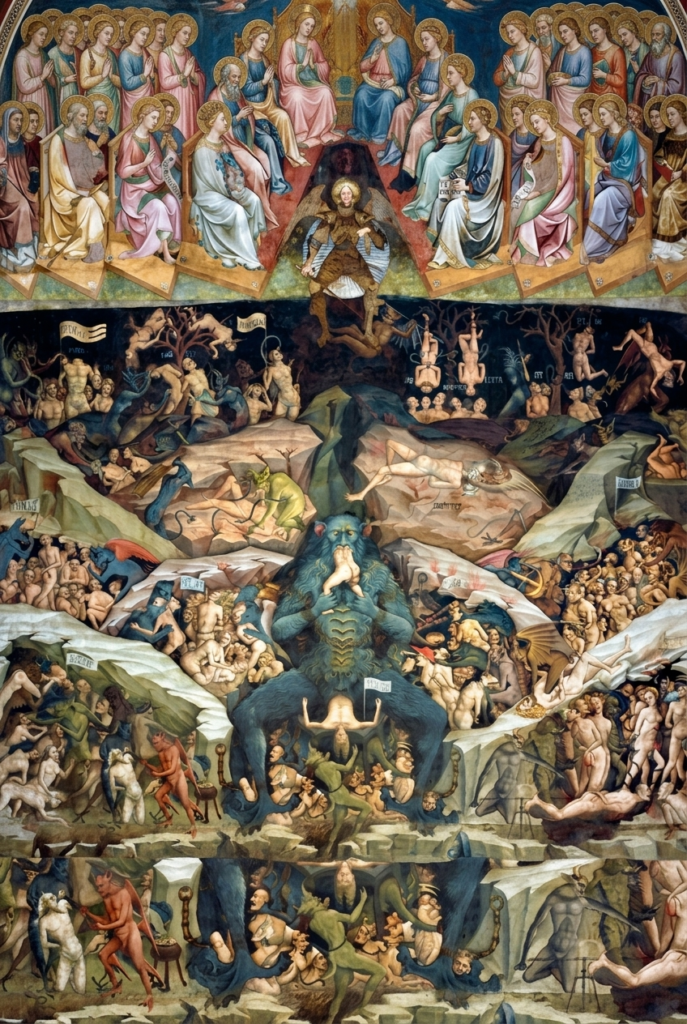
The proud suffer directly beneath Satan. While the greedy, lustful, wrathful, gluttonous, slothful, and envious endure appropriately horrible punishments around him.
Above them are heretics, schismatics, blasphemers, idolaters, and others who committed offenses against the Church. Demons pull, bite, stab, hang, and torment the sinners in scenes that are grotesque, theatrical, and sometimes almost darkly comic.
The fresco is often described as Dante-inspired, but that’s a little misleading. Giovanni borrowed some ideas familiar from the Inferno. But much of the imagery comes from an older medieval tradition of depicting Hell and the punishments of sin.
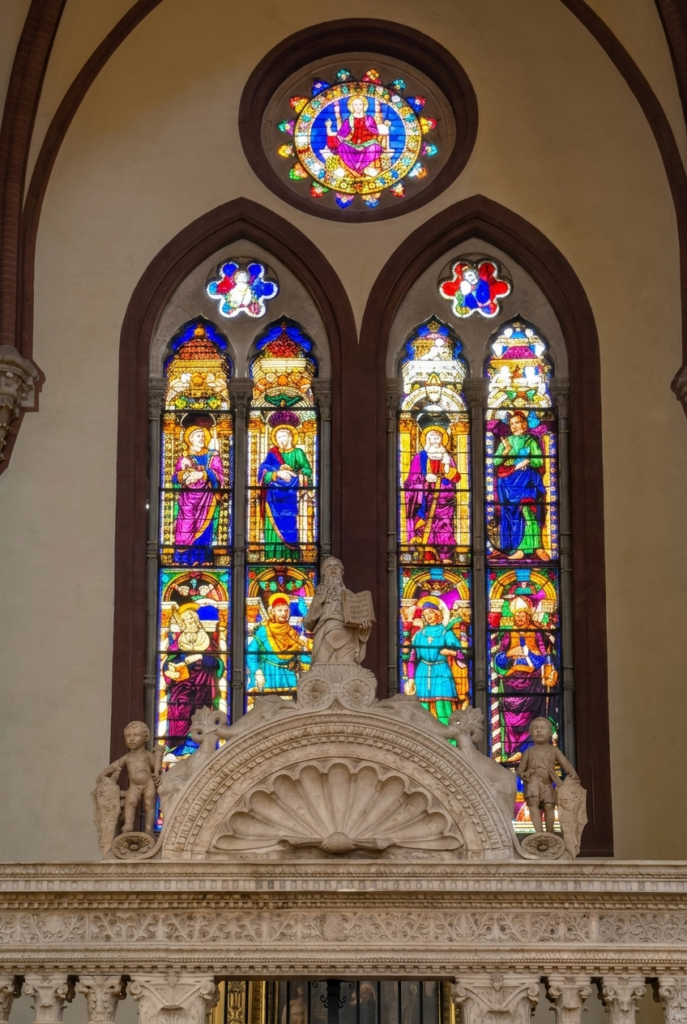
Chapel 5, dedicated to St. Sebastian, has a large Martyrdom of St. Sebastian, an Annunciation, and figures of the Twelve Apostles by Lorenzo Costa. The angel in the Annunciation is generally attributed to Francesco Francia.
Chapel 7 is another standout. Costa’s Madonna and Child Enthroned with Saints from 1492 is one of his finest works in the basilica, and he also designed the stained glass. The chapel also contains the tomb of Elisa Bonaparte, Napoleon’s politically formidable sister, and her husband, Felice Baciocchi.
Chapel 8 has Parmigianino’s St. Roch with a Donor from 1527. Chapel 9 contains Denys Calvaert’s Archangel Michael Driving Out the Demon, while Chapel 10 has Alessandro Tiarini’s theatrical Glorification of Saint Barbara.
Chapel 11 has a gilded altar with the dark-robed Franciscan saint.
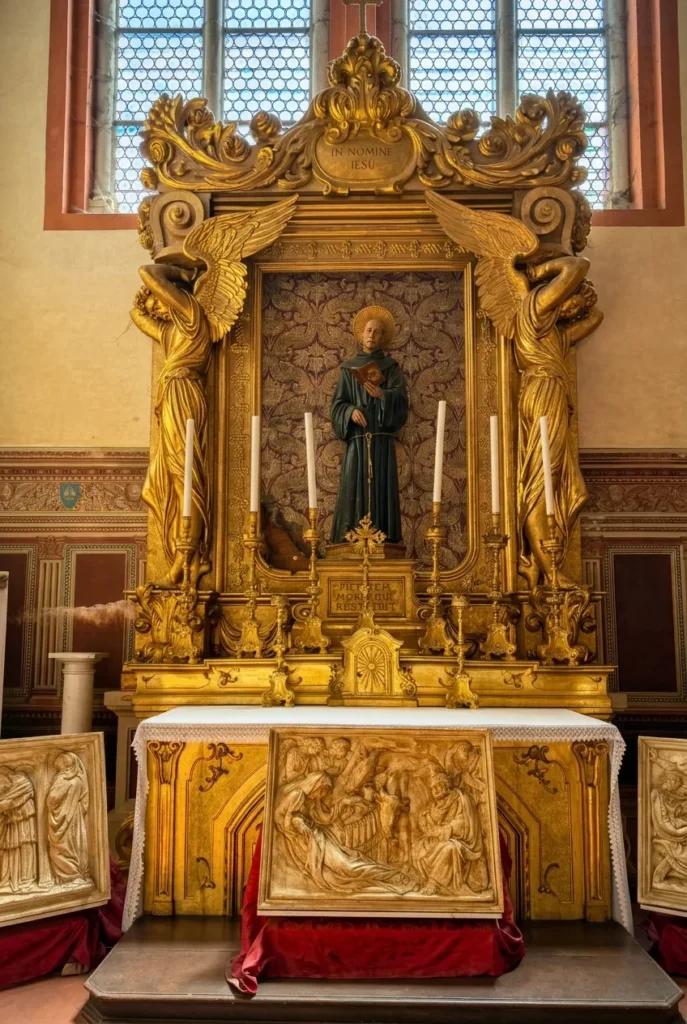
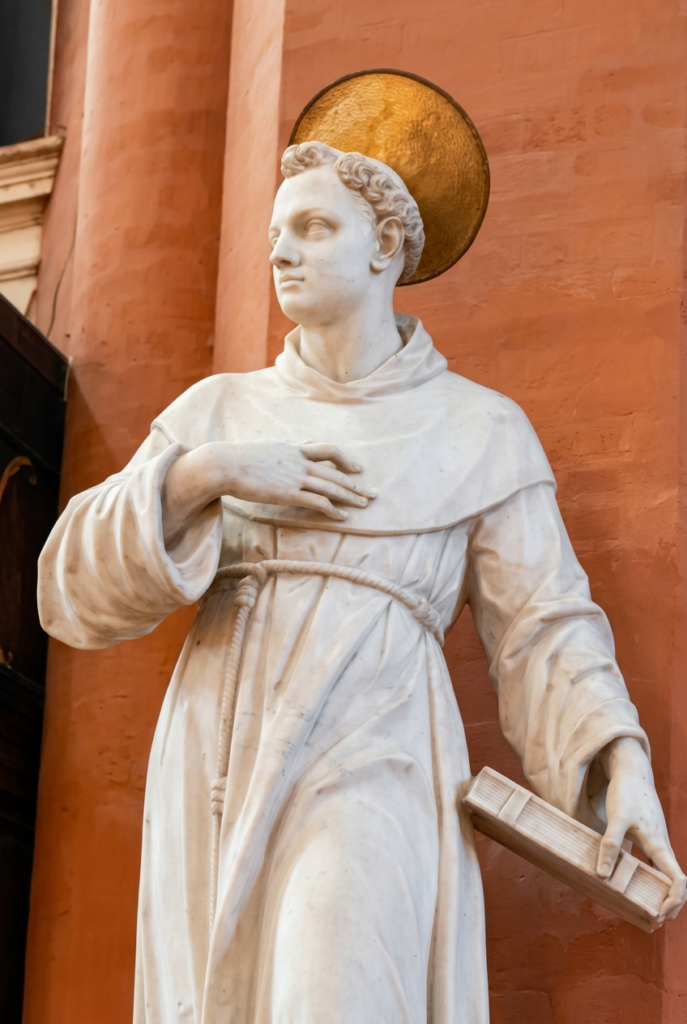
That central figure is the 15th century wooden statue of Bernardino. The chapel was restored in 1909, when the statue and 18th century altarpiece were installed in their present arrangement.
Chapel 14, dedicated to St. Anthony of Padua, preserves a unified Renaissance decorative scheme by Girolamo da Treviso, including the statue of the saint and a cycle showing his miracles. The stained glass incorporates designs by Perugino and later Pellegrino Tibaldi.
In Chapel 15, the altar niche designed by Vignola contains Alessandro Algardi’s throne of the Blessed Sacrament, made from ancient Roman marble.
Chapel 17 has Costa’s St. Jerome Enthroned, and Chapel 18 has Amico Aspertini’s Pietà from 1519.
Capella Musicale
San Petronio has an extraordinary musical history. Its Cappella Musicale was founded in 1436 and became one of Europe’s major centers of sacred music.
The basilica still preserves its original horseshoe-shaped choir loft and two historic organs: one by Lorenzo da Prato from 1475 and another by Baldassarre Malamini from 1596. They’re still played today.
Then there’s the small San Petronio Museum inside the basilica. It’s free and holds reliquaries, vestments, and old choir books.
The musical archive is enormous too, with about 3,500 manuscripts and early editions spanning the 15th through 19th centuries, including works associated with Monteverdi, Palestrina, Gabrieli, Victoria, and others.
Bell Tower
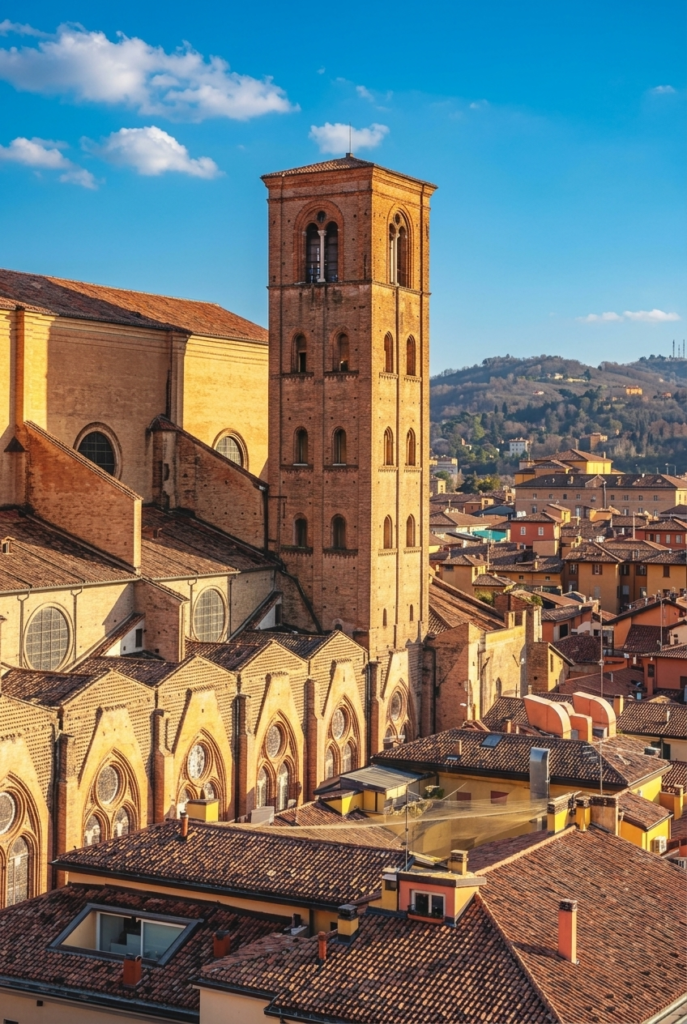
San Petronio’s bell tower was built between 1481 and 1492 and rises about 65 meters. It’s tucked along the side of the basilica, so it’s easy to miss from Piazza Maggiore. The original grand plan envisioned four bell towers flanking the church, but, like so much else at San Petronio, that scheme was never completed.
San Petronio’s official site lists the bell tower and roof space among its “special visits,” which require advance reservation and a licensed guide. There’s no elevator.
They also run occasional scheduled “Campanile e Sottotetto” tours. The current listings include access to the bell chamber, city views, and even the ringing of the four bells. The listed price is €25 for a 1 hour visit.
I hope you’ve enjoyed may guide to San Petronio. You may find these other Emilia-Romagna guides useful:
- Bologna’s Santo Stefano
- Bologna’s National Gallery
- Bologna’s San Luca Portico & Sanctuary
- Bologna’s Anatomical Theater
- One day in Parma itinerary
- Things to do in Modena
- Guide to Parma’s Palazzo della Pilotta
Pin it for later.