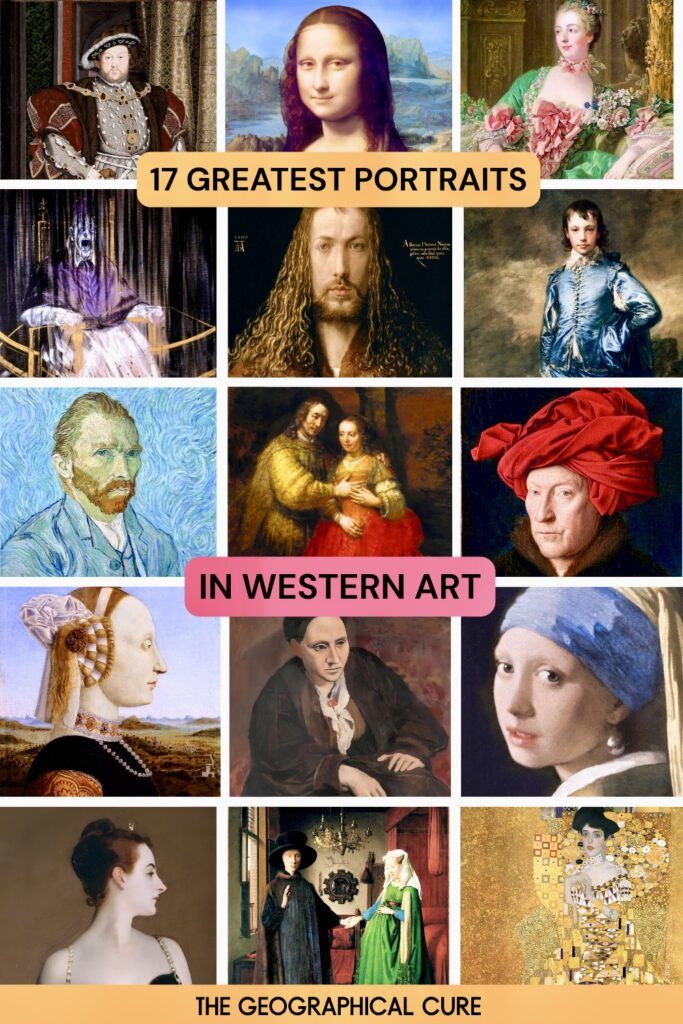
Some portraits capture a likeness. Others capture an entire personality. The greatest somehow do both.
A portrait, at its core, is a painting whose primary purpose is to depict the likeness, personality, or status of one or two identifiable individuals.
Portraiture as we know it didn’t truly flourish until the 15th century.
Medieval artists generally created religious images rather than capturing an individual’s unique personality. That changed dramatically with artists like Jan van Eyck, whose astonishing realism transformed portrait painting forever.
Portraiture is also one of art’s most subjective genres. Unlike landscapes or history paintings, portraits invite us to judge not only technical skill but also psychology, character, and human presence.
That’s why no two “greatest portraits” lists are ever quite the same. This is my personal ranking, based on artistic achievement and historical significance rather than celebrity. Spanning more than 500 years of Western art, these are the 17 portraits I think have stood the test of time.
Important Portraits in Art History
1. Jan Van Eyck, The Arnolfini Portrait
📍 National Gallery of Art, London UK
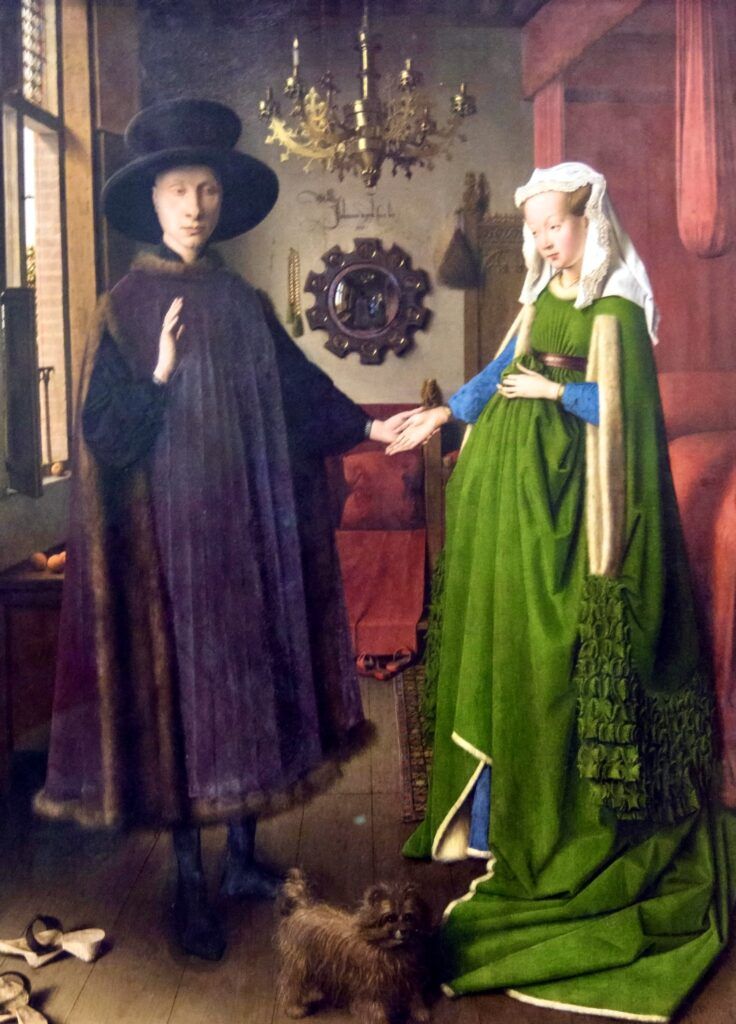
Ranking the greatest portraits in Western art is a bit of a fool’s errand. But if I had to choose just one, it would be Jan van Eyck’s Arnolfini Portrait. More than six centuries later, it still feels remarkably modern.
The full length double portrait dazzles with its astonishing realism. Yet it’s also one of art history’s greatest puzzles. What exactly is Van Eyck depicting? A wedding? A legal contract? A memorial? Or something else entirely?
On the surface, it’s a portrait of a wealthy merchant and his wife in their elegant Bruges home. But every object seems loaded with meaning, and scholars still debate the painting’s true purpose.
One of the most intriguing theories asks whether the woman is even alive. Rather than celebrating a marriage, the painting may commemorate a deceased wife. If so, she may be less a living sitter than a spectral presence.
Then, there’s the tiny convex mirror at the center of the composition. It reflects the couple from behind, along with two additional figures entering the room. It’s one of Van Eyck’s greatest technical achievements and a detail that continues to fascinate viewers today.
>>> Click here to book a National Gallery guided tour

2. Leonardo da Vinci, Mona Lisa
Leonardo da Vinci’s Mona Lisa is arguably the most famous portrait ever painted. More than 500 years after it was created, her enigmatic smile and penetrating gaze continue to draw millions of visitors every year.
Leonardo worked on the portrait for more than a decade, refining it with extraordinary patience. The result was a revolutionary image that transformed portraiture.
Instead of presenting a stiff profile, he turned the sitter toward the viewer in a natural 3/4 pose Her hands rest before an imaginary landscape that seems to breathe with her.
The portrait’s enduring mystery lies in Leonardo’s masterful use of sfumato, a technique of subtle tonal transitions that softens every contour. Her elusive smile also appears to change depending on where you stand, making the painting feel uncannily alive.
Ironically, the Mona Lisa wasn’t always the world’s most famous painting. Its legend grew after its sensational theft from the Louvre in 1911, cementing its status as the ultimate icon of Western art.
>>> Click here to book a Louvre masterpieces tour

3. Johannes Vermeer, Girl with a Pearl Earring
📍 Mauritshuis, The Hague Netherlands
Often called the “Mona Lisa of the North,” Vermeer’s Girl with a Pearl Earring is celebrated for its luminous beauty and enduring mystery.
The young woman turns toward us as though she’s just been interrupted. Dressed in an exotic blue and gold turban and an oversized pearl earring, she seems simultaneously approachable and unknowable.
Today, she appears against a dark background. But technical analysis has revealed that Vermeer originally painted her before a rich green curtain that simply faded over time. And despite the painting’s title, many scholars believe the famous “pearl” is actually a piece of polished Venetian glass.
The sitter’s identity remains a mystery. Rather than a true portrait, the painting is probably a tronie, a popular Dutch genre depicting an expressive face or character rather than a specific individual. While some have suggested she may be Vermeer’s daughter, no evidence supports the theory.
Ironically, the painting attracted little attention during Vermeer’s lifetime. Its worldwide fame came centuries later, fueled by exhibitions, Tracy Chevalier’s bestselling novel, and the 2003 film starring Scarlett Johansson.
>>> Click here to book a guided tour of The Hague & Mauritshiusticket

4. Albrecht Dürer, Self-Portrait at 28
📍 Alte Pinakothek, Munich Germany
To us, it seems perfectly natural that a portrait can reveal something essential about a person’s identity. It’s the assumption behind every selfie we take.
But that idea had to be invented. And no artist did more to invent it than Albrecht Dürer, the leading painter of the German Renaissance.
More than 500 years ago, Dürer created portraits of astonishing precision that left his contemporaries spellbound. Yet, his favorite subject was himself.
His masterpiece, Self-Portrait at 28, is often regarded as the first great autonomous self-portrait in Western art. With painstaking detail, Dürer presents himself in a solemn, frontal pose usually reserved for images of Christ.
The effect is extremely arrogant. His right hand rests against his chest in a gesture that recalls a blessing, while his unwavering gaze meets the viewer head-on. It’s an extraordinarily confident image, one that elevates the artist to a status previously reserved for kings and saints.

5. Vincent van Gogh, Self-Portrait
Vincent van Gogh painted more than 40 self-portraits, using his own face as both a laboratory for experimentation and a way to avoid paying professional models.
This haunting image, painted near the end of his life, is widely considered one of his greatest. Van Gogh had recently left the asylum at Saint-Rémy in Provence and was beginning a new chapter in Auvers-sur-Oise, cautiously hopeful that his health was improving.
His gaunt face emerges from a sea of swirling mint green and turquoise brushstrokes. While Van Gogh himself appears calm and motionless, the restless background seems to pulse with nervous energy, hinting at the inner turmoil never far from the surface.
Van Gogh carried the portrait with him to Auvers-sur-Oise and showed it to Dr. Paul Gachet, who described it as “absolutely fanatical.” Art historians still debate whether this or Self-Portrait Without Beard was his final self-portrait.
>>> Click here to book an Orsay ticket

6. Gustav Klimt, Portrait of Adele Bloch-Bauer I
📍 Neue Galerie, NYC
Few portraits are as dazzling as Gustav Klimt’s Portrait of Adele Bloch-Bauer I. Completed during his celebrated “Golden Phase,” the painting transforms its sitter into a shimmering icon of Viennese elegance.
Adele Bloch-Bauer was a sophisticated patron of the arts and the wife of sugar industrialist Ferdinand Bloch-Bauer, one of Klimt’s most important supporters. She was also the only woman Klimt painted twice in monumental formal portraits.
Inspired by the glittering Byzantine mosaics in Ravenna, Klimt covered the canvas with gold leaf, geometric motifs, and intricate decorative patterns. Adele’s face and hands emerge from the gilded surface with remarkable delicacy.
The painting has an equally remarkable modern history. Seized by the Nazis after Austria’s annexation in 1938, it remained in an Austrian museum for decades until Adele’s niece, Maria Altmann, successfully reclaimed it in 2006.
The legal battle inspired the film Woman in Gold. Ronald Lauder later purchased the portrait for a then record $135 million, and it remains the centerpiece of New York City’s Neue Galerie.

7. Hans Holbein the Younger, Portrait of Henry VIII
📍Thyssen-Bornemisza Museum (Madrid); Walker Art Gallery (Liverpool); Hampton Court Palace (London)
No portrait has done more to shape the image of a monarch than Hans Holbein’s portrait of Henry VIII. Six centuries later, it still defines the king in the public imagination.
Ironically, the original wasn’t an easel painting at all. It was part of Holbein’s monumental Whitehall Palace mural, which was destroyed in the fire of 1698. Fortunately, numerous contemporary copies preserve its unforgettable design.
Holbein portrays Henry in a commanding frontal pose, standing broad-legged with one hand on his hip. Every detail reinforces his authority, from the lavish jewels and embroidered fabrics to his immense, barrel-chested physique. The king seems to stare the viewer into submission.
It’s less a faithful likeness than a masterpiece of royal propaganda. Holbein distilled Henry’s power, confidence, and ambition into a single image that has outlived both the palace and the original painting itself.
>>> Click here to book a HCP ticket

8. Pablo Picasso, Portrait of Gertrude Stein
📍 Metropolitan Museum of Art, NYC
Pablo Picasso’s Portrait of Gertrude Stein marks a turning point in the history of portraiture. Rather than capturing a perfect likeness, Picasso sought to convey the force of Stein’s personality, paving the way for Cubism and modern art.
Picasso met the influential American writer in Paris and was captivated by her intelligence and commanding presence. Stein later claimed she sat for the artist around 90 times. Yet, Picasso repeatedly scraped away and repainted her face.
The result is striking. Stein’s body remains solid and naturalistic, while her face takes on the sculptural, mask-like quality that would soon become a hallmark of Picasso’s revolutionary style.
When critics complained that the portrait didn’t resemble its sitter, Picasso famously replied, “She will.” More than a century later, it’s difficult to imagine Gertrude Stein looking any other way.
>>> Click here to book a Met highlights tour

9. Rembrandt, The Jewish Bride
Rembrandt’s The Jewish Bride is one of the most moving portraits ever painted. Rather than celebrating wealth or status, it captures something far rarer in art: genuine tenderness between two people.
Long believed to depict a Jewish father giving a necklace to his daughter, the painting is now generally identified as the biblical couple Isaac and Rebecca. Whatever their identity, Rembrandt transformed them into universal symbols of love, trust, and devotion.
Painted late in the artist’s career, the work reveals a remarkable evolution in his style. Thick, sculptural impasto and luminous golds, reds, and ochres give the richly embroidered costumes an almost tangible presence. Every brushstroke seems alive.
The painting’s emotional heart lies in a single gesture. The man’s hand rests gently over the woman’s heart, while she lightly touches his hand in return.
It’s an intimate moment of affection that feels remarkably modern, helping make The Jewish Bride one of Rembrandt’s greatest achievements and one of the finest portraits in Western art.
>>> Click here to book a timed entry Rijksmuseum tour

10. Diego Velázquez, Portrait of Pope Innocent X
📍 Doria Pamphilj Gallery, Rome Italy
Diego Velázquez’s Portrait of Pope Innocent X is widely regarded as one of art history’s greatest psychological portraits. Painted at the height of the artist’s career, it captures not just the pope’s appearance but the sheer force of his personality.
Innocent X sits on his throne in brilliant crimson robes, fixing the viewer with an unflinching stare. His expression conveys intelligence, authority, suspicion, and perhaps even weariness, making him feel startlingly human rather than an idealized ruler.
When Velázquez unveiled the portrait, the pope is said to have exclaimed, “Troppo vero!” (“Too true!”). Whether or not the story is apocryphal, it perfectly captures the painting’s uncompromising realism.
The portrait has fascinated artists ever since. Most famously, it inspired Francis Bacon’s haunting Screaming Popes series, proof that Velázquez’s unforgettable image of power continues to resonate centuries later.
Click here to book a skip the line ticket to the gallery. The museum has such a wealth of history and art that you may want to book a guided tour.

11. John Singer Sargent, Madame X
📍 Metropolitan Museum of Art
John Singer Sargent’s Madame X is one of the most arresting portraits of the 19th century. Elegant, aloof, and unapologetically modern, it transformed a fashionable Parisian socialite into an enduring icon.
The sitter, Amélie Avegno Gautreau, was an American born beauty who married a wealthy French banker. She became notorious in Parisian society for her glamorous lifestyle and rumored affairs. Sargent, then an ambitious young portraitist, was determined to paint her.
Dressed in a sleek black gown, Gautreau stands in profile with porcelain-pale skin and an air of cool confidence. The portrait’s bold pose and striking simplicity were unlike anything Paris had seen.
When it debuted at the 1884 Salon, critics were outraged. The painting’s perceived sensuality and unconventional style damaged Gautreau’s reputation and prompted Sargent to leave Paris for London.
Time has completely reversed that verdict. Today, Madame X is regarded as Sargent’s masterpiece. Sargent later called it “the best thing I have done.”

12. Piero della Francesca, Portraits of Federico da Montefeltro and Battista Sforza
📍 Uffizi Galleries, Florence Italy
Piero della Francesca’s The Duke and Duchess of Urbino is one of the defining portraits of the Italian Renaissance. With its serene geometry, luminous landscape, and quiet emotional power, it transformed the formal profile portrait into something profoundly human.
The double portrait depicts Federico da Montefeltro, Duke of Urbino, and his wife Battista Sforza. Although they face one another, they never make eye contact. Instead, the sweeping landscape unites them, creating one of the earliest and most beautiful panoramic backgrounds in Western portraiture.
Piero contrasts the duke’s weathered, sunburned features with the duchess’s porcelain complexion, emphasizing their different lives and roles. Battista’s fashionable high forehead reflects Renaissance ideals of beauty. While her pale skin hints at a deeper truth: the portrait was likely painted after her death as a loving memorial.
Combining mathematical precision with remarkable psychological restraint, Piero created a portrait that is both deeply personal and timeless. More than five centuries later, it remains one of the most iconic double portraits ever painted.
>>> Click here to book an Uffizi ticket

13. Raphael, Portrait of Baldassare Castiglione
Raphael’s Portrait of Baldassare Castiglione is often considered the perfect Renaissance portrait. It embodies the balance, grace, and quiet confidence that humanists admired above all else.
Castiglione was a diplomat, writer, and courtier best known for The Book of the Courtier, one of the Renaissance’s most influential texts. In many ways, Raphael’s portrait became a visual companion to that ideal, presenting the sitter as the model of intelligence, refinement, and effortless dignity.
Raphael portrays his friend in a relaxed 3/4 pose reminiscent of Leonardo, creating an immediate sense of intimacy. Castiglione meets the viewer with liquid blue eyes and the faintest suggestion of a smile, as though engaged in quiet conversation.
Every detail reinforces the portrait’s understated elegance. The soft fur trim, rich fabrics, and muted earth tones convey luxury without ostentation. While Raphael’s subtle modeling gives the sitter an extraordinary sense of warmth and humanity.
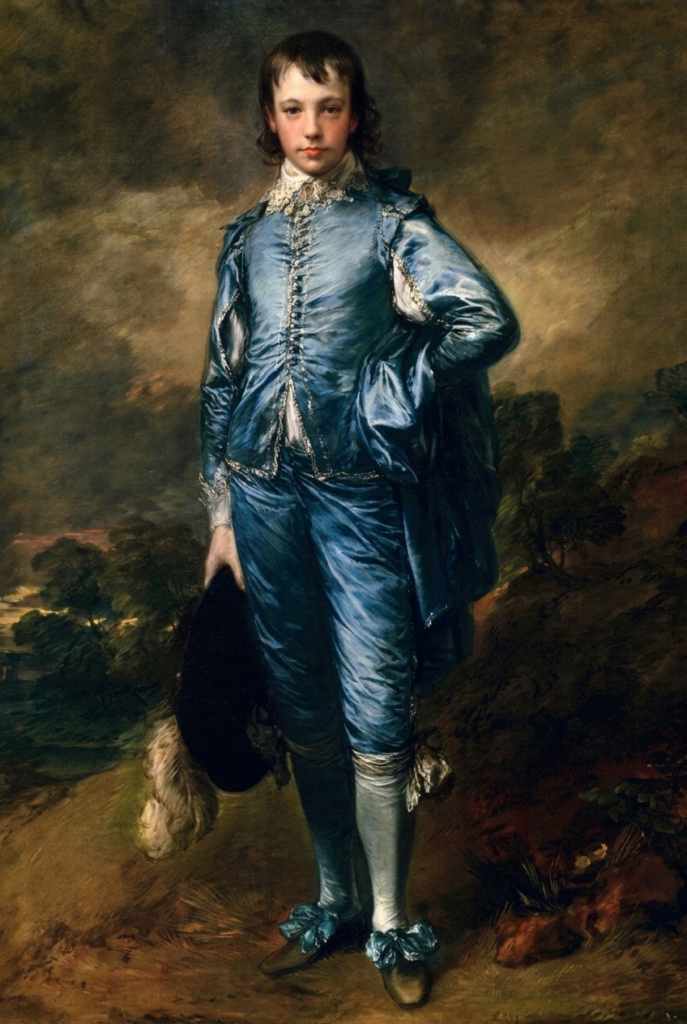
14. Gainsborough, Blue Boy
📍Huntington Library, California
Thomas Gainsborough’s Blue Boy is arguably the most iconic portrait in British art. Its luminous blues, aristocratic swagger, and effortless elegance have made it a masterpiece of Western portraiture.
The identity of the sitter remains uncertain, though many believe he was Jonathan Buttall, the son of a wealthy merchant. Dressed in shimmering blue satin inspired by the portraits of Anthony van Dyck, the young man stands confidently before one of Gainsborough’s signature pastoral landscapes.
The painting’s greatest triumph is its extraordinary play on color. Gainsborough orchestrated a symphony of blues, from deep ultramarine and Prussian blue to pale azure.
Some art historians have even suggested it was a playful rebuttal to Sir Joshua Reynolds’ preference for warm color palettes.

15. Frans Hals, Laughing Cavalier
📍Wallace Collection, London UK
Frans Hals’ The Laughing Cavalier is one of the liveliest portraits ever painted. With its confident pose, mischievous smile, and dazzling brushwork, it seems to capture a fleeting moment rather than a formal sitting.
Despite the title, the sitter is neither laughing nor a cavalier. His identity remains unknown, though his sumptuous costume suggests he was a wealthy Dutch merchant or prominent citizen.
The richly embroidered sleeves are decorated with symbols of love and courtship, leading many scholars to believe this was painted as a betrothal portrait.
Hals’ virtuoso technique is the painting’s greatest triumph. His loose, energetic brushwork somehow conveys the shimmer of satin, delicate lace, and black silk with astonishing realism.
The sitter’s direct gaze, unmistakable swagger, and quirky mustache make him feel as riveting today as he was nearly 400 years ago.
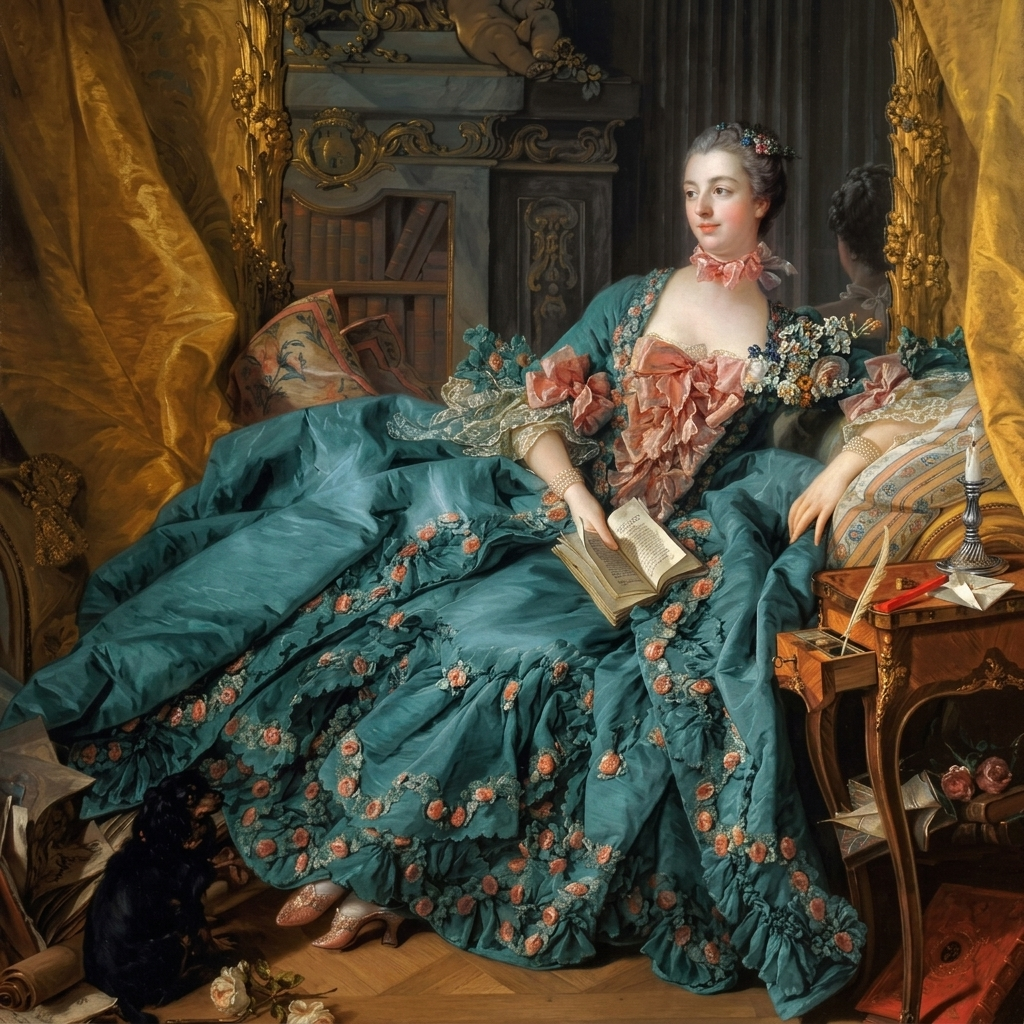
16. François Boucher, Madame de Pompadour
📍Alte Pinakothek, Munich Germany
François Boucher’s Portrait of Madame de Pompadour is one of the finest Rococo portraits ever painted. Elegant, intelligent, and impeccably staged, it transformed Louis XV’s famous mistress into a woman of culture and influence.
Madame de Pompadour was far more than the king’s favorite. She became one of the most powerful women in 18th century France and an important patron of artists, writers, and philosophers. Boucher painted her seven times, but this is his most celebrated likeness.
Dressed in a sumptuous green silk gown adorned with pink bows and roses, she appears surrounded by books, sheet music, prints, and writing implements. Every object was carefully chosen to present her not simply as a celebrated beauty, but as an educated patron of the arts.
The portrait perfectly captures the grace, refinement, and playful elegance of the Rococo era. More than two centuries later, it remains the definitive image of one of France’s most fascinating women.
>>> Click here to book a Pinakothek tour

17. Francis Bacon, Study after Velázquez’s Portrait of Pope Innocent X
📍 Des Moines Art Center
Francis Bacon’s Study after Velázquez’s Portrait of Pope Innocent X is one of the most unsettling portraits of the 20th century. Inspired by Velázquez’s 17th century masterpiece I spoke of above, Bacon transformed a commanding pope into a universal symbol of fear, isolation, and human suffering.
Rather than depicting a recognizable likeness, Bacon sought to capture an emotional truth. The screaming pontiff appears trapped within a cage-like structure, his face dissolving into blurred brushstrokes and raw emotion. The portrait is less about Pope Innocent X than the fragility of power itself.
With this painting, Bacon shattered centuries of portrait tradition. Instead of celebrating status, beauty, or authority, he exposed the psychological torment lurking beneath the surface. The result is a portrait that is both terrifying and unforgettable.
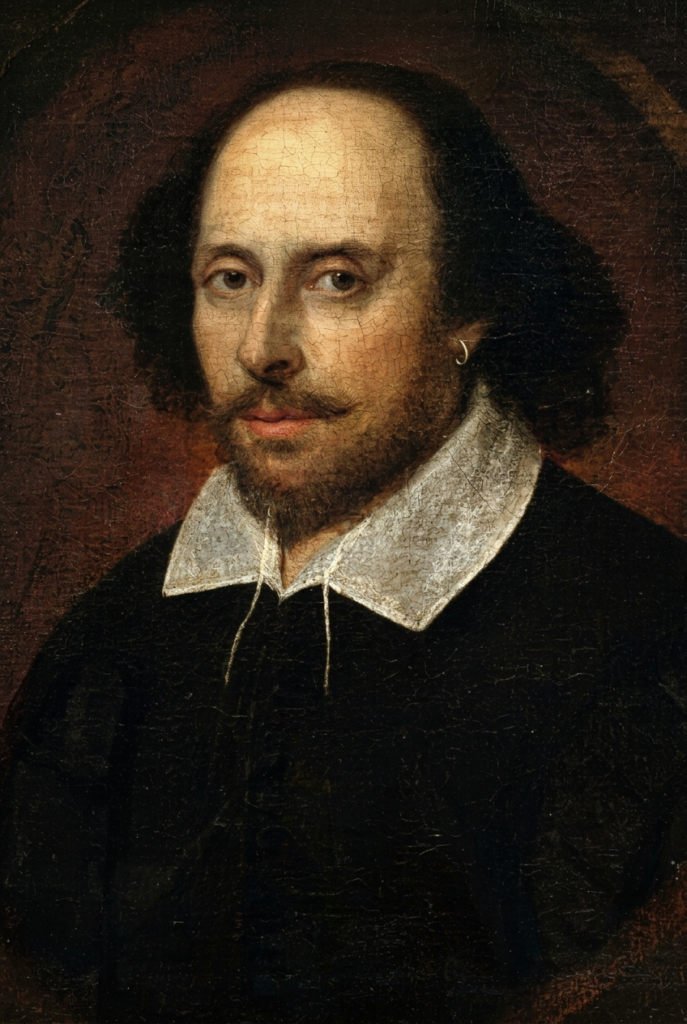
18. Chandos Portrait of Shakespeare
📍National Portrait Gallery, London
No portrait is more closely associated with William Shakespeare than the famous Chandos Portrait. Attributed to John Taylor, it dates to the early seventeenth century and takes its name from the Duke of Chandos, one of its former owners.
Although its authorship and exact history remain uncertain, many scholars believe it is the only surviving portrait painted during Shakespeare’s lifetime, probably in the years just before his death in 1616. If true, it is the closest we can come to seeing the playwright as his contemporaries knew him.
Shakespeare is shown as a thoughtful middle-aged man with a receding hairline, a neatly trimmed beard, and a fashionable lace collar. His direct gaze and understated expression have helped shape our mental image of the Bard for more than four centuries.
The portrait was the very first work acquired by the National Portrait Gallery in London in 1856. Whether or not every detail of its attribution is correct, the Chandos Portrait has become the definitive image of Shakespeare and one of the most historically significant portraits in the English-speaking world.
I hope you’ve enjoyed my guide to the greatest portraits in history. You may enjoy these other art guides:
- Famous French artists
- Famous Italian artists
- Top Renaissance paintings
- Top 20th century paintings
- Top Post-Impressionist paintings
- Top paintings in the United States
- Famous Mannerist paintings
- 75 masterpieces in Europe
- Paintings with hidden meanings
- Shocking Art Heists In History
Pin it for later.