Of all England’s royal dynasties, none inspires quite as much obsession as the Tudors.
And really, how could they not? Their 118 year reign was a pressure cooker of ambition, court politics, religious upheaval, betrayals, scandals, plots, executions, and spectacular falls from grace. It was history’s version of a very expensive and risqué soap opera.
Henry VII took the crown from Richard III and somehow made his shaky new dynasty stick. Henry VIII turned marriage into a matter of state, broke with Rome, and sent wives to the scaffold.
England then saw its first queens regnant, Mary I and Elizabeth I, two formidable women who could hardly have been more different.
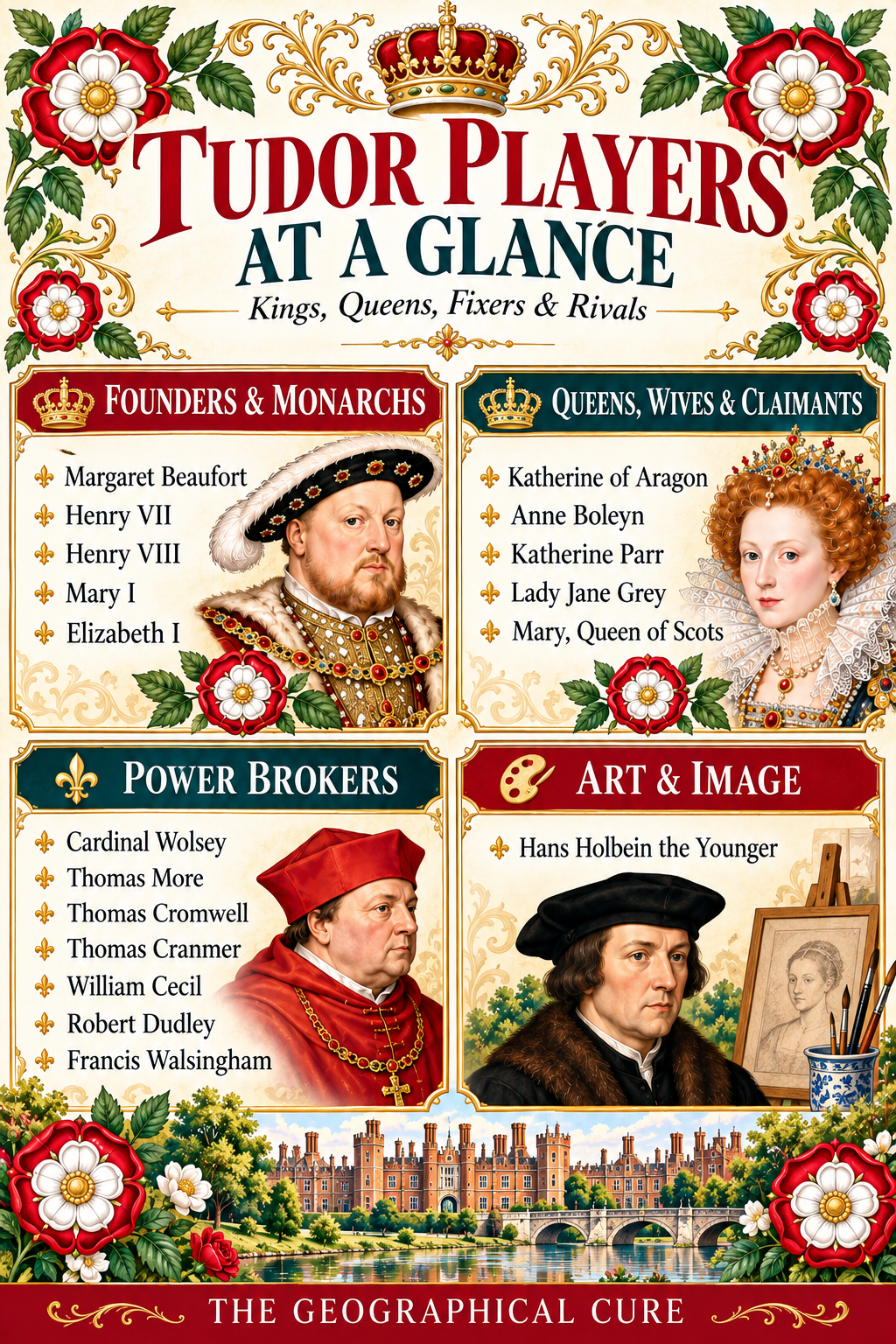
Around them swirled an equally fascinating cast: brilliant ministers, ruthless fixers, spies, reformers, adventurers, ambitious mothers, and courtiers who discovered just how dangerous royal favor could be.
The Tudors reshaped England in every direction, forcing its jagged political, religious, and social seams together, not always neatly.
But what keeps pulling us back is the people themselves: brilliant, vain, stubborn, ruthless, loyal, reckless, and often spectacularly dysfunctional.
So, who were the most fascinating players in this extraordinary family drama? Let’s take a look.
The Tudors Cast of Characters
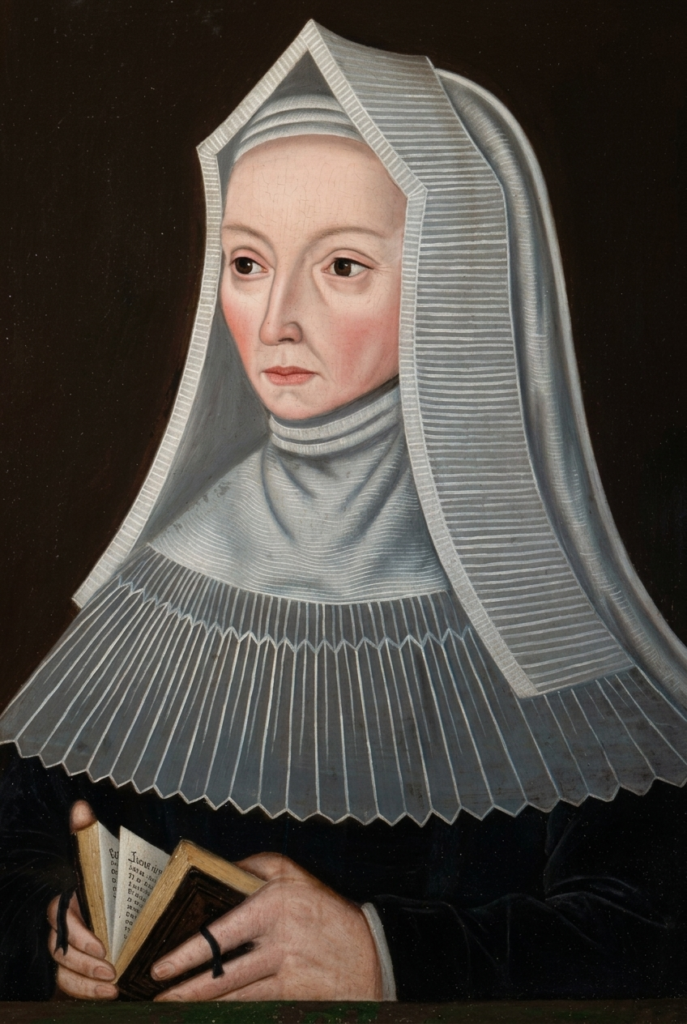
Margaret Beaufort, Behind the Scenes Power Broker
Margaret Beaufort was one of the chief architects of the Tudor dynasty. She never led an army, of course. But she used money, marriage, religion, alliances, and sheer willpower to put her only son on the throne.
Born the only child of John Beaufort, Earl of Somerset, Margaret was politically valuable from childhood. At just 12, she married Edmund Tudor, the king’s half-brother.
A year later, she gave birth to Henry Tudor. He spent much of his youth in exile in Brittany. In his absence, Margaret did what she did best: survived, cultivated powerful allies, and plotted.
Her most useful marriage was to Thomas Stanley. He had money, troops, and an uncanny ability to land on the winning side.

After Richard III claimed the throne in 1483, Margaret began working with Elizabeth Woodville.
The two women agreed that Henry Tudor would marry Elizabeth’s daughter, Elizabeth of York. It was a brilliant piece of political engineering.
At Bosworth in 1485, Stanley’s forces helped tip the battle against Richard III.
Margaret had pulled it off. Once her son was king, she managed vast estates, founded colleges, and carved out an almost regal position at the new Tudor court.

Henry VII, Tudor Founder
Henry VII didn’t inherit the Tudor dynasty. He created it.
After defeating Richard III at Bosworth, Henry took the throne with a decidedly shaky claim and dedicated himself to making his new regime look inevitable.
He was cautious, suspicious, and intensely hands-on. Pretenders such as Lambert Simnel and Perkin Warbeck repeatedly challenged his right to rule, while rebellious nobles remained a constant concern.
Henry responded with money, administration, dynastic marriages, and plenty of image-making. He also sanctioned propaganda that made Richard III a villain and the Tudor victory more providential.

Unlike his son, Henry generally preferred diplomacy to expensive foreign adventures.
He strengthened England’s position through marriage alliances, tightened royal administration, increased Crown revenues, and left Henry VIII a stable kingdom and full coffers.
His most spectacular architectural legacy is the Henry VII Lady Chapel at Westminster Abbey, begun in 1503. Henry and Elizabeth of York lie there beneath a magnificent gilt-bronze tomb.
Henry wasn’t exactly lovable. But after decades of dynastic warfare, he put the kingdom back together and made the Tudor monarchy stick.

Henry VIII, The Tempestuous Monarch
Henry VIII is remembered as the king who married six women and eventually ate his way through England’s livestock. But he didn’t start out as the hulking tyrant of popular imagination.
Young Henry was handsome, athletic, highly educated, musical, multilingual, and intellectually curious. He hunted, jousted, wrestled, played tennis, composed music, collected books, and surrounded himself with scholars and artists.
Then things got considerably darker.
His expensive wars in France achieved little of lasting value, despite Henry’s dreams of emulating Henry V. His court, palaces, tournaments, and military adventures consumed enormous sums.
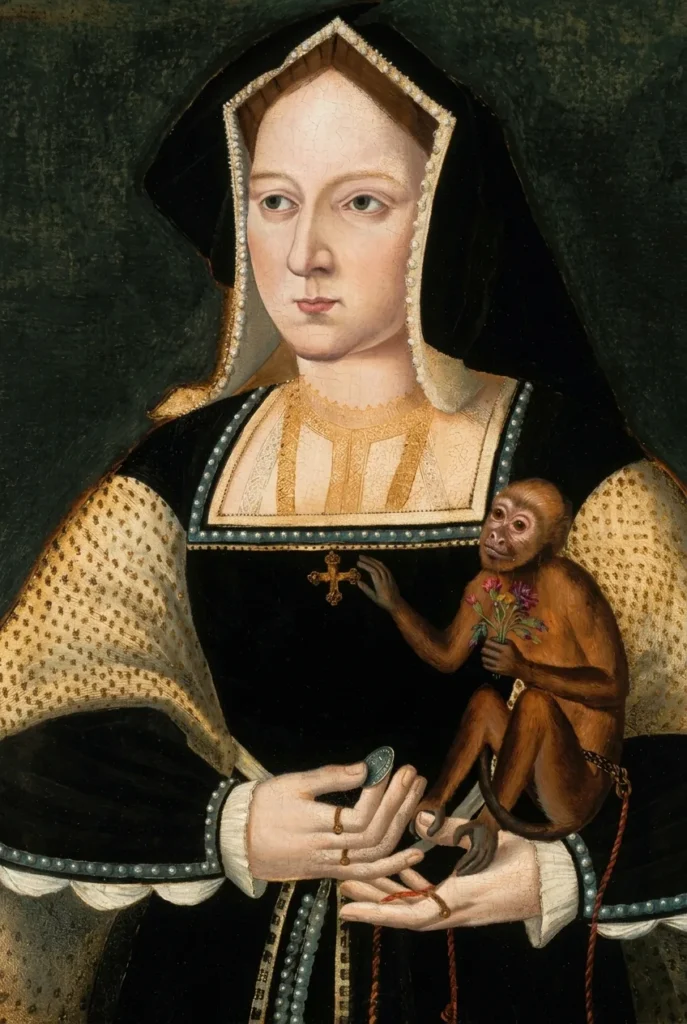
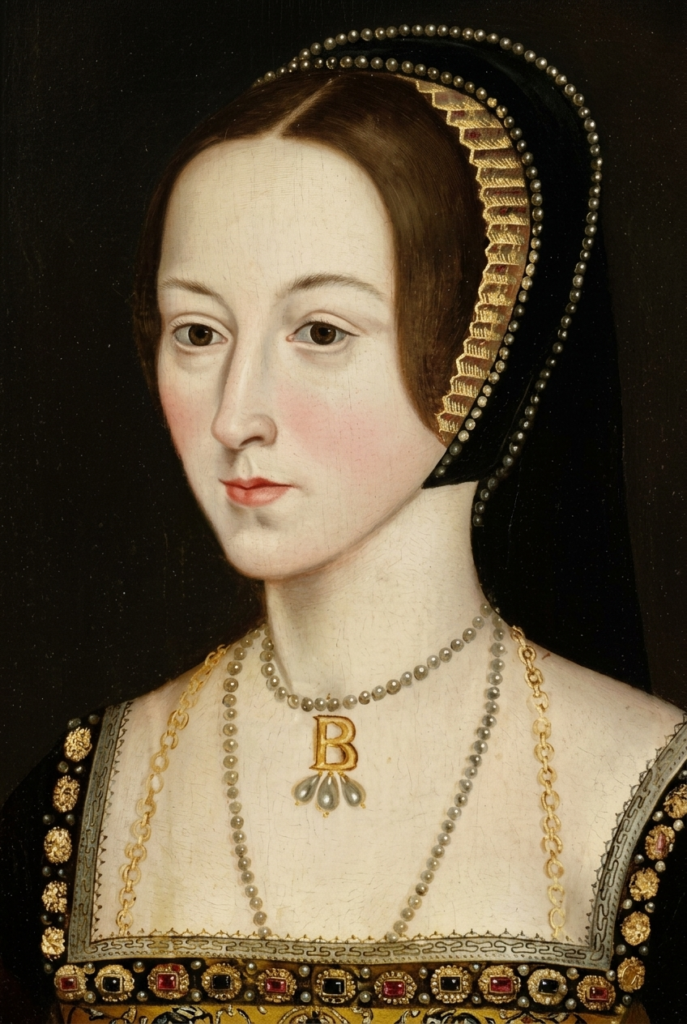
And then came the “Great Matter.”
When the pope refused to annul his marriage to Katherine of Aragon, Henry used Parliament to strip away papal authority in England. The 1534 Act of Supremacy made Henry supreme head of the English church.
Meanwhile, his marital record became grotesque: two wives were annulled, two beheaded, one died after childbirth, and one survived him.
Strip away the Holbein magnificence and Tudor nostalgia, and Henry’s reign contains an extraordinary amount of violence, coercion, religious upheaval, and ruined lives.
England survived him. A surprising number of people around him did not.
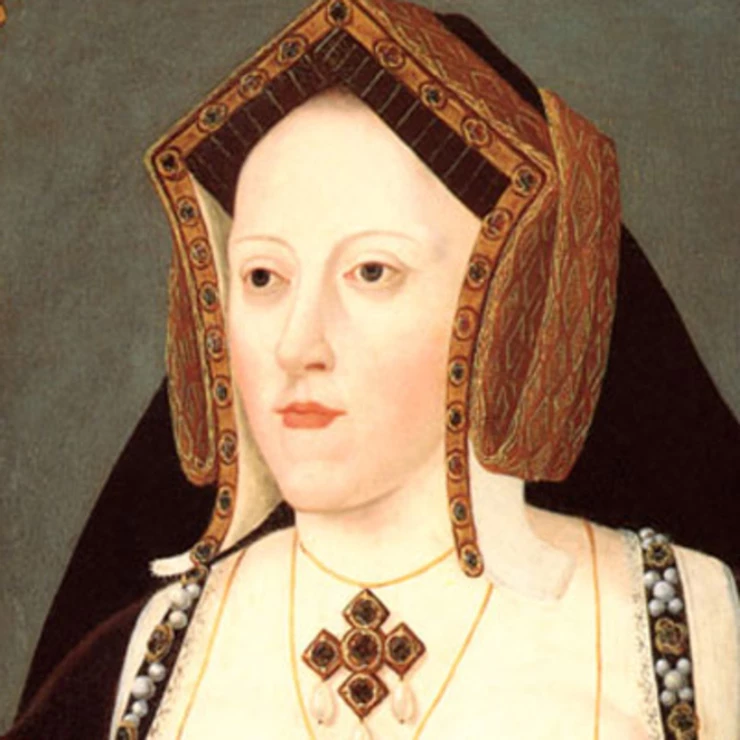
Katherine of Aragon, the Unmovable Queen
Katherine of Aragon, daughter of Ferdinand and Isabella of Spain, was Henry VIII’s straight-laced and formidable first wife.
She first came to London as the bride-to-be of Henry’s older brother Arthur. She spent her first night of wedded bliss at Baynard’s Castle. Whatever happened — or didn’t happen — that night provided the ground for Henry’s divorce from Katherine 27 years later.
Katherine endured repeated pregnancies, but produced only one surviving child, Mary. When Henry became determined to marry Anne Boleyn, Katherine absolutely refused to concede that their marriage was invalid.
And she had powerful backing. Her nephew was Charles V, Holy Roman Emperor. With Rome unwilling to cooperate, Katherine managed to frustrate Henry’s “Great Matter” for years.
Eventually Thomas Cromwell and Thomas Cranmer found a way around the pope and declared Henry’s marriage invalid.
By then, she was already banished from court and living in a succession of increasingly remote residences. She never saw Mary again and died, desolate, in 1536. It was Henry at his most cruel.

Anne Boleyn, the Catalyst
Anne Boleyn had an edge before Henry VIII ever noticed her. She’d spent years at the sophisticated courts of Burgundy and France, absorbing languages, fashion, diplomacy, and Renaissance culture.
When she returned to England, she was polished, confident, witty, and politically alert. She also refused the usual role of royal mistress when she caught Henry’s eye.
Henry wanted her. Anne held out for marriage.
That decision helped turn the king’s marital crisis into something much larger. Henry’s determination to marry Anne became one of the major forces behind England’s break with Rome and the upheaval of the Reformation.

Once married, Anne faced the same problem as Katherine: she failed to produce the coveted son. Her only surviving child was Elizabeth.
In just three years, everything collapsed with astonishing speed.
Cromwell constructed a case against her. The charges of adultery, treason, and incest were almost certainly manufactured. Anne went from queen to prisoner to executed traitor in a matter of weeks.
Henry tried to erase her afterward, even ordering Anne’s badges and symbols removed from Hampton Court Palace.
But he never quite managed it. Anne had given him Elizabeth, a daughter she was fiercely proud of and believed would matter. And boy, was she right.
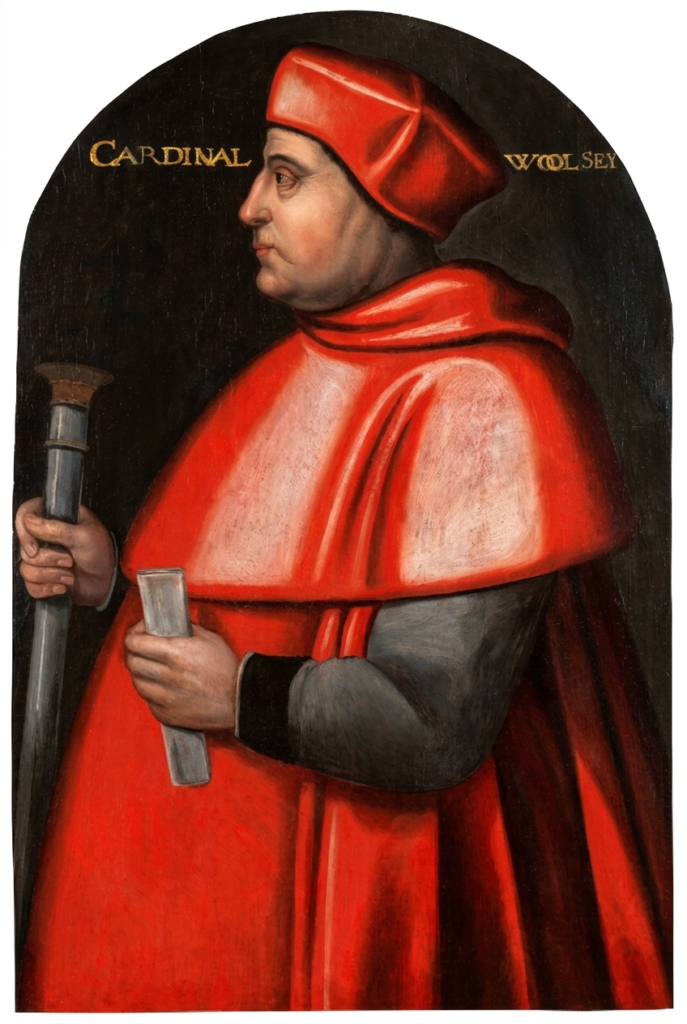
589-1595 (National Portrait Gallery)
Thomas Wolsey, The Cardinal & Chancellor
For years, Thomas Wolsey was almost absurdly powerful.
The butcher’s son from Ipswich rose to become cardinal, Lord Chancellor, papal legate, and Henry VIII’s indispensable chief minister. He ran much of the government, handled foreign diplomacy, and accumulated enough wealth and magnificence to make other nobles deeply resent him.
He also had expensive taste. Hampton Court was originally his, built on a scale grand enough to make a king take notice.
Wolsey’s talent was solving Henry’s problems. Unfortunately, Henry eventually handed him one that couldn’t be solved.

The king wanted his marriage annulled so he could marry Anne. Wolsey spent years trying to persuade Rome to cooperate, but Pope Clement VII would not give Henry what he wanted.
That failure ruined him.
Henry stripped Wolsey of his offices and much of his property. York Palace and Hampton Court passed to the king. In 1530, Wolsey was arrested for treason and ordered back to London.
He never made it. Exhausted and ill, he died at Leicester Abbey on the journey south.
For all his brilliance, Wolsey learned the central rule of Henry VIII’s court: being indispensable only lasted until you failed him.
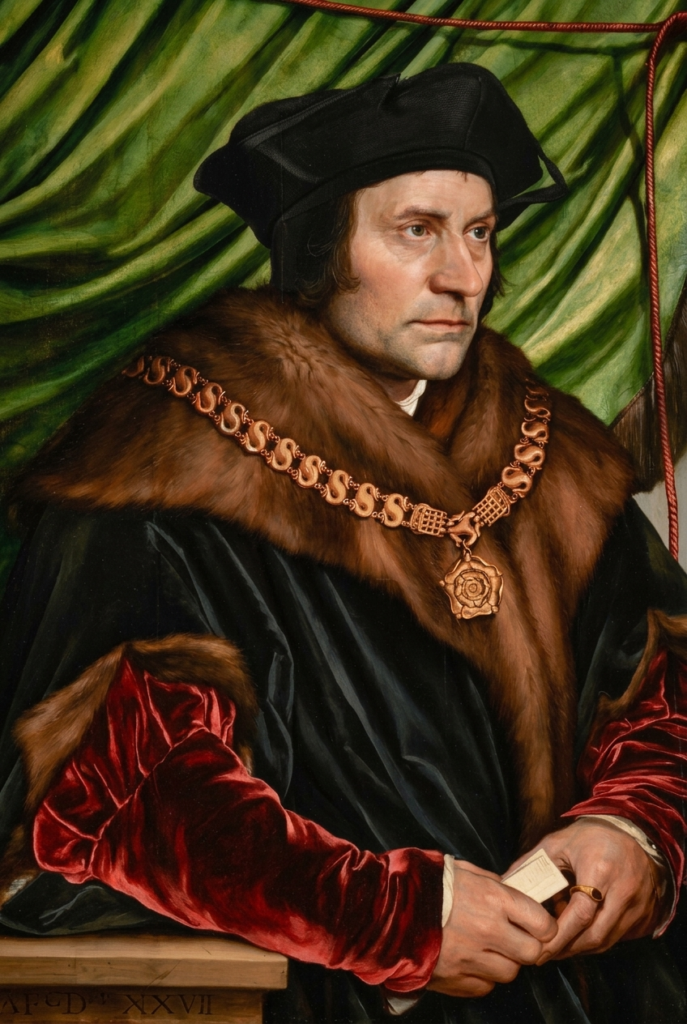
Thomas More, Chancellor & Marytr
Thomas More was one of the great humanists of Tudor England, author of Utopia, a successful lawyer, and eventually one of Henry VIII’s most trusted ministers.
When Wolsey fell in 1529, Henry made More Lord Chancellor. It was an extraordinary rise for a layman, and Henry clearly valued his intelligence, learning, and judgment.
But More had a dark side.
He regarded Protestantism as a dangerous contagion that threatened both religion and social order. As Chancellor, he threw himself into suppressing it, hunting prohibited books, interrogating suspected evangelicals, and using the machinery of government against religious dissent.
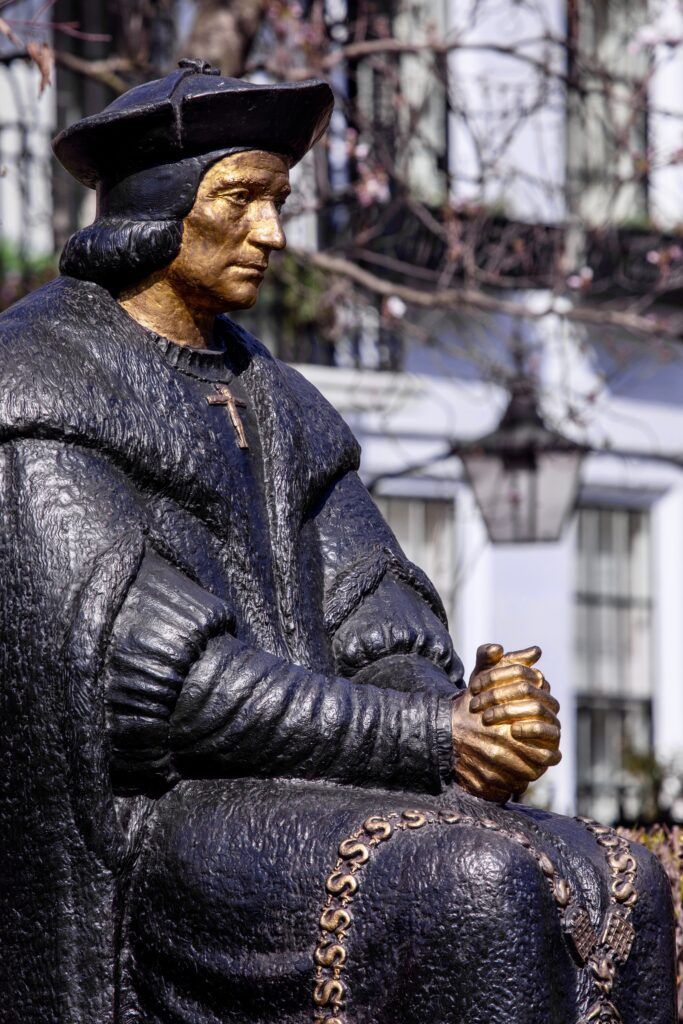
Then Henry’s own religious revolution caught up with him.
More couldn’t accept the king’s growing assault on papal authority. He resigned as Chancellor in 1532 and later refused the oath recognizing Henry’s supremacy over the English church.
That refusal landed him in the Tower of London. He was executed for treason in 1535.
Ever since, More is remembered as a Catholic martyr and heroic man of conscience. It’s a compelling story. It’s also incomplete.
More ultimately demanded the right to follow his own conscience against the state, after spending years helping the state punish people for following theirs. Not really “a man for all seasons.”

Thomas Cromwell, the King’s Fixer
Thomas Cromwell rose from poverty and humble origins. The son of a blacksmith and brewer with a colorful record of brushes with the law, he somehow rose to become the Henry VIII’s consigliere.
In his quest for advancement, he had two advantages: an appetite for power and the patronage of the doomed Cardinal Wolsey.
Cromwell was clever and admittedly a champion of realpolitik. “Tell me what you want, I’ll get it” was essentially his mantra.
His great breakthrough came with Henry’s marriage crisis. When Rome refused the annulment, Cromwell helped devise the parliamentary machinery that severed England from papal authority.
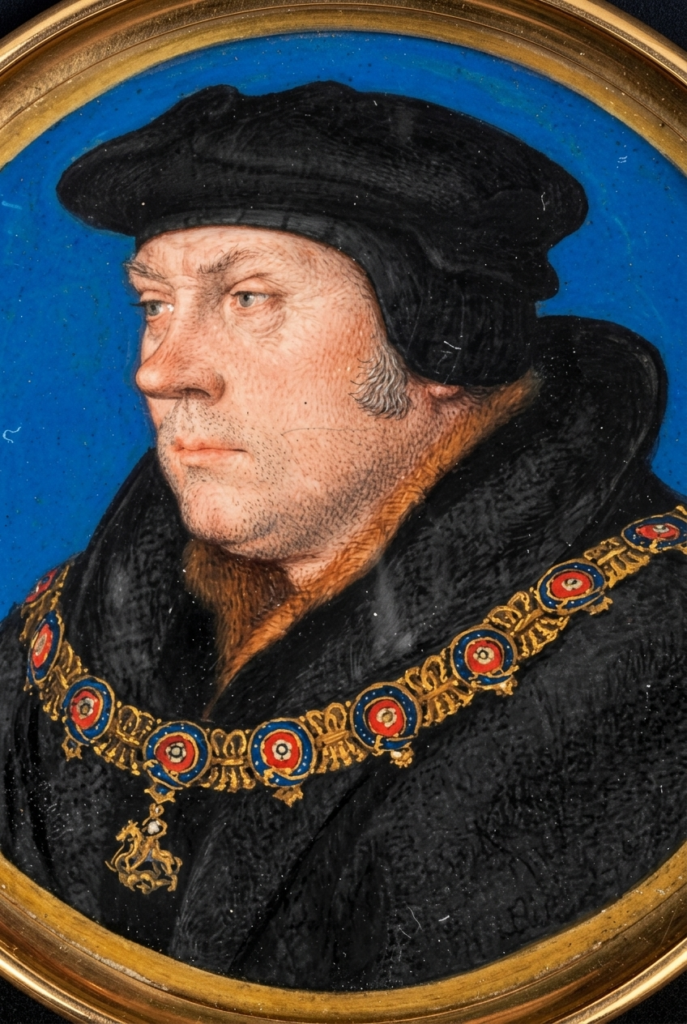
Then came the Anne Boleyn affair. Henry wanted to be rid of her and was captivated by the rather dull Jane Seymour. Cromwell got it done and Henry married Jane.
She gave Henry a son, but died after childbirth. Cromwell searched the continent for Henry’s next wife and landed on Anne of Cleves. On paper, it was an excellent dynastic match. In person, Henry simply didn’t fancy her.
The marriage badly damaged Cromwell. Within months, he was accused of treason and heresy, arrested, and executed on Tower Hill.
In the end, Henry’s great fixer discovered the one problem he couldn’t fix: Henry himself.
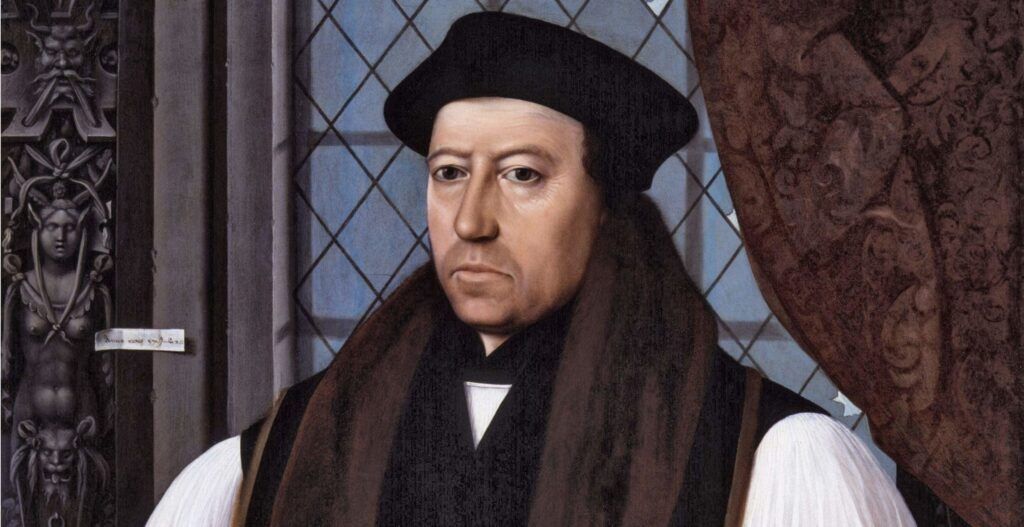
Thomas Cranmer, the Reformer
Thomas Cranmer was one of the most consequential religious figures of Tudor England.
He rose to Henry VIII’s attention during the king’s marriage crisis and became Archbishop of Canterbury in 1533.
Soon enough, he declared Henry’s marriage to Katherine of Aragon invalid and recognized his marriage to Anne. It took a village to achieve this apparently.
But Cranmer’s real importance came later. He helped turn Henry’s break with Rome into a lasting religious revolution. And, under Henry’s son Edward VI, pushed England decisively toward Protestantism.
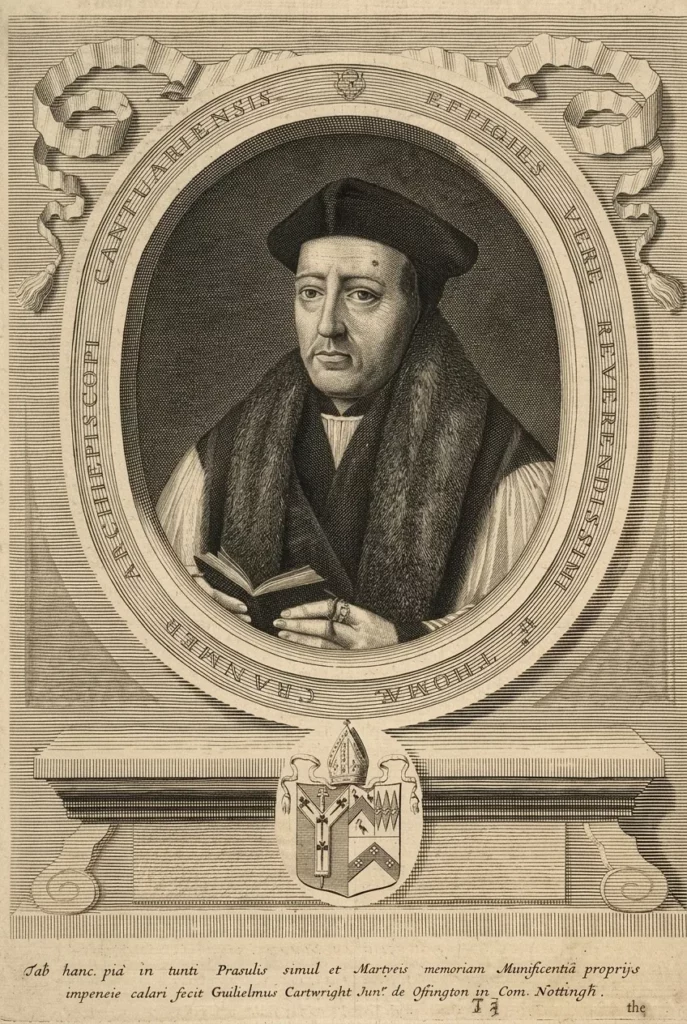
Unfortunately for him, Mary I, an avowed Catholic, was next in line for the throne. When she ascended in 1553, her purge of Protestants began.
Cranmer was her most famous victim. He was imprisoned, tried for heresy, and pressured into recanting his Protestant beliefs.
At the last moment, he dramatically withdrew those recantations and was burned in Oxford in 1556.
He spent his career helping kings remake England’s religion. In the end, the religious revolution he helped create consumed him too.

Lady Jane Grey, The Nine Day Queen
Lady Jane Grey is one of the Tudors’ most tragic figures, remembered as the teenage queen who ruled for just nine days in 1553.
A great-granddaughter of Henry VII, Jane had a genuine place in the succession. Jane was also exceptionally educated, fiercely intelligent, and deeply Protestant.
As Edward VI lay dying, he became determined to prevent his Catholic half-sister Mary from inheriting the throne. He altered the succession and named Jane his heir.
Jane didn’t seek the crown and reportedly resisted accepting it. But once proclaimed queen, she understood exactly what was at stake.
The scheme collapsed almost immediately. Mary rallied enormous support, the Privy Council abandoned Jane, and nine days after her proclamation Mary was recognized as queen.

Jane was imprisoned in the Tower and convicted of treason. At first, Mary had no desire to execute her.
Then came Wyatt’s Rebellion in 1554. Jane’s father joined the uprising, and Jane suddenly became a dangerous Protestant alternative to Mary all over again.
Mary offered Jane her life if she converted to Catholicism. Jane refused.
At 16 or 17, she went to the scaffold on Tower Green with remarkable composure. Her reign lasted nine days. Her legend has lasted nearly five centuries.

Mary I, Bloody Mary
Mary Tudor is one of history’s most fascinating, complex, and maligned figures.
History remembers her as a murderous monster who burned around 280 of her subjects at the stake. It was terrifying. But religious persecution was hardly unique to Mary, even if the scale of her burnings made her notorious.
As Katherine daughter, Mary was raised as a devout Catholic princess and for years treated as Henry’s heir. But once Henry married Anne, Mary was declared illegitimate and removed from the succession.
But, after Henry finally had his son Edward with Jane Seymour, he softened. His sixth wife Katherine Parr helped persuade him to restore Mary and Elizabeth to the succession. Having only one heir wasn’t exactly ideal.

When Mary became queen, she initially promised not to force her religion on anyone. That didn’t last.
By 1555, the old heresy laws were back in force, and Protestants were burning at the stake. The persecutions earned her the unfortunate sobriquet “Bloody Mary.”
Marriage served her no better. To secure a Catholic dynasty, she married Philip, newly made King of Naples and later King of Spain. She was 38 and he was 27. Mary adored him, but Philip spent much of their marriage abroad.
She desperately needed an heir, but experienced two false pregnancies. Modern writers have proposed everything from pseudocyesis to hormonal disorders or cancer as the cause. Mary died at only 42, alone and without the heir she had wanted so badly.

Elizabeth I, The Virgin Queen
Elizabeth I inherited an unenviable situation. England was divided by religion, the succession remained uncertain, and plenty of men still doubted that a woman could rule effectively.
Elizabeth proved otherwise.
Her refusal to marry became one of her greatest political weapons. Suitors were encouraged, delayed, or dangled before foreign powers. But no husband ever acquired authority over her or her throne. Elizabeth wanted no master.
She surrounded herself with exceptionally capable advisers, but remained firmly in charge. And she was extraordinarily skilled at keeping rival factions competing for her favor rather than for the crown.

Her reign also coincided with an extraordinary cultural flowering. Shakespeare and Marlowe wrote for the London stage, Raleigh and Drake ventured overseas, and England increasingly saw itself as a serious European power.
Then came the Spanish Armada in 1588. Elizabeth’s famous appearance before the troops at Tilbury helped cement the image she had spent decades constructing: not a vulnerable woman occupying a man’s throne, but the embodiment of England itself.
She could be vain, indecisive, ostentatious, temperamental, and maddeningly reluctant to commit. But she survived conspiracies, foreign threats, religious division, and nearly 45 years on the throne.
The daughter Henry VIII once declared illegitimate became the Tudor who outlasted them all.
William Cecil, The Right Hand
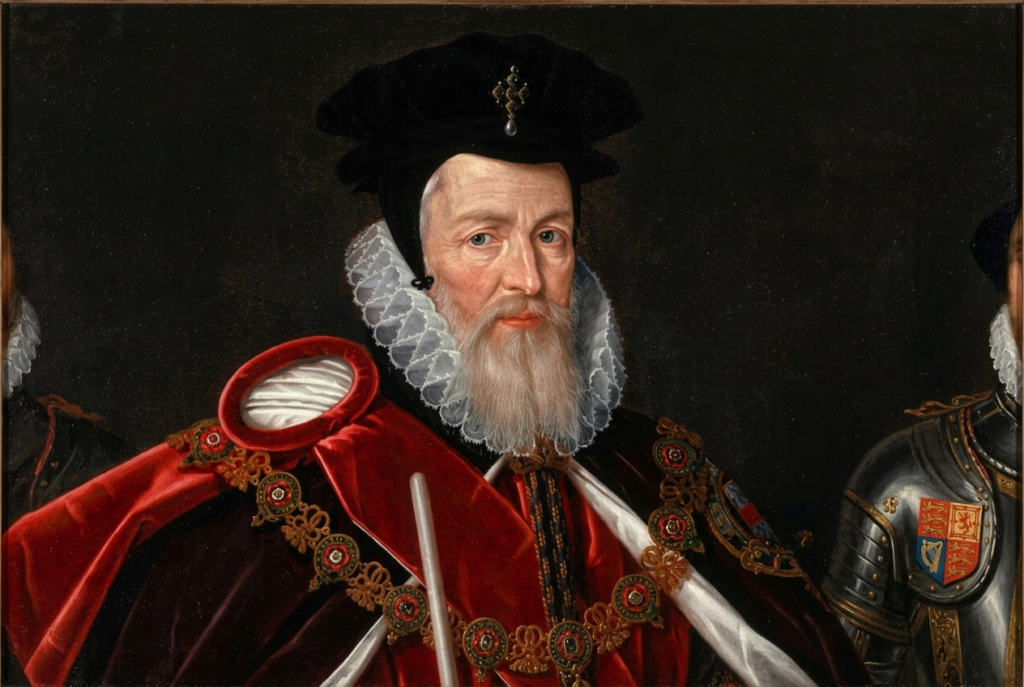
Elizabeth gave considerable thought to the men who would help her govern. One of her very first acts as queen was to appoint William Cecil her Principal Secretary.
It was an inspired choice. Elizabeth trusted him enormously and wanted him close at hand. She even nicknamed him her “Spirit.”
For nearly 40 years, Cecil helped run the machinery of Elizabethan government.
He dealt with foreign policy, defense, religion, finance, and the endless problem of keeping England secure while avoiding expensive wars. He later became Master of the Court of Wards, Lord Treasurer, Baron Burghley, and a Knight of the Garter.
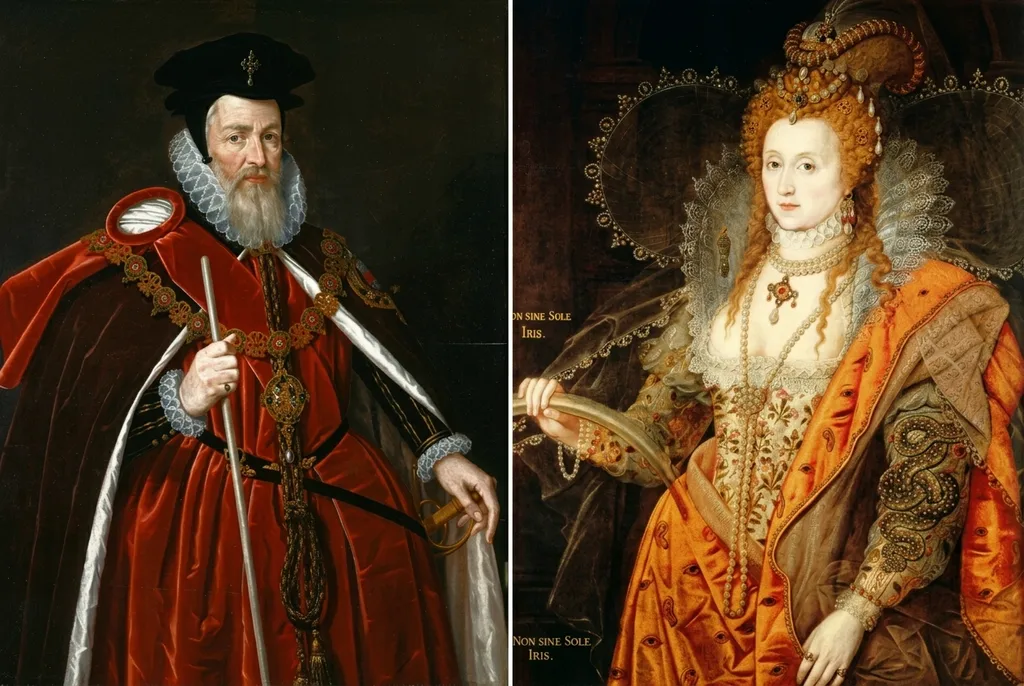
Cecil was unusually steady in an age of intrigue and spectacular falls from grace. He was cautious, pragmatic, relentlessly hardworking, and devoted to Elizabeth and the Protestant settlement.
Except when it came to his uncharacteristic venom toward Mary Queen of Scots. He regarded her as an enduring threat and repeatedly pushed Elizabeth toward harsher action. Elizabeth, characteristically, hesitated over executing an anointed queen. Cecil did not.
Unlike Wolsey, More, or Cromwell, Cecil never suffered the great Tudor fall. He remained Elizabeth’s most influential adviser until his death in 1598.
Elizabeth supplied the crown. Cecil supplied much of the machinery that kept it secure.

Francis Walsingham, The Spymaster
Sir Francis Walsingham’s official title was Principal Secretary to Elizabeth I. But was that all he did? Decidedly not.
This pious, tight-lipped Protestant became Elizabeth’s great spymaster. He built an intelligence network designed to sniff out Catholic plots before they reached the queen.
Walsingham knew when to shut up and listen, a useful quality in a court full of people desperate to hear themselves talk. His reserve could be unnerving. He watched everyone while revealing very little of himself.
His specialty was covert intelligence: intercepted correspondence, informers, double agents, secret codes, surveillance, and carefully laid traps.
His masterpiece was the Babington Plot of 1586. It had all the elements of a spy thriller: secret messages, assassination plans, coded letters, and double agents.
Mary Queen of Scots believed she’d found a safe way to communicate with her supporters. In reality, her letters were being intercepted, opened, deciphered, copied, resealed, and sent on their way.
Walsingham waited until Mary implicated herself in a plot to assassinate Elizabeth and then pounced. Babington and his fellow conspirators were arrested and executed. Mary followed in 1587 after Elizabeth finally signed her death warrant.
Walsingham died in 1590 with surprisingly little money to show for decades of royal service. He never wore the crown or commanded the court. But for years, Walsingham knew England’s secrets before almost anyone else did.

Mary, Queen of Scots, The Self-Destructive Queen
The life of Mary Queen of Scots can almost be summed up in one line: clever enough to wear the crown, not clever enough to keep it.
She was one of the most fascinating women of the Tudor age and one of the most exasperating.
Was she unlucky? Badly advised? Reckless in love? Hopelessly entitled? Or simply a Catholic woman trying to rule a Protestant Scotland where powerful men were waiting for her to stumble?
Probably a bit of everything.
Mary became Queen of Scots when she was just six days old. Raised largely in France, she returned to Scotland in 1561 as a sophisticated Catholic queen facing a newly Protestant country. At first, she handled the situation surprisingly well.


Then came the husbands.
Her marriage to Lord Darnley was a disaster. Darnley was murdered, and Mary soon married the Earl of Bothwell, the man widely suspected of involvement in his death.
The scandal helped bring down her government. She was imprisoned, forced to abdicate, escaped, and fled to England.
That may have been her greatest miscalculation.

Mary expected help from her cousin Elizabeth I. Instead, Elizabeth saw a Catholic queen with a strong claim to the English throne and kept her under increasingly restrictive confinement.
And Mary still couldn’t resist plotting. The final disaster was the Babington Plot.
After nearly 19 years in England, Mary was executed in 1587.
She died with considerably more dignity than she had sometimes governed. And, as usual, Mary left behind exactly what she did best: a mess, a controversy, and a magnificent legend.
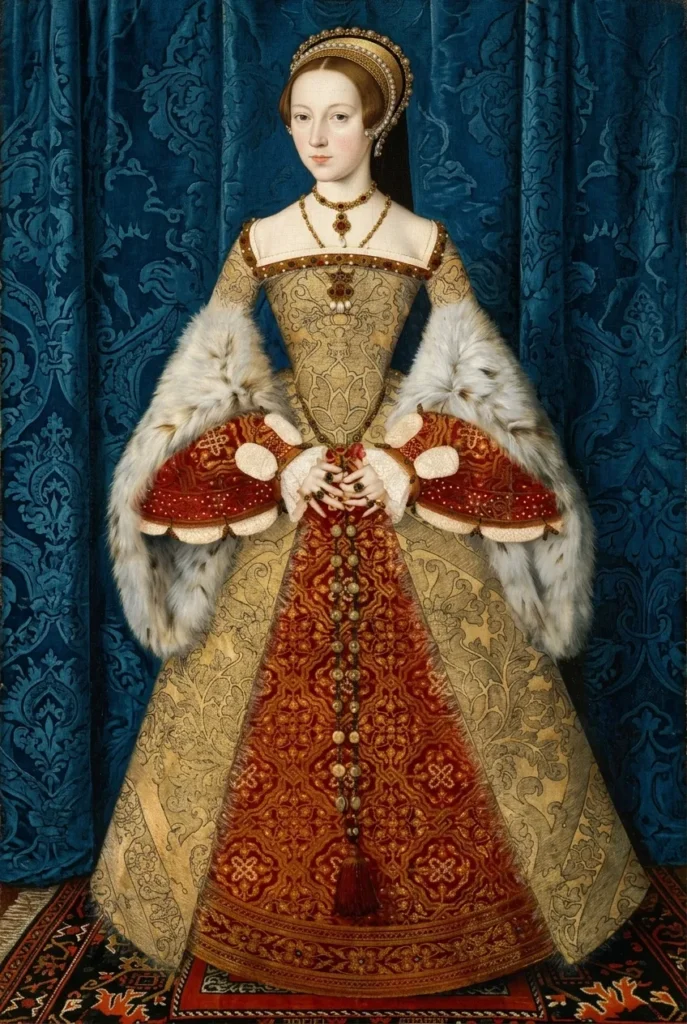
Katherine Parr, The Scholar Queen
Katherine Parr is usually remembered as the wife who survived Henry VIII. That sells her rather short.
She was highly educated, politically astute, and the first English queen consort to publish books under her own name. She also leaned toward Protestant reform, which was not exactly a risk-free intellectual hobby in Henry’s court.
She handled Henry remarkably well. She helped reconcile him with Mary and Elizabeth, took a serious interest in their education, and even served as Regent while Henry campaigned in France.
But Katherine nearly pushed her luck too far.
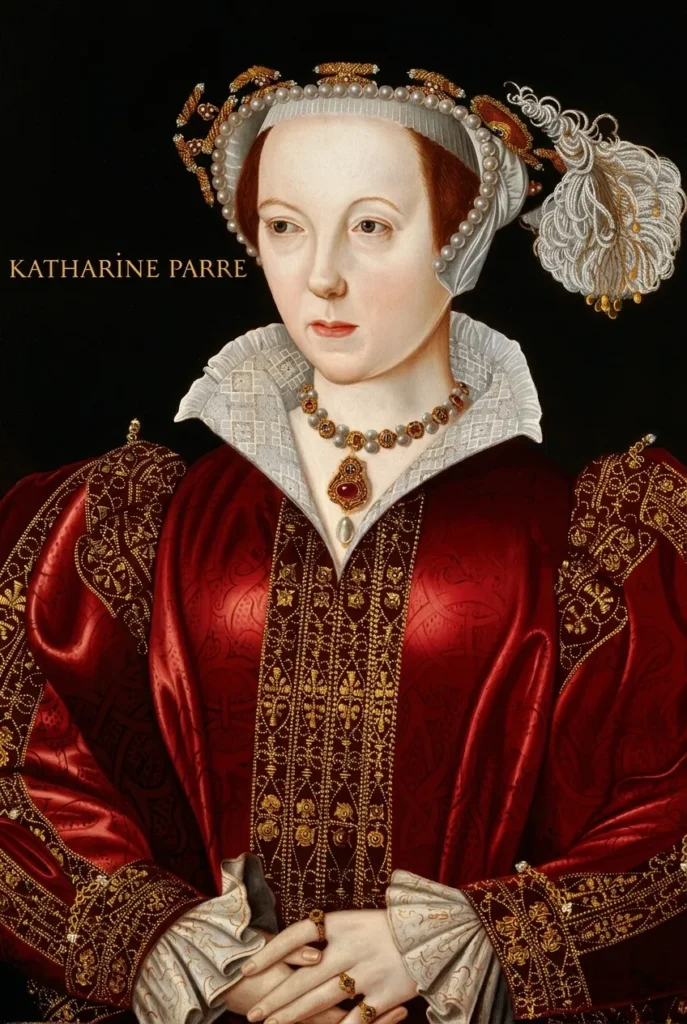
Her religious debates with Henry alarmed conservative courtiers, and the king actually signed a warrant for her arrest on suspicion of heresy. Warned in time, Katherine hurried to Henry and convinced him that she argued theology only to entertain and distract him from his pain.
It worked. The arresting officers were sent packing.
After Henry died, Katherine married Thomas Seymour. The romance proved messier than expected, especially after Seymour began behaving inappropriately toward the teenage Elizabeth living in their household. Katherine was forced to send Elizabeth away.
Katherine died in 1548 after giving birth to her only child. She didn’t merely survive Henry VIII. She outthought him when it mattered.
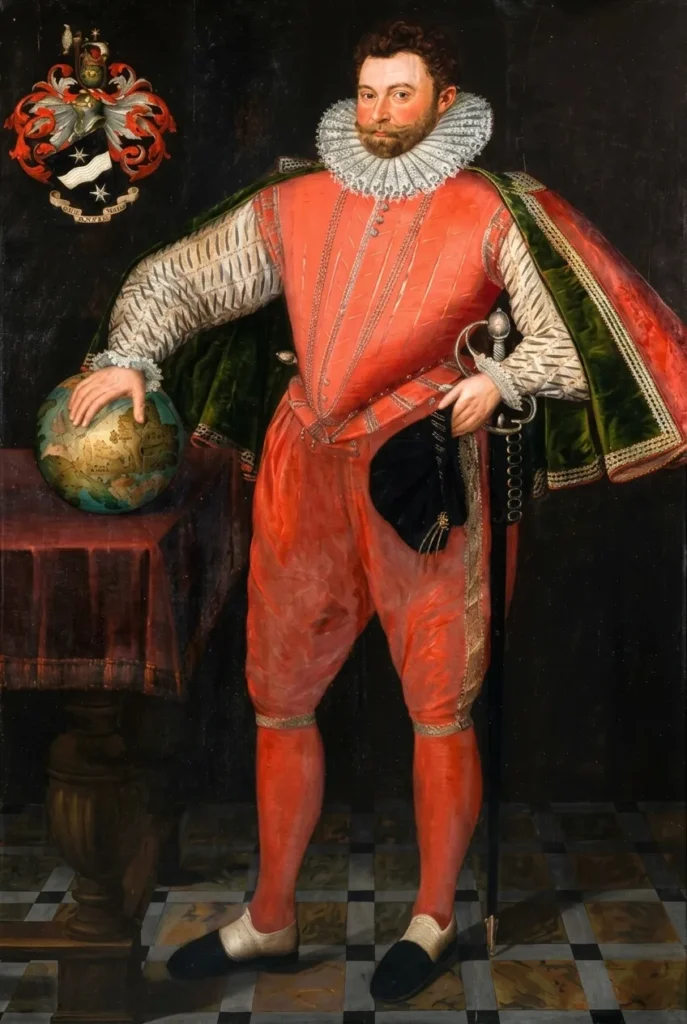
Francis Drake, the Pirate-Hero
Francis Drake was a different kind of Tudor figure. He was a sailor, privateer, explorer, naval commander, court favorite.
He was a national hero to the English, but also a raider, slave trader, and violent imperial figure from the Spanish perspective.
He was the first Englishman to circumnavigate the globe in 1577–80. He made an enormous fortune attacking Spanish ships and settlements. He was knighted by Elizabeth, and later helped fight the Spanish Armada in 1588.
He can’t be reduced to “great explorer” though. He was daring and extraordinarily capable. But also ruthless and deeply implicated in the brutal expansionist world of the 16th century.
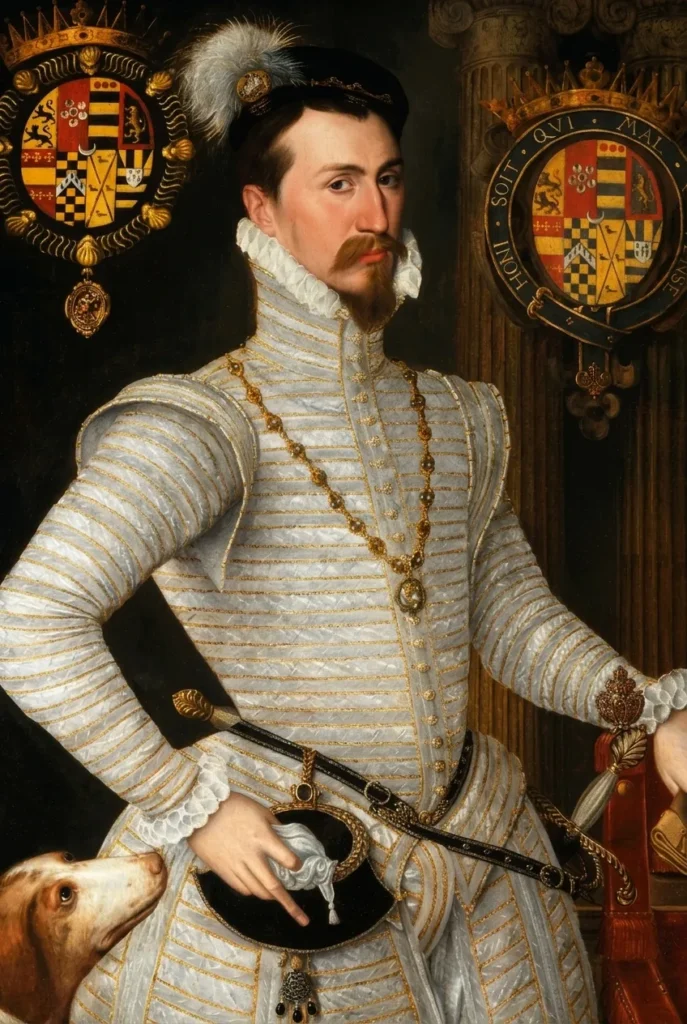
Robert Dudley, Bess’ Best Friend
Elizabeth I never married, despite decades of diplomatic pressure, matchmaking, and anxious councilors. But she certainly enjoyed male company and was never above a good flirtation.
No man mattered more than Robert Dudley. They’d known each other since youth. Once Elizabeth became queen, Dudley was almost constantly at her side.
Foreign ambassadors quickly concluded that he was the man she loved. Some went much further, spreading rumors that the relationship was sexual. There was one rather inconvenient obstacle: Dudley already had a wife.
Amy Robsart lived mostly away from court while her husband enjoyed extraordinary access to the queen. Then, in 1560, she was found dead at the bottom of a staircase.
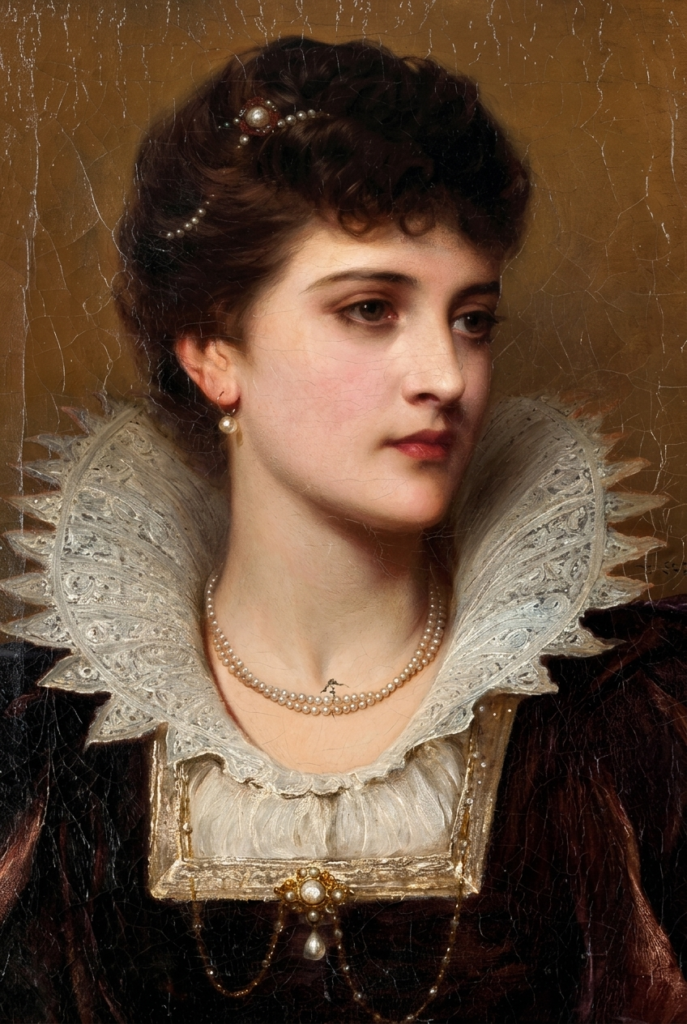
The timing was disastrous. Rumors of murder exploded across Europe, with Dudley the obvious suspect. An inquest found no evidence that he killed her, but politically it hardly mattered. Any hope that Elizabeth could marry him without scandal was effectively dead on arrival.
Still, Dudley remained her favorite for decades. Elizabeth made him Earl of Leicester and granted him Kenilworth Castle, where he spent lavishly creating a residence fit for royal visits.
In 1575, Dudley staged an extravagant 19 day festival at Kenilworth complete with fireworks, banquets, masques, music, hunting, and pageantry.
If it was one last marriage pitch, it failed. Whatever exactly passed between them, Dudley came closer than anyone else to being Elizabeth’s almost-king.

Hans Holbein, The Court Painter
Hans Holbein the Younger was one of the greatest portraitists of the Northern Renaissance and the man largely responsible for how we picture the Tudors today.
His portraits are astonishingly precise: velvet, fur, jewels, embroidery, wrinkles, wary eyes. But Holbein did more than record faces. He understood status and power.
As Henry VIII’s court painter, he created the definitive “swagger” image of the king: massive, magnificently dressed, legs planted apart, staring straight at the viewer as if daring anyone to challenge him.
Holbein painted many of the people who populated Henry’s court, including Thomas More, Thomas Cromwell, Anne of Cleves, and a parade of nobles, diplomats, and prospective brides.
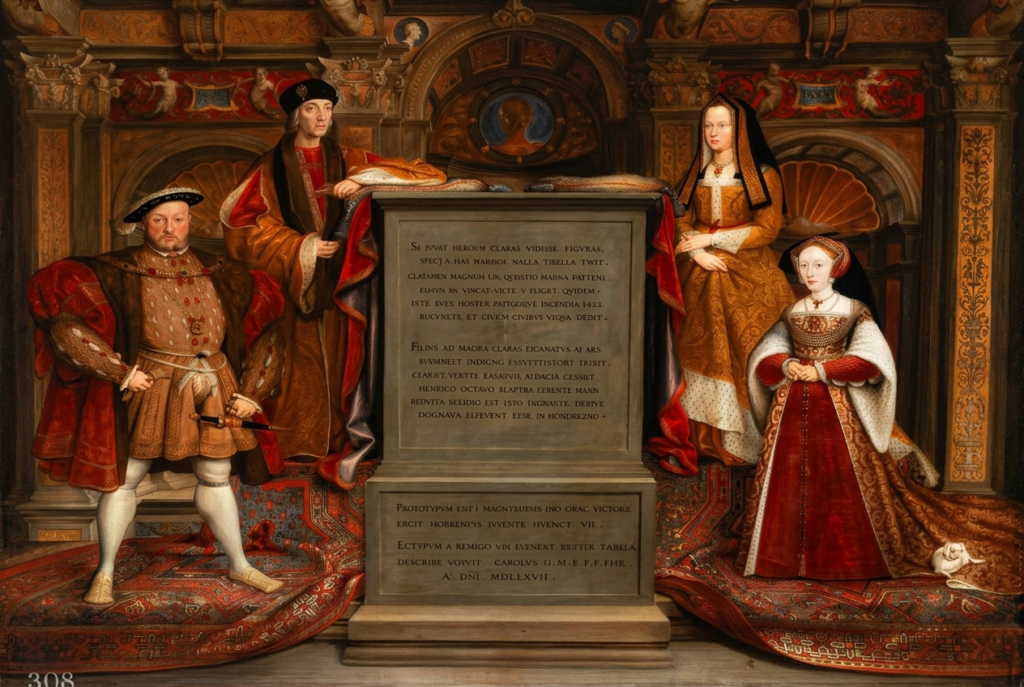
He also decorated royal palaces. His greatest lost work was the enormous dynastic mural at Whitehall Palace showing Henry with Jane Seymour and his parents. The palace burned in 1698, but copies preserve the terrifyingly confident Henry.
Then came Anne of Cleves. In 1539, Holbein was sent to paint Anne so Henry could evaluate her as a prospective wife. Cromwell strongly supported the match, and Henry agreed.
When Anne arrived in England, the king was decidedly unimpressed. Henry later complained bitterly about her appearance and quickly sought to escape the marriage.
Cromwell paid dearly for the disaster. Holbein, interestingly, did not.

Perhaps that tells us something. Henry may have disliked the bride, but apparently he still trusted the painter. Or perhaps it was his love of great art?
I hope you’ve enjoyed may guide to the most fascinating Tudor figures. You may enjoy this either English history guides:
- Royal Whodunits
- English myths
- History of Medieval and Tudor England
- Tudor queens of England
- Power Women of Medieval & Tudor England
- Historical Mistresses and Favorites
- Wives of Henry VIII
- Worst kings of England
- Anglo-Saxon kings of England
Pin it for later.