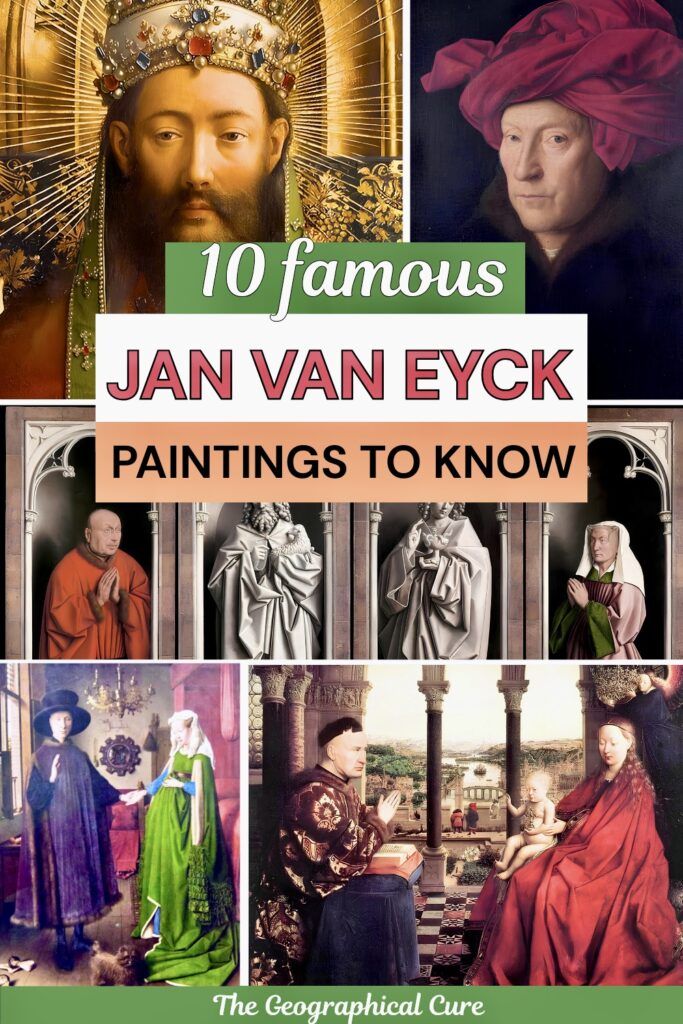
The painter created illusions that seem more real than reality.
God is in the details, they say. But some art is so jam-packed with details, each hair so fine, each jewel so luminous, each fold of fabric so painstakingly rendered, that it seems to surpass the divine.
Nearly six centuries ago, Jan van Eyck was that painter. He didn’t invent oil painting, but he transformed what it could do.
Layer by translucent layer, he achieved a level of realism that astonished his contemporaries and still leaves viewers slack-jawed today.
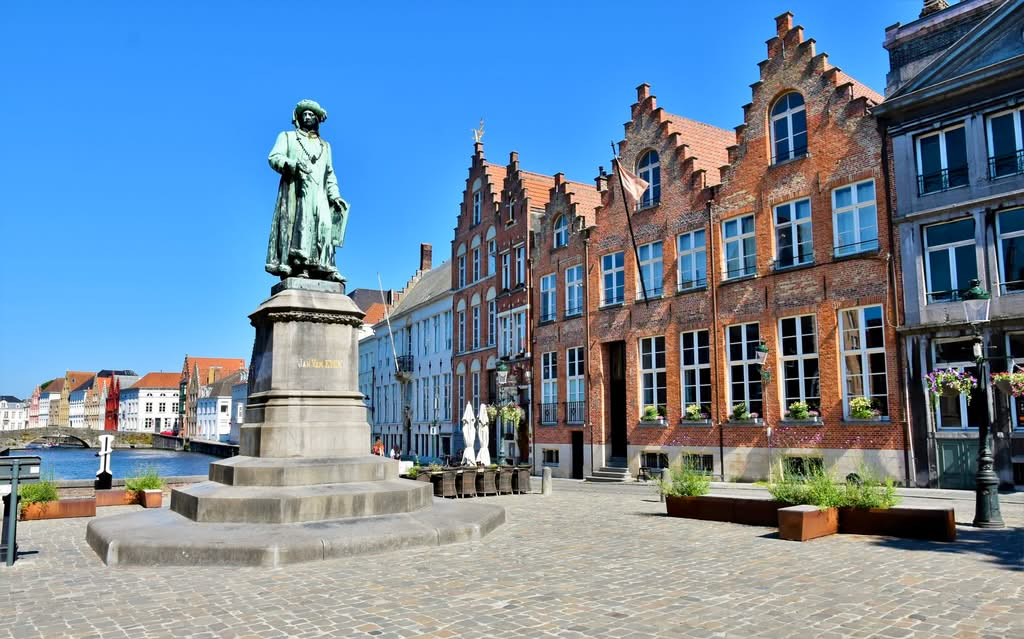
If Leonardo perfected sfumato and Michelangelo redefined sculpture, Van Eyck changed the way painters captured reality.
His revolutionary command of light, texture, and reflection influenced generations of artists across Europe. Many art historians consider him the greatest painter of all time.
Van Eyck’s paintings reward slow looking. His motto, Als Ich Can (“As Best I Can”), wasn’t false modesty. It was a declaration of artistic ambition.
Here are the Van Eyck masterpieces every art lover should see. You won’t need to be persuaded of his genius.

Mini Biography of Van Eyck
Van van Eyck was probably born around 1390 in what is now eastern Belgium. He spent the most important years of his career in Bruges, where he lived and worked until his death in 1441.
Like many medieval artists, Van Eyck’s early life is largely a mystery.
The surviving records tell us almost nothing about his childhood or family, suggesting he wasn’t born into wealth or prominence. Instead, he appears to have risen through sheer talent.
The first documented reference to him comes in the 1420s, when financial records mention payments to “Master Jan the Painter.” By then, he was already an established artist.
It’s also unclear where Van Eyck trained. Whether he apprenticed with another master or was largely self-taught remains unknown. Some speculate that the artists started out as a manuscript illuminator.
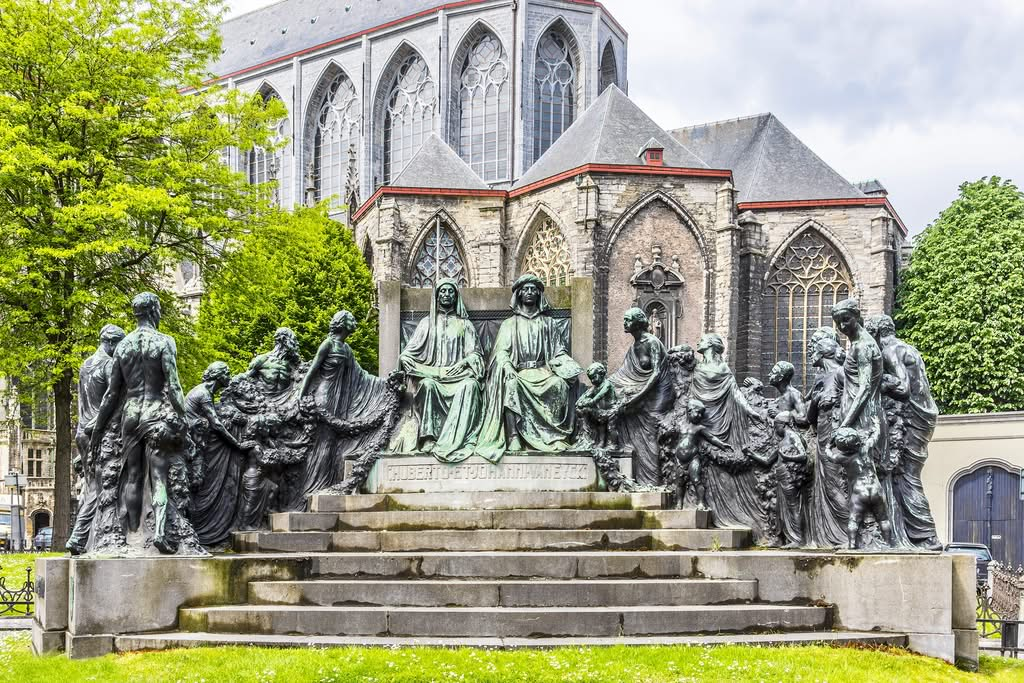
He was clearly well educated, however. Latin, Greek, and Hebrew inscriptions appear in several of his paintings, reflecting an unusually sophisticated intellect and helping art historians authenticate his work.
In the early 15th century, Van Eyck entered the service of Philip the Good, Duke of Burgundy, one of Europe’s wealthiest and most powerful rulers. As court painter and diplomat, he enjoyed prestige, financial security, and access to elite patrons.
Van Eyck rejected the flat, stylized conventions of medieval painting. Instead, he pursued an unprecedented level of realism, using oil paint to capture light, texture, reflections, and minute details with astonishing precision. His work helped usher in the Northern Renaissance and changed the course of Western art.
Van Eyck died in his 50s, leaving many of his masterpieces unfinished. Assistants and apprentices completed many of them and they continued to fetch extraordinarily high prices.
Despite his enormous influence, only about 22 securely attributed paintings by Van Eyck survive today, making each one an extraordinary treasure.

Van Eyck’s Most Important Works
Ghent Altarpiece
📍St. Bavo’s Cathedral, Ghent Belgium
The Ghent Altarpiece is Van Eyck’s most revered work. It’s the gateway drug to the era of Flemish Primitives.
It’s in situ at St. Bavo’s Cathedral in Ghent. Seeing it that way makes a difference too. You’ll start to see the craft and intellect behind it.
The altarpiece is one of the first oil paintings in the world and the first to show unidealized realism as opposed to stiff medieval images.

The work is monumental, situated in its own chapel. The central scene is full of religious symbolism, with a white lamb on an altar in the center.
The level of detail is astonishing. There are dozens of lush plant species, flowers, and birds.
God presides in the upper panels, raising a hand in a solemn blessing. The outermost panels depict Adam and Eve, and may be the first nudes in Northern Europe.
Don’t forget to walk around the back. There are panels in grisaille, with donors and sacred figures.
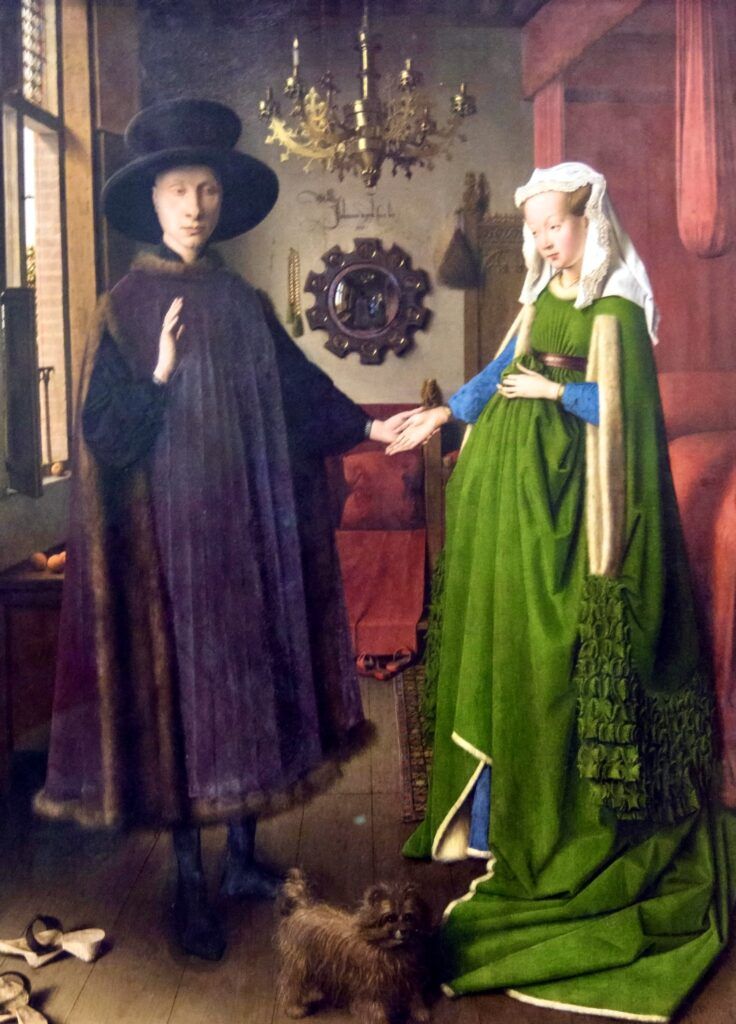
The Arnolfini Portrait
📍National Gallery of Art, London UK
Coming in at second place is the Arnolfini Portrait, one of the most celebrated paintings of the Northern Renaissance. Painted in 1434, it transformed what portraiture could be, combining intense realism with layers of symbolism that scholars still debate today.
The painting depicts an elegantly dressed couple standing in a luxurious Bruges home. They’re often identified as the Italian merchant Giovanni Arnolfini and his wife, though even their identities remain uncertain.
Van Eyck’s technical virtuosity is on full display. Every surface is rendered with extraordinary precision, from the shimmering brass chandelier and polished oranges to the luxurious fur trim and folds of emerald-green fabric.
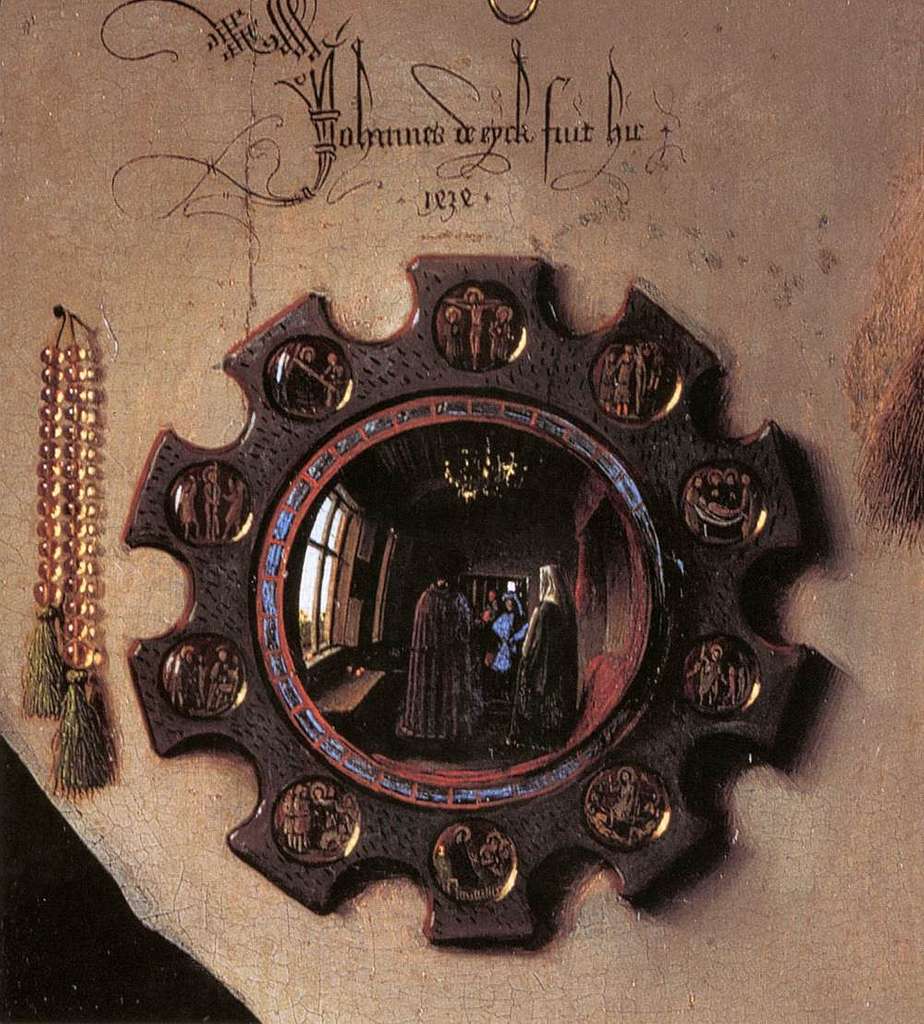
The tiny convex mirror at the back of the room, reflecting two additional figures, is one of the marvels of Renaissance painting.
Yet the painting is as mysterious as it is beautiful. Are the couple exchanging wedding vows, commemorating a marriage, or participating in some other legal or religious ceremony?
No one knows for certain. The objects scattered throughout the room, including the little dog, the single burning candle, and the discarded shoes, have inspired centuries of competing interpretations.
The more you study the painting, the stranger it becomes. Its quiet atmosphere and carefully staged composition hint that Van Eyck was creating something far more complex than a simple double portrait.
>>> Click here to book a guided tour of the National Gallery

Madonna with Canon Joris van der Paele
📍Groeninge Museum, Bruges Belgium
Many art historians consider Madonna with Canon Joris van der Paele to be Van Eyck’s greatest achievement after the Ghent Altarpiece. Completed in 1436, it’s one of the most dazzling demonstrations of his technical brilliance.
The Virgin Mary sits enthroned in a sumptuous red robe with the Christ Child on her lap. Beside them stand St. Donatian and St. George, who presents the kneeling Canon Joris van der Paele to the Virgin.
What makes the painting extraordinary is its naturalism. Van Eyck renders every surface with uncanny precision, from polished armor and gleaming jewels to embroidered vestments and weathered skin. Even the reflections in St. George’s armor reveal the artist’s fascination with light and optics.
Rather than presenting an idealized vision of heaven, Van Eyck grounds the sacred scene in a tangible world that feels completely believable. It’s a wonderful blend of meticulous observation and spiritual grandeur.
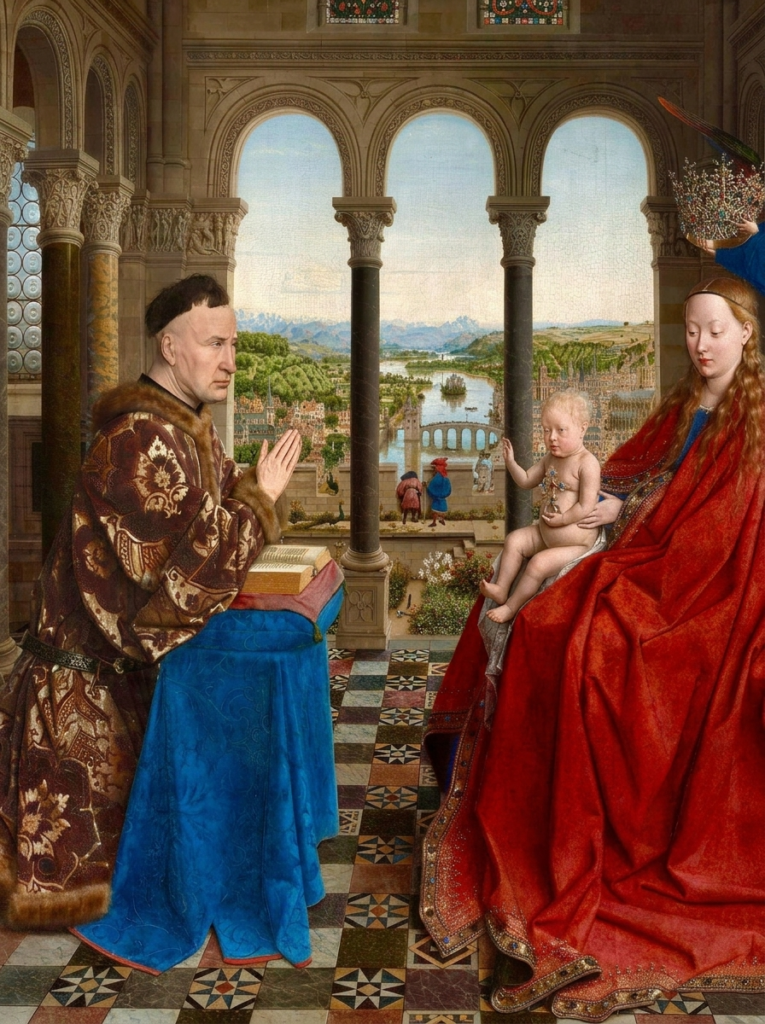
Madonna with Chancellor Rolin
📍Louvre, Paris France
This painting is very similar in concept and composition to the one just above. The Virgin is enthroned in the center with the Christ Child. A wealthy patron kneels nearby. And there’s an elaborate architectural setting.
However, there are some important differences.
In this painting, Rolin faces the Virgin more directly across a small space, almost as though he’s admitted to a heavenly court.
Behind them, you’ll see one of the artist’s most accomplished landscapes with a river, bridges, gardens, and a distant city. You can even see tiny figures on the bridge.
The mood is different here too. The Rolin madonna feels more expansive and political, befitting a powerful man in Burgundy.
>>> Click here to book a Louvre ticket
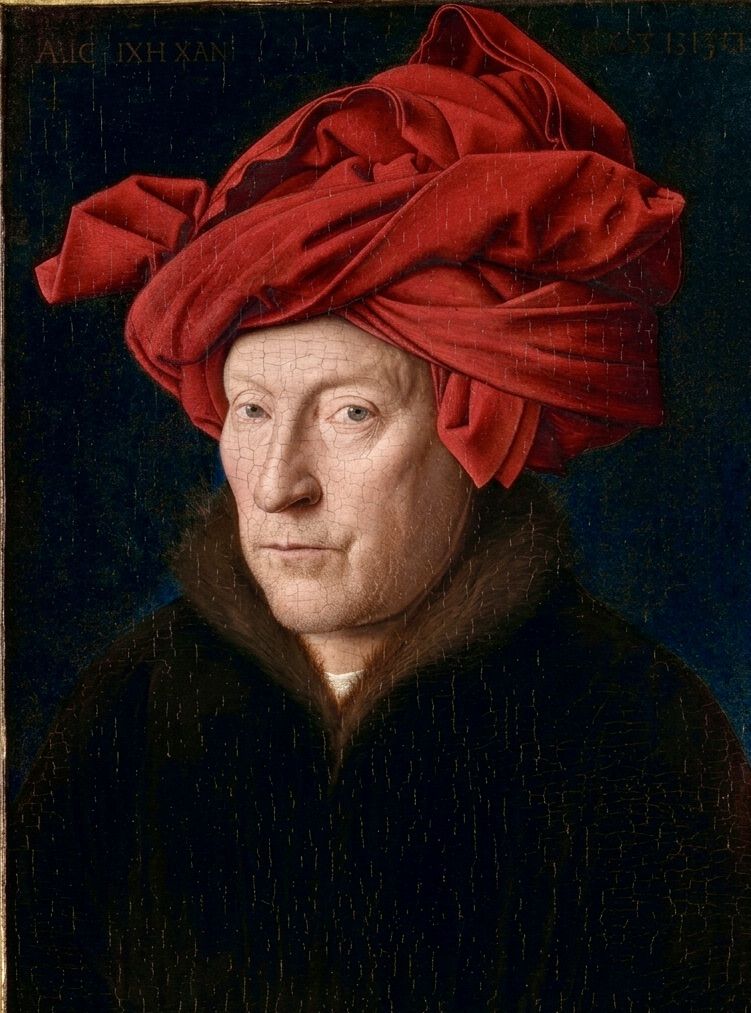
Portrait of a Man in a Red Turban
📍National Gallery, London UK
Art historians believe that this man with an impassive face is the artist’s self-portrait. It’s a small oil on oak painting completed in 1433.
The painting depicts a prosperous individual, clad in a startling red hat. It’s called a chaperon, a man’s headdress popular in the 15th century.
The portrait has the dark shadows and bright highlights typical of Van Eyck. And, like all his work, it’s very lifelike.
The paintings has two inscriptions. Across the top of the original frame, in Greek letters, is: “Als Ich Can” This translates roughly as “As Best I Can.” It’s a pun on his name.
Along the bottom of the frame is the Latin inscription “Johannes de Eyck me fecit Anno MCCCC.33. 21. Octobris.” This translates to “Jan van Eyck made me on October 21, 1433.”

Portrait of Margaret van Eyck
📍Groeninge Museum, Buges Belgium
Van Eyck painted this striking portrait of his wife, Margareta, in 1439, six years after their marriage. The couple had two children, and after the artist’s death, Margareta is believed to have managed his workshop and estate.
Dressed in a luxurious red gown trimmed with fur, she gazes directly at the viewer with a calm, self-assured expression. Her tightly pinned hairstyle may look unusual today, but it reflected the height of Burgundian fashion.
The portrait is remarkable for its psychological presence. Van Eyck doesn’t flatter or idealize his wife. Instead, he captures her as an individual, complete with subtle signs of age and character.
That’s what makes the painting so important. At a time when portraits were largely reserved for royalty, saints, and the highest nobility, Van Eyck treated an ordinary woman with the same care, dignity, and realism.
The result is one of the earliest and most compelling individual portraits of the Northern Renaissance.
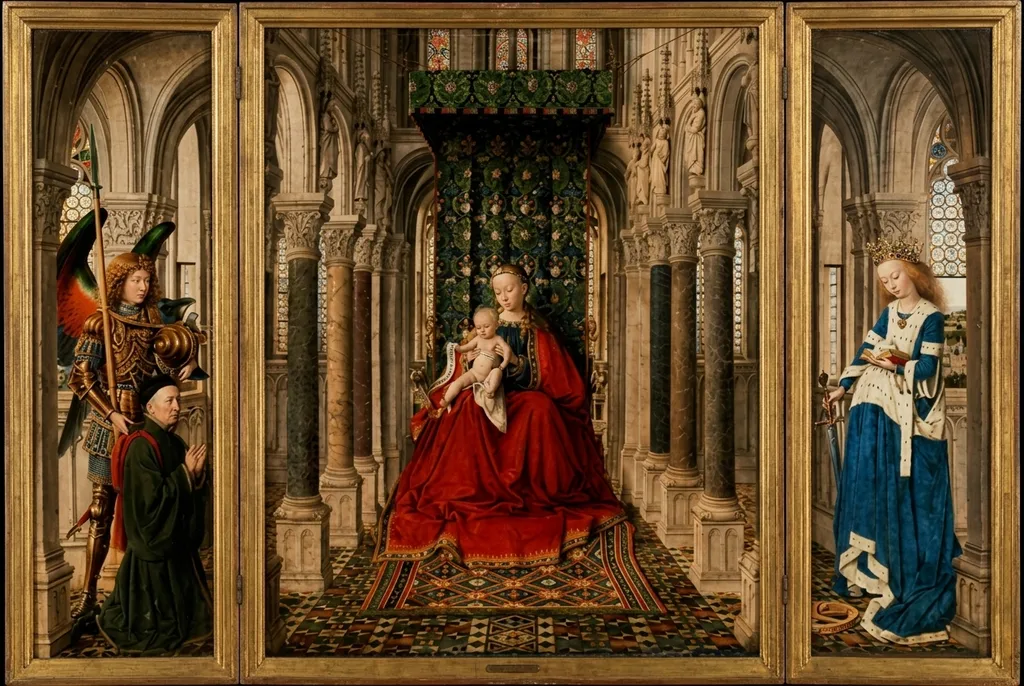
The Dresden Triptych
📍Gemaldegalerie Alte Meister, Dresden Germany
This tiny jewel of a painting is a late Van Eyck. Despite that, it has microscopic details that reward close looking.
The central panel shows the Virgin and Child enthroned in a Gothic interior. It’s odd though, Mary seems outsize for the space. Perhaps that’s intended to blur the line between architecture and theology.
As always, the surface shimmers with polish marble, gilded capitals, and embroidered textiles.
There are two side panels, completing the triptych and set in its original gilded frame. On the front side, they show St. Catherine and St. Michael. The reverse sides depict an annunciation scene in grisaille.
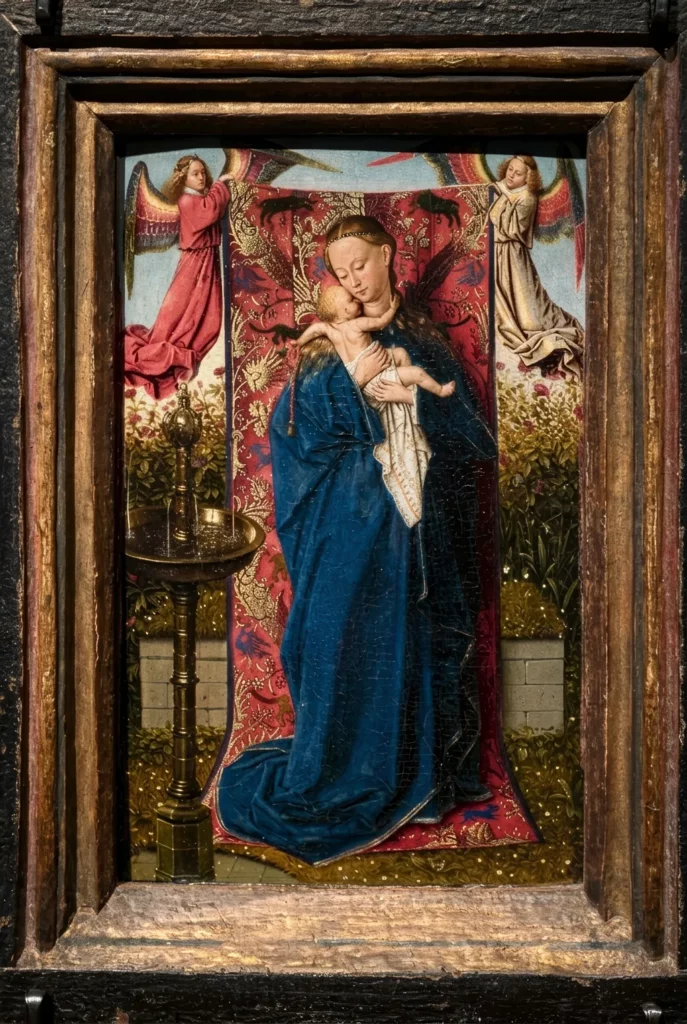
Madonna at the Fountain
Madonna at the Fountain is a beautifully intimate work. It’s tiny too, only 7.5 by 5 inches. And it’s one of Van Eyck’s last securely attributed works.
Van Eyck places Mary in a rose garden dressed in a beautifully draped sumptuous blue robe. The closed-off garden could be an allegory for the love and union between Christ and the church or symbolize the doctrine of Mary’s perpetual virginity.
She stands against an ornate red brocaded cloth held by angels with rainbow wings. To her right is a glistening bronze fountain, symbolizing the Virgin as the “Fountain of Life.”
If you look closely, you’ll see that every flower, jewel, and blade of grass is painted with Van Eyck’s trademark microscopic precision.
>>> Click here to book a Frick ticket
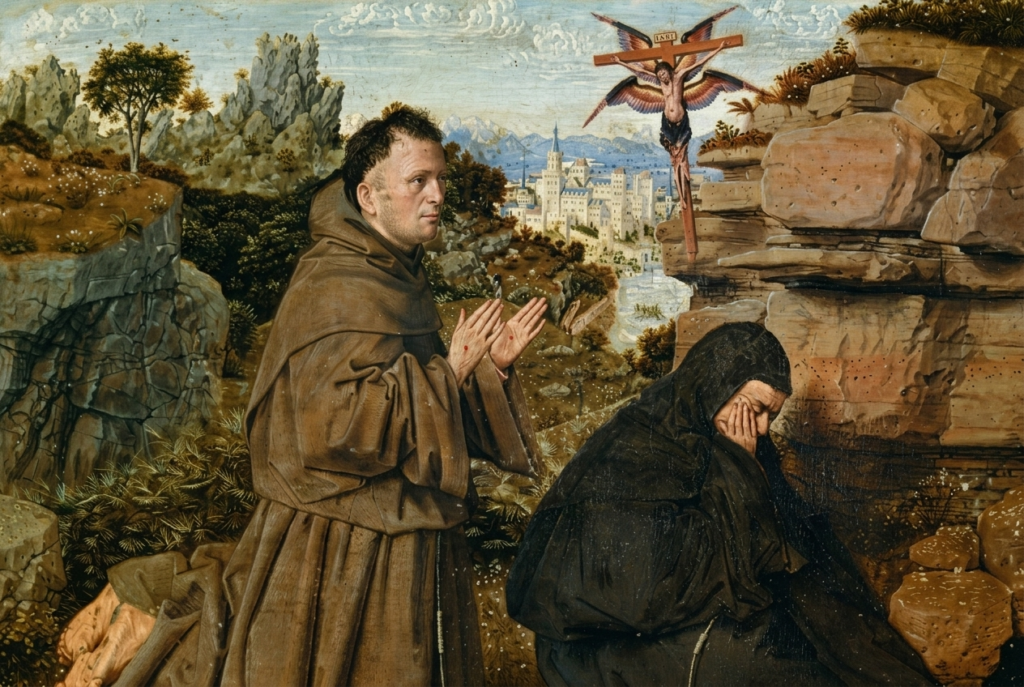
Saint Francis Receiving the Stigmata
At first glance, this Van Eyck painting looks like a conventional treatment of St. Francis. The saint is kneeling in prayer, the stigmata are shown, Brother Leo is nearby, and a rocky wilderness surrounds them.
But where Van Eyck distinguishes himself is how he paints the scene. His take on the subject is rendered with hyperrealism.
The landscape is convincing and seems to recede for miles. Every leaf, pebble, and tree are exquisitely painted. In essence, the supernatural unfolds in a landscape that feels completely real.
For a time, there was controversy about whether it was a genuine Van Eyck. Some scholars argue that Van Eyck’s workshop took a heavy hand in its creation.
I think you can see Van Eyck’s hand in the technical precision. Whether every brush stroke was his is another issue, that still sparks debate today.
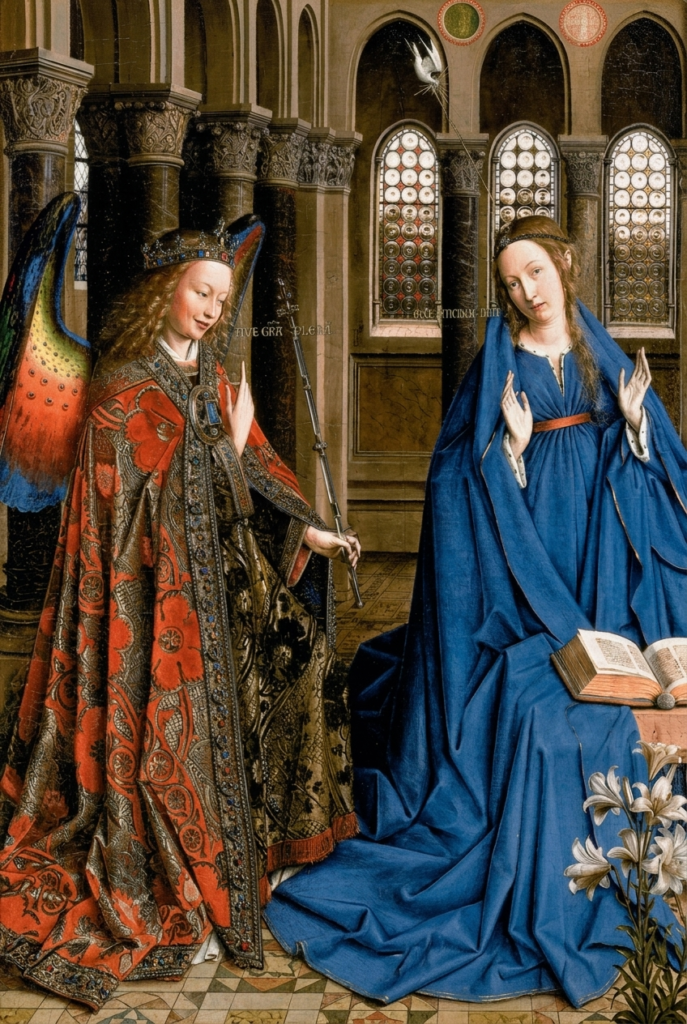
The Annunciation
📍National Gallery of Art, London UK
The Annunciation is one of Van Eyck’s finest surviving works. It’s a glorious explosion of dazzling detail, luminous color, and complex symbolism. It appears almost photographic.
It’s a classic annunciation scene where the archangel Gabriel comes, bearing a message, telling Mary she’s expecting. Light rays beam down from heaven, lighting the frame.
Mary is clad in her usual blue robes (a symbol of divinity), though the draping is beautiful rendered. She’s holding up her hands in an expression of surprise.
Gabriel has rainbow wings and is also in richly adorned robes with jewels. The look on his face struck me as a bit unusual at first. He almost looks mischievous. But the expression is more likely due to the fact that he knows something that Mary doesn’t.
Another interesting detail is that Gabriel appears to be speaking the words of the annunciation, which appear in Latin.
I hope you’ve enjoyed my guide to Van Eyck’s 10 most famous paintings. You may find these other Belgium travel guides useful:
- One week in Belgium itinerary
- Best things to do in Ghent
- One day Ghent itinerary
- Best things to do in Bruges
- 1 day in Bruges itinerary
- 2 days in Bruges itinerary
- 1 day in Brussels itinerary
- 2 days in Brussels itinerary
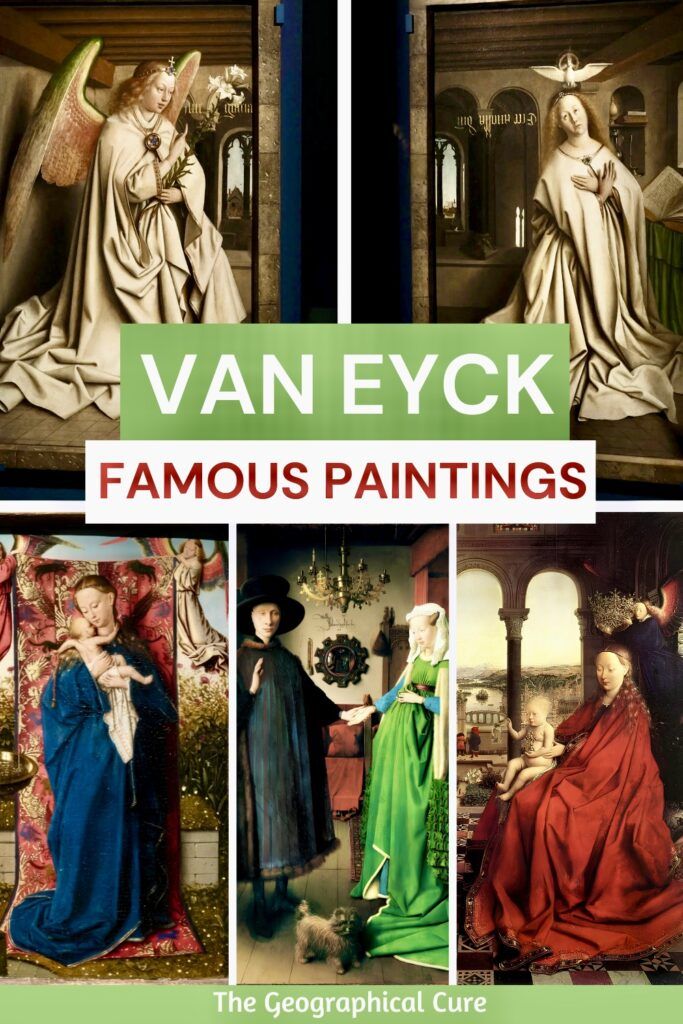
Pin it for later.