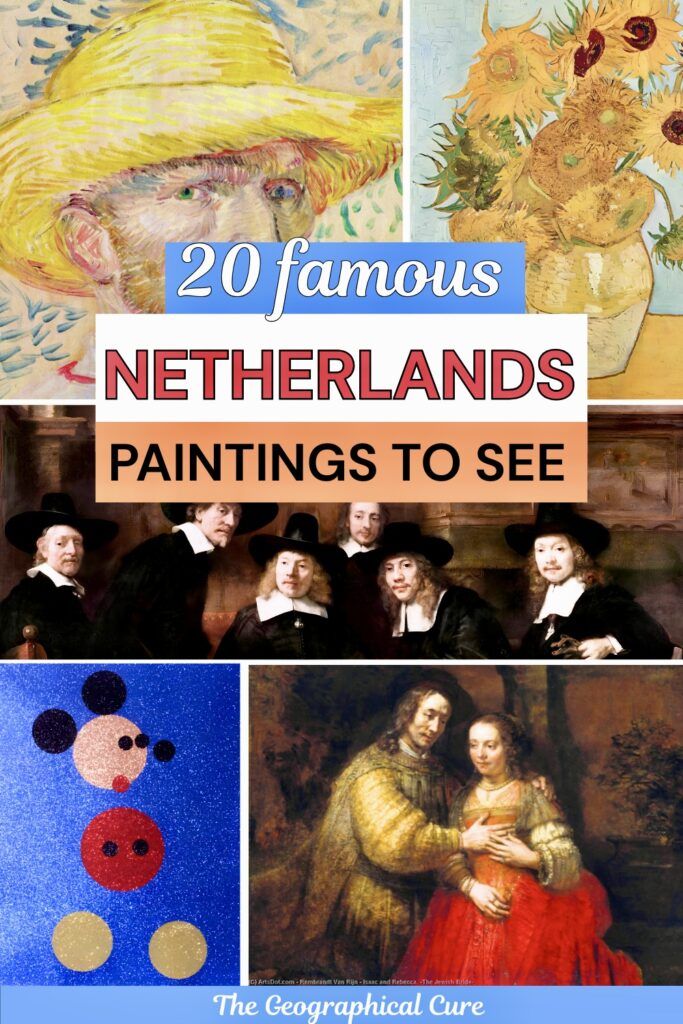
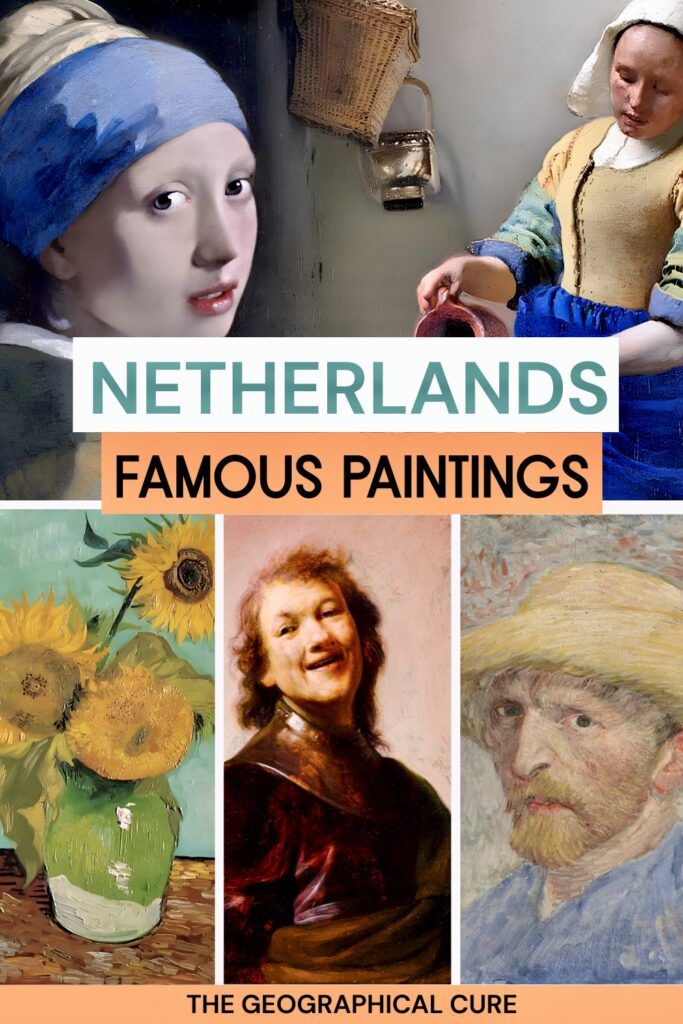
For art lovers, the Netherlands has it all. You’ll find something for every art geekery: a slew of Dutch old masters, a huge cache of Van Gogh paintings, and a thriving contemporary art scene.
It’s a winning combo of historical depth and absolute giants of art history. In fact, you’ll find the largest number of museum per mile anywhere in the world.
In this guide, I take you on a tour of the most important paintings in the Netherlands and tell you where to find them. If this doesn’t prompt you to travel there, I’m not sure what will!

Netherlands Art Bucket List
Van Gogh, Potato Eaters
The Potato Eaters is widely regarded as Van Gogh’s first great masterpiece and the most ambitious painting of his early career.
Painted during his years in the Dutch countryside, it reflects Van Gogh’s deep admiration for working class people. Around a rough wooden table, a peasant family gathers for a simple evening meal. Their supper consists of little more than a steaming dish of potatoes, illuminated by the dim glow of a single oil lamp.
On the right, one of the women pours chicory, an inexpensive coffee substitute commonly drunk by the poor. Every detail reinforces the family’s modest circumstances.
But Van Gogh wasn’t trying to evoke pity alone. He wanted viewers to recognize the dignity of honest labor. As he wrote to his brother Theo, these were people who had “earned their food honestly.”
The painting lacks the brilliant colors and expressive brushwork that would later make Van Gogh famous. Instead, he chose an earthy palette of browns, greens, and grays to match the harsh realities of peasant life.
I highly suggest booking tickets or guided tours for this museum at least a month in advance!

Van Gogh, The Bedroom
📍Van Gogh Museum, Amsterdam
While living in Arles, Van Gogh painted this intimate view of his bedroom in his famous Yellow House. It has since become one of the most recognizable interiors in Western art.
Van Gogh intended the painting to evoke peace and rest. The bold colors, simplified forms, and sturdy furniture were meant to convey a sense of calm after the intensity of daily life.
Ironically, many viewers experience just the opposite. The tilted floor, skewed perspective, and slightly off-kilter furniture create a subtle feeling of unease. The room seems to vibrate with nervous energy rather than tranquility.
The distorted perspective wasn’t a mistake. Van Gogh deliberately abandoned strict realism in favor of emotional expression, allowing the painting to communicate a mood rather than an exact likeness of the room.
Look closely at the wall on the right and you’ll spot framed portraits, including what is thought to be a self-portrait of the artist.

Van Gogh, Sunflowers
📍Van Gogh Museum, Amsterdam
Van Gogh’s Sunflowers have become one of the most recognizable images in Western art history. More than any other subject, they have come to symbolize the artist himself.
Between 1888 and 1889, Van Gogh painted a series of sunflower still lifes to decorate the Yellow House in Arles. The version in Amsterdam is the last of the five major canvases and one of the museum’s greatest treasures.
Van Gogh pushed the color yellow to its limits, creating a dazzling symphony of gold, ochre, and amber. Rather than carefully blending the paint, he built the flowers with thick, sculptural strokes that give the petals and seed heads an almost 3D quality.
He once wrote that he wanted the flowers to glow like “stained glass in a Gothic church.” Standing in front of the painting, it’s easy to see what he meant. The vibrant yellows seem to radiate light from within.
The flowers are anything but static. Some bloom proudly, others droop or wither, reminding us that beauty and decay exist side by side.

Van Gogh, Almond Blossoms
Almond Blossoms is one of Van Gogh’s most joyful paintings. He created it in 1890 as a gift for his brother Theo and sister-in-law Jo to celebrate the birth of their son, Vincent Willem.
The painting was deeply personal. Almond trees are among the first to flower at the end of winter, often blooming while the landscape is still cold and bare. For Van Gogh, they symbolized hope, renewal, and new beginnings, making them the perfect tribute to his infant nephew.
The gift proved especially meaningful. Vincent Willem would later establish the Van Gogh Foundation, ensuring that his uncle’s paintings were preserved for future generations.
The composition also reveals Van Gogh’s admiration for Japanese woodblock prints. Instead of placing the tree in a traditional landscape, he crops the branches dramatically against a brilliant blue sky. The flattened perspective, bold outlines, and asymmetrical composition all reflect the influence of Japanese art.
The result is one of Van Gogh’s most optimistic and lyrical paintings. Delicate white blossoms seem to float across the canvas, offering a quiet reminder that even after the darkest winter, spring eventually arrives.

Vermeer, Girl with the Pearl Earring
Often called the “Mona Lisa of the North,” Vermeer’s Girl with a Pearl Earring is the Mauritshuis’ undisputed masterpiece. It’s celebrated for its luminous light, quiet intimacy, and the young woman’s unforgettable gaze.
Dressed in a blue and gold turban and oversized pearl earring, she turns toward the viewer with an expression that’s both open and enigmatic. The dark background was originally a deep green curtain, which darkened over the centuries.
Despite its title, scholars believe the “pearl” is actually Venetian glass, an inexpensive imitation. And the sitter probably wasn’t a real person at all. Vermeer specialized in tronies, character studies that depicted idealized faces rather than portraits of identifiable individuals.
Like the Mona Lisa, the painting now draws crowds from around the world. Ironically, it wasn’t especially famous during Vermeer’s lifetime. Its global celebrity came much later, helped along by exhibitions, Tracy Chevalier’s bestselling novel, and the film adaptation starring Scarlett Johansson.
>>> Click here to book a Mauritshius ticket
Rembrandt, The Anatomy Lesson of Dr. Nicolaes Tulp
📍Mauritshuis, The Hague
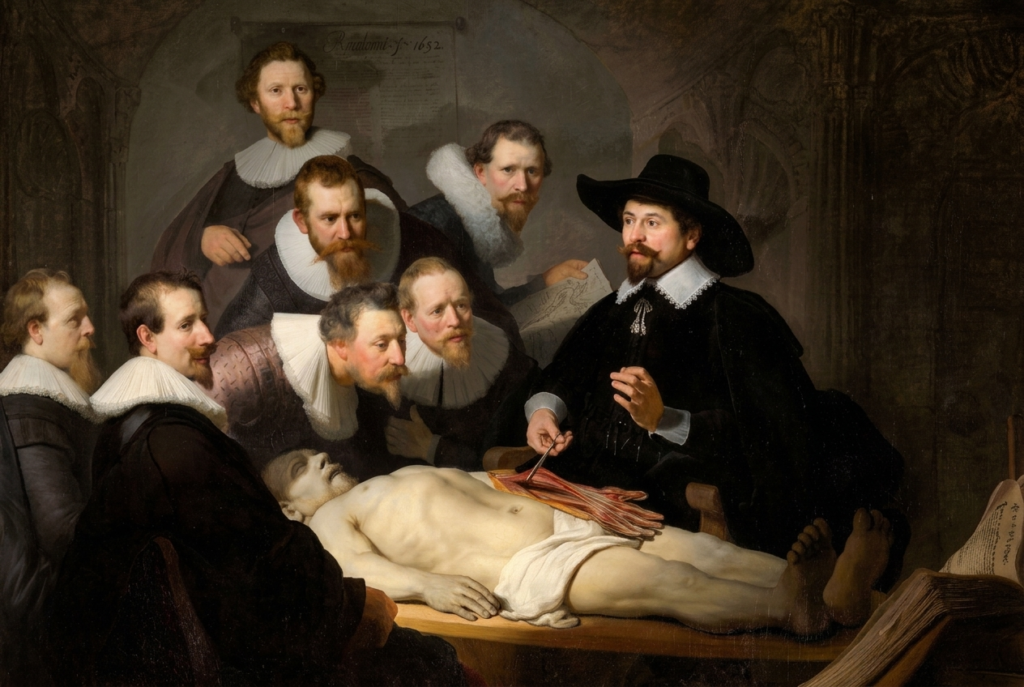
The Mauritshuis owns a whopping 11 paintings by Rembrandt. But The Anatomy Lesson of Dr. Nicolaes Tulp is undoubtedly the star. It’s one of the greatest group portraits ever painted. I actually prefer it to the more famous Night Watch in Amsterdam.
Painted when Rembrandt was just 26, it announced the arrival of a remarkable new talent. The commission launched his career in Amsterdam and established him as one of the Dutch Republic’s leading painters.
The scene depicts Dr. Nicolaes Tulp demonstrating the anatomy of a cadaver to fellow surgeons. Rather than arranging the figures in a stiff row, Rembrandt gives each man a distinct personality and reaction. Their expressions, gestures, and shifting gazes create the feeling that you’re witnessing a real event rather than a formal portrait.
Dramatic light falls across the faces and corpse, drawing your eye through the composition and heightening the sense of theater. It’s an extraordinary demonstration of Rembrandt’s early mastery of psychology, storytelling, and chiaroscuro.

Carel Fabritius, The Goldfinch
📍Mauritshuis, The Hague
The Goldfinch is one of the Mauritshuis’ greatest treasures. Although admired by art historians for centuries, the tiny painting became a cultural phenomenon after inspiring The Goldfinch by Donna Tartt.
Carel Fabritius was Rembrandt’s most gifted pupil and an important influence on Vermeer, making him a crucial bridge between the two masters.
Tragically, he was killed in the Delft gunpowder explosion of 1654, which destroyed much of his work. Only about a dozen paintings survive.
At first glance, The Goldfinch seems almost disarmingly simple: a chained pet bird perched against a plain wall. But its extraordinary realism, delicate lighting, and convincing illusion of depth make it one of the finest examples of trompe l’oeil painting.
Fabritius abandoned Rembrandt’s dramatic darkness in favor of luminous light and open space, pointing the way toward the style that Vermeer would later perfect.

Rembrandt, The Night Watch
The Night Watch is the Rijksmuseum’s greatest treasure and one of the most famous paintings in the world.
Rather than arranging his sitters in set tableaux, Rembrandt depicts an Amsterdam civic militia springing into action. The bustling composition feels almost cinematic, with figures talking, marching, loading weapons, and looking in different directions.
Rembrandt even slipped himself into the scene. Look to the left and you’ll spot the artist peering over a shoulder. The brilliantly illuminated young girl is thought to bear the features of his wife, Saskia.
The painting you see today isn’t quite the original. In 1715, it was trimmed on all four sides to fit a new location, cutting away about 20 percent of the composition, including two full figures. Fortunately, the Rijksmuseum has created a digital reconstruction showing how the masterpiece originally appeared.
The Night Watch is currently undergoing one of the most ambitious restorations in history. Even if conservators are at work during your visit, it’s fascinating to watch the process unfold.
You won’t be able to visit the Rijksmuseum without pre-booking a timed entry ticket or guided tour.

Rembrandt, The Jewish Bride
📍Rijskmuseum, Amsterdam
The Jewish Bride was my favorite painting in the Rijksmuseum. I’m in good company. Van Gogh admired it so much that he reportedly said he would gladly give ten years of his life to spend two weeks sitting in front of it.
Long believed to portray a Jewish father and daughter, the painting is now generally thought to depict the biblical couple Isaac and Rebecca. Rembrandt painted it about 20 years after The Night Watch, near the end of his career.
By then, his fortunes had changed dramatically. He had declared bankruptcy and fallen out of fashion. But his artistic powers had only deepened.
Gone is the meticulous finish of his early work. Instead, Rembrandt used rich colors and thick impasto, building up the shimmering gold embroidery, crimson fabric, and luminous pearls with almost sculptural strokes.
The painting’s emotional heart lies in the couple’s restrained tenderness. The man’s hand rests gently over the woman’s heart, a quiet gesture of love, trust, and devotion. There’s no theatrical drama here, just a deeply human intimacy that makes the painting unforgettable.

Vermeer, The Milkmaid
📍Rijskmuseum, Amsterdam
The Milkmaid is one of Vermeer’s most beloved paintings. Despite its modest size, it’s one of the great masterpieces of the Dutch Golden Age.
The scene is wonderfully ordinary. A young maid quietly pours milk into a bowl, completely absorbed in her task. Nothing dramatic happens, yet Vermeer transforms the everyday into something almost monumental.
His mastery of light is on full display. Sunlight streams through the window, illuminating the rough bread, earthenware jug, and blue apron with astonishing realism. Every surface seems tangible.
In the 17th century, milkmaids often carried flirtatious or even scandalous associations in Dutch art. Vermeer turns that convention on its head, portraying his subject as dignified, hardworking, and quietly self-possessed.
Look closely at the Delft tiles near the floor and you’ll spot Cupid. It’s a subtle reminder of romance, but the maid pays him no mind. Her attention remains fixed on her work, making the painting as much a tribute to quiet industry as domestic life.

Vermeer, The Love Letter
📍Rijskmuseum, Amsterdam
The Love Letter is one of Vermeer’s most intriguing paintings. Rather than placing you directly in the room, he invites you to peek into a private scene from a shadowy hallway, creating the feeling that you’ve stumbled upon an intimate moment.
An elegantly dressed woman has just received a letter from her maid. Her expression suggests anticipation, while the objects scattered around the room quietly reveal its meaning.
The lute points to romance, the abandoned slippers hint at a clandestine affair, and the broom suggests everyday domestic life unfolding just beyond the lovers’ world.
Even the paintings hanging on the back wall contribute to the story. One depicts a ship at sea, perhaps symbolizing an absent lover, while another shows a lone traveler walking into the distance.
Vermeer never tells us exactly what’s in the letter. Instead, he lets light, composition, and carefully chosen symbols create a scene filled with longing, mystery, and quiet emotional tension.

Vermeer, Woman Reading a Letter
📍Rijskmuseum, Amsterdam
Woman Reading a Letter is another of Vermeer’s deceptively simple masterpieces. It captures an ordinary moment so beautifully that it feels almost timeless. It was also the first Vermeer acquired by the Rijksmuseum.
A young woman stands quietly reading a letter, completely absorbed in its contents. Sunlight pours through the window, illuminating her brilliant blue jacket, whose rich lapis lazuli pigment immediately draws the eye.
Like many of Vermeer’s paintings, the work is filled with subtle clues. The large map on the wall hints at travel or an absent lover, leading many scholars to believe she’s reading a love letter.
Her plain dress and lack of jewelry suggest sincerity rather than wealth, while the rumpled cloth on the table makes the scene feel wonderfully spontaneous, as though we’ve interrupted a deeply private moment.

Jan Steen, The Merry Family
📍Rijskmuseum, Amsterdam
Jan Steen was the great comic storyteller of the Dutch Golden Age. Instead of solemn history paintings, he specialized in rowdy scenes of everyday life, filled with jokes, bad behavior, and sharp social commentary.
The Merry Family is Steen at his best. The room is bursting with noise and disorder. Parents drink, children run wild, music plays, and even the toddler seems to be offered wine.
It’s funny, but not innocent. Steen is poking fun at a household where discipline has collapsed and everyone is happily ignoring the strict Calvinist morals of the day.
Beneath the chaos lies the warning: as the parents behave, so will the children. But Steen delivers the lesson with such warmth and comic timing that the scolding goes down easily.
Frans Hals, The Banquet of the Officer of the St. George Civic Guard, 1616
📍Frans Hals Museum, Haarlem
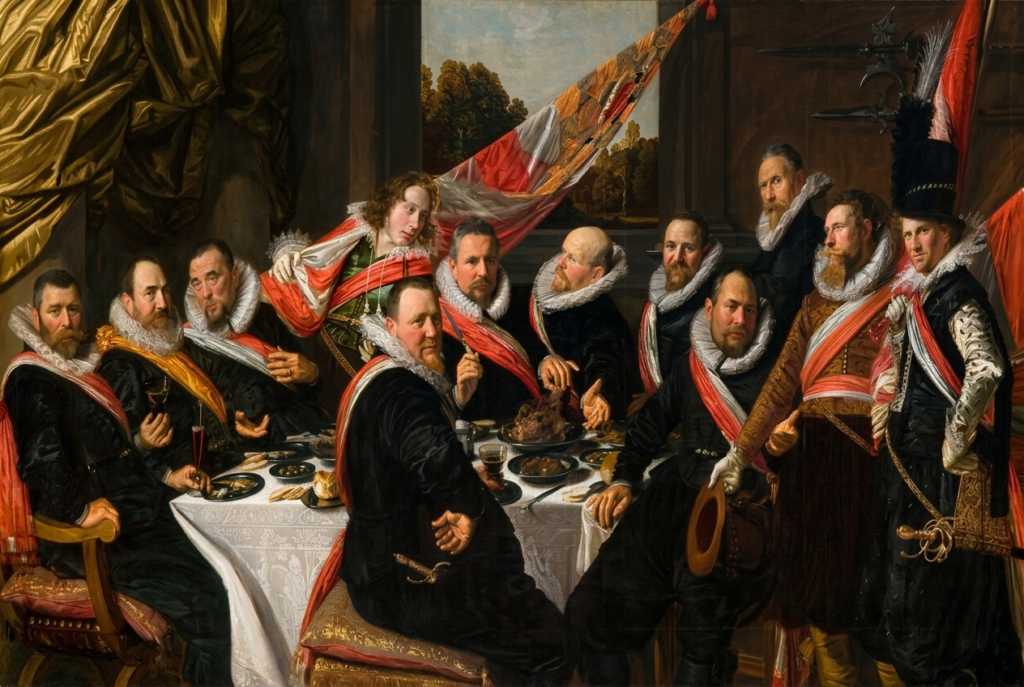
The undisputed stars of the Frans Hals Museum are the artist’s monumental civic guard portraits. This 1616 masterpiece is the most celebrated of them all.
Hals was only in his early 30s when he painted it. And it immediately established him as Haarlem’s leading portraitist.
Instead of arranging the guards in stiff, formal rows, Hals captures them as though they’ve paused in the middle of a lively banquet. They chat, gesture, laugh, and turn toward one another, creating an extraordinary sense of spontaneity.
Every face has its own personality, every pose feels natural. The brilliant orange sashes, fluttering flags, and gleaming armor inject the scene with remarkable energy.
It was a revolutionary approach to group portraiture, one that helped redefine the genre and influenced generations of Dutch painters, including Rembrandt.
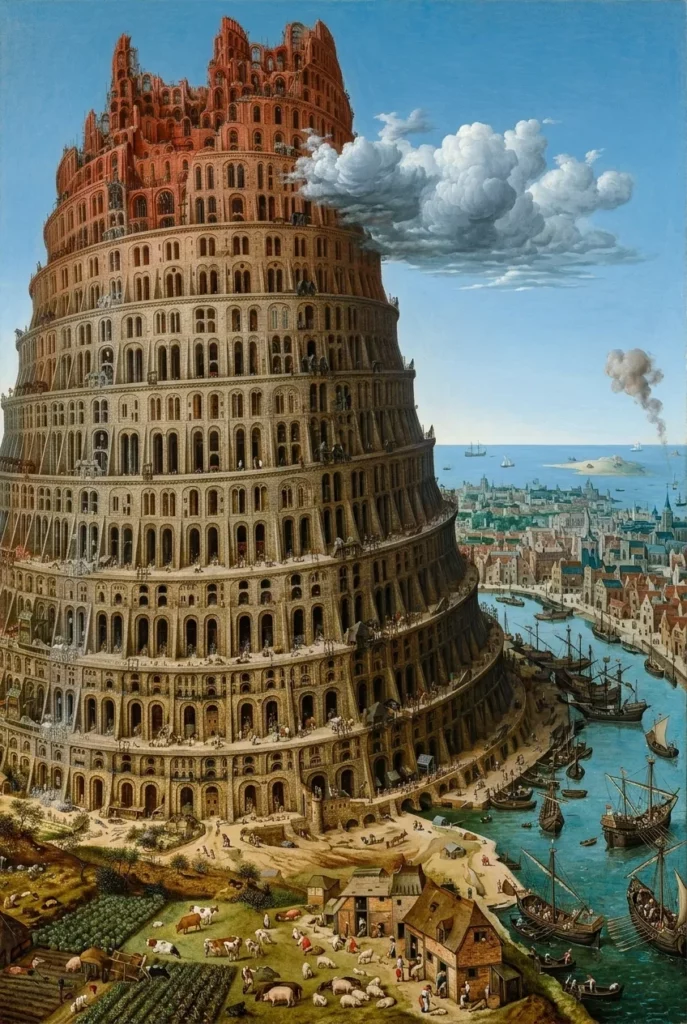
Pieter Bruegel the Elder, The Tower of Babel
📍Museum Boijmans Van Beuningen, Rotterdam
Pieter Bruegel the Elder is celebrated for his richly detailed paintings, which blend keen observation, humor, and social commentary. His bustling scenes are filled with hundreds of tiny figures, rewarding close inspection with new discoveries at every turn.
The Tower of Babel is one of his greatest masterpieces and a highlight of the Museum Boijmans Van Beuningen collection in Rotterdam.
Inspired by the Old Testament, the painting depicts humanity’s ambitious attempt to build a tower that reaches heaven. Bruegel based the massive structure on Rome’s Colosseum, giving the biblical story a setting his contemporaries would have recognized.
At first glance, the construction appears to be progressing at a furious pace. But look closer and cracks begin to emerge.
The tower’s uneven foundations, mismatched arches, and impossible engineering suggest it’s doomed long before God intervenes. Bruegel turns the story into a timeless meditation on pride, ambition, and the limits of human achievement.

Barnett Newman, Cathedra
📍Stedelijk Museum, Amsterdam
Barnett Newman transformed Abstract Expressionism by reducing painting to its essentials. Rather than depicting recognizable subjects, he relied on vast expanses of color interrupted by thin vertical bands he called “zips.”
Newman believed color could communicate directly with the viewer, bypassing intellect in favor of an emotional or even spiritual response. His monumental canvases aren’t meant to be analyzed so much as experienced.
Cathedra is one of the finest examples of his mature style and among the Stedelijk Museum’s most important postwar acquisitions. The immense blue canvas is interrupted by a single pale blue zip near the right edge, creating a subtle tension between stillness and movement.
Standing in front of it, you’re enveloped by color. The painting doesn’t tell a story or depict an object. Instead, it invites quiet contemplation, much like the soaring interior of the cathedral that inspired its title.

Yayoi Kusama, Thousand Boats Show
📍Stedelijk Museum, Amsterdam
Before she became one of the world’s most celebrated contemporary artists, Yayoi Kusama struggled to gain recognition in the fiercely competitive New York art scene of the 1960s. Her groundbreaking ideas were often dismissed or “borrowed” by better known male artists.
Thousand Boats Show was Kusama’s first room sized installation and marked a turning point in her career. At its center sits a simple white rowboat completely covered with the soft, stuffed forms that became one of her signature motifs.
The surrounding walls are papered with repeated black-and-white photographs of the same boat, creating an almost hypnotic sense of endless repetition. A pair of white high heels rests inside the boat, adding another layer of mystery and unease.
Like much of Kusama’s work, the installation grew out of her psychological obsessions and recurring hallucinations. The repeated forms and immersive setting blur the line between reality and imagination, inviting viewers into the artist’s intensely personal world.
First exhibited in New York in 1963, the installation later appeared in the influential Nul exhibition at the Stedelijk Museum in 1965. Kusama subsequently donated the work to the museum, where it remains one of its most important contemporary masterpieces.

Charley Toorop, Working Class Woman
📍Stedelijk Museum, Amsterdam
Charley Toorop was one of the Netherlands’ most formidable modern painters, forging a successful career in a field overwhelmingly dominated by men. Her uncompromising style and psychological intensity made her one of the country’s most distinctive artistic voices.
Painted in 1943 during the German occupation, Working Class Woman is one of the Stedelijk Museum’s standout masterpieces. The woman’s unwavering gaze immediately commands attention, conveying quiet determination rather than despair.
Behind her lie the shattered ruins of Rotterdam, a reference to the devastating German bombing of the city in 1940. The contrast between the destruction and the sitter’s resolute presence transforms her into a symbol of endurance.
More than a portrait, the painting is a tribute to ordinary people who carried on through extraordinary hardship. It’s both deeply moving and unmistakably political, capturing the resilience of the Dutch people during one of the darkest chapters in their history.
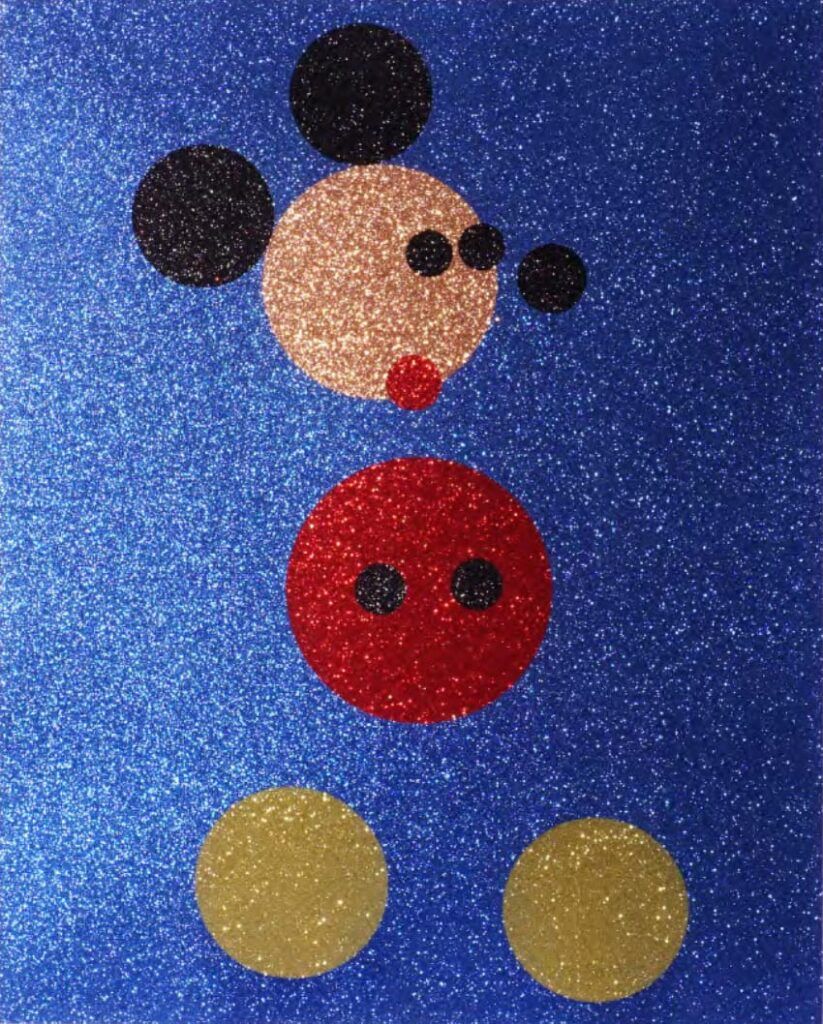
Damien Hirst, Diamond Dust Mickey
Damien Hirst is one of Britain’s most famous and controversial contemporary artists. Throughout his career, he’s built his reputation on spectacle, provocation, and a knack for turning familiar objects into luxury commodities.
At the MOCO Museum, you’ll find his Diamond Dust Mickey displayed prominently in the first floor foyer. Hirst reduces one of the world’s most recognizable cartoon characters to a simplified arrangement of circles and geometric forms, transforming Mickey into both an icon and a brand.
The surface is coated with glittering diamond dust, giving the work a seductive, jewel-like sparkle. From a distance it feels playful and glamorous. Up close, it’s cool, polished, and oddly impersonal.
Like much of Hirst’s work, the piece invites conflicting reactions. Is it a celebration of pop culture, a critique of consumerism, or simply an expensive cartoon?
Hirst deliberately refuses to answer, leaving viewers to decide whether they’re looking at a profound meditation on celebrity and commerce or a brilliantly marketed joke.
>>> Click here to pre-book a Moco ticket

Banksy, Love Is in the Air
📍MOCO, Amsterdam
Love Is in the Air (also known as Flower Thrower) is one of Banksy’s most iconic images. A masked protester winds up to throw what appears to be a Molotov cocktail. But instead of a weapon, he’s clutching a colorful bouquet of flowers.
The substitution completely changes the meaning of the scene. Banksy transforms an act of violence into one of hope, suggesting that ideas, compassion, and beauty can be more powerful than destruction.
The contrast is striking. The figure is rendered in stark black and white, while the flowers explode with vibrant color. Your eye goes straight to them, reinforcing the painting’s optimistic message.
Of course, this isn’t a sentimental plea for everyone to simply “get along.” The protester is still angry, still resisting, still prepared to fight.
Banksy just changes the weapon. The result is both rebellious and deeply human, a giant middle finger to oppression, injustice, and anyone who believes violence is the only way to be heard.
I hope you’ve enjoyed my guide to the most famous paintings in Amsterdam. You may find these other Netherlands travel guides useful:
- Tips for visiting the Netherlands
- One week Netherlands itinerary
- One day in Amsterdam itinerary
- 2 days in Amsterdam itinerary
- One day in Rotterdam itinerary
- One day in Delft itinerary
Pin it for later.