
Belgium is a weirdly under-branded art destination, even though it’s absurdly rich.
People think Italy = Renaissance, France = Impressionism, Netherlands = Vermeer/Rembrandt/Van Gogh. Belgium gets reduced to beer, chocolate, waffles, and Bruges.
But for art lovers? It’s a sleeper powerhouse, especially if you like Flemish art and Surrealism.
Here are 15 artworks you should make time for.

Belgium Art Bucket List
Jan van Eyck, Ghent Altarpiece
📍St. Bavo’s Cathedral, Ghent
The Ghent Altarpiece is the masterpiece that introduced me to the world of the Flemish Primitives. Housed in St. Bavo’s Cathedral, it’s the most celebrated painting of the Northern Renaissance and one of the greatest works of European art.
To be honest, I wasn’t expecting to love it quite as much as I did. But I absolutely did. Seeing it in person was one of the highlights of my trip to Belgium.
It was among the world’s first great oil paintings and the first to depict the everyday world with astonishing realism. The rigid, stylized figures of the medieval period give way to real people with individual faces, expressions, and personalities. You can almost see the Renaissance taking shape before your eyes.
No photograph, however sharp, prepares you for the real thing. The colors seem to glow from within.

Every jewel, leaf, flower, and strand of hair has been painted with extraordinary precision. And the figures meet your gaze with an intensity that’s almost startling.
It’s also enormous. The altarpiece occupies its own chapel and measures roughly 15 feet wide by 11 feet tall. Made up of a dozen panels, it contains hundreds of figures and weighs well over a ton.
You’ll find yourself lingering over the intricate symbolism and remarkable details. The artists included dozens of different plants, flowers, and birds, each rendered with meticulous care.
Together, they reinforce one of the painting’s central ideas: that the beauty of the natural world reflects the glory of creation.
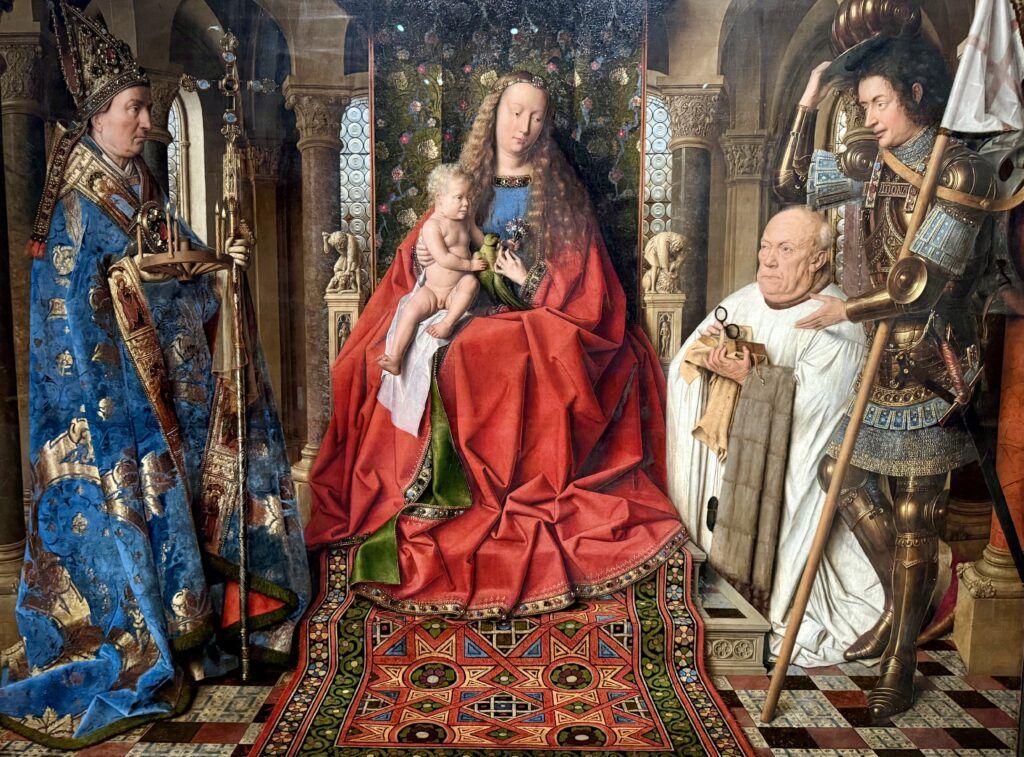
Jan van Eyck, Madonna with Canon Joris van der Paele
📍 Groeningemuseum, Bruges
Jan van Eyck’s Madonna with Canon Joris van der Paele is one of the crowning achievements of the Northern Renaissance. Van Eyck was Europe’s first great master of oil painting, and many art historians consider this his finest work.
The painting is astonishing for both its beauty and its realism. The Virgin Mary sits enthroned in a sumptuous red robe, gently playing with the Christ Child. Baby Jesus reaches toward St. George, the armor-clad dragon slayer, while the saint introduces the kneeling donor, Canon Joris van der Paele, to the Virgin.
At first glance, it looks like a traditional devotional painting. But Van Eyck quietly breaks with medieval convention.
The holy figures don’t float in a golden, otherworldly realm. Instead, they occupy a richly furnished interior that feels tangible and believable, almost like a grand Flemish home.
Van Eyck was just as interested in observing the real world as he was in conveying religious meaning. Every surface seems almost touchable, from polished metal and embroidered silk to fur, marble, and glass. Light glints off armor, reflects in gemstones, and pools in the folds of Mary’s robe.
Nor does Van Eyck flatter his patron. Canon Joris appears exactly as he was, with aging skin, tired eyes, and a weathered face that speaks to a life well lived.

Rogier van der Weyden, Portrait of Anthony of Burgundy
📍 Royal Museums of Fine Arts, Brussels
Rogier van der Weyden was one of the leading painters of the Early Netherlandish school. He’s best known for his emotionally powerful religious scenes, but his portraits are equally remarkable. They combine extraordinary realism with a keen ability to capture a sitter’s personality and presence.
This striking portrait depicts the young Prince Anthony of Burgundy in a black robe and deep red cap. His pale face and elegantly posed hand emerge from a dark background, drawing your eye immediately to his calm, self-assured expression.
Anthony was something of a Renaissance prince before the Renaissance fully arrived north of the Alps. A skilled diplomat, accomplished knight, and noted patron of the arts, he was also admired for his impeccable taste. His luxurious Burgundian court even influenced fashion at the Medici court in Florence.
Van der Weyden presents him at the height of his prestige. Anthony holds an arrow, a symbol of his courage, military accomplishments, and membership in the elite chivalric Order of the Golden Fleece. Every detail reinforces the image of a powerful and sophisticated Burgundian prince.
>>> Click here to book a Royal Museums ticket

Hans Memling, St. John Altarpiece
📍 Sint-Janshospitaal Museum, Bruges
This magnificent triptych once stood above the high altar of the hospital chapel. Also known as the Mystical Marriage of St. Catherine, it’s one of Hans Memling’s greatest masterpieces.
In the center, Mary sits enthroned with the Christ Child beneath a canopy of angels. Flanking them are John the Baptist and John the Evangelist. The child places a ring on St. Catherine’s finger, symbolizing her mystical marriage to Christ.
Catherine was a Christian princess who rejected the marriage proposal of the Roman emperor Maxentius. Enraged, he ordered her execution on a spiked wheel.
According to legend, the wheel shattered, so she was ultimately beheaded. That’s why she’s almost always shown with a broken wheel and a sword.
The side panels depict the martyrdom of John the Baptist on the left and John the Evangelist receiving his vision of the Apocalypse on Patmos on the right. Together, the three panels combine vivid storytelling with Memling’s trademark serenity and jewel-like detail.
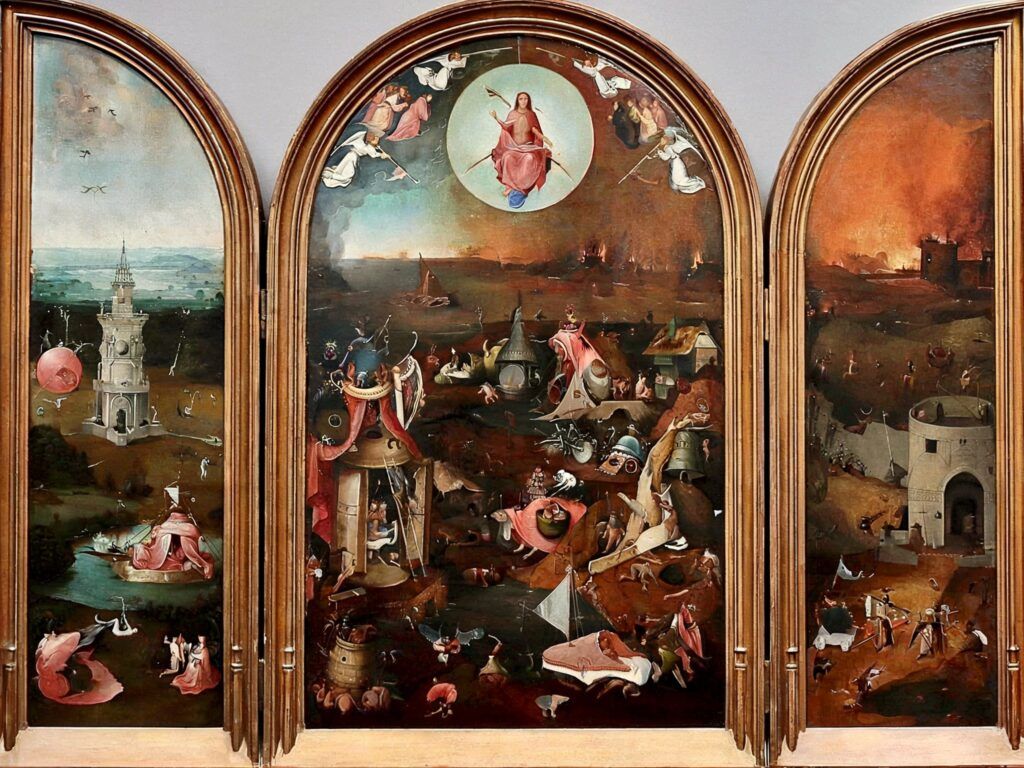
Hieronymus Bosch, The Last Judgment
📍 Groeningemuseum, Bruges
Hieronymus Bosch was unlike any artist of his time. His wildly imaginative paintings are filled with bizarre creatures, symbolic riddles, and scenes that still feel unsettling more than 500 years later.
Bosch painted during a period of enormous change. The medieval world was giving way to the Renaissance, and old certainties about religion, morality, and humanity were beginning to fray.
In The Last Judgment, the final reckoning has arrived. Christ appears high above the earth inside a glowing mandorla, calmly presiding over humanity’s fate.
Below him, however, the world has descended into glorious madness. Half-naked figures feast, frolic, and indulge every earthly temptation in a landscape crowded with monstrous hybrids, oversized objects, and strange inventions. It’s almost as if humanity is squeezing in one last celebration before the bill comes due.
Around them, order quickly gives way to chaos. Angels shepherd the righteous toward paradise on one side, while demons drag the damned into a terrifying hellscape on the other. Fires rage, grotesque monsters torture sinners, and every corner reveals another unsettling punishment.
Bosch doesn’t just illustrate the Book of Revelation. He invites you to wander through it, discovering bizarre details and hidden symbols at every turn.
The longer you look, the stranger the painting becomes. It’s equal parts nightmare, morality tale, and visual puzzle, which helps explain why Bosch remains one of the most fascinating artists in the history of Western art.
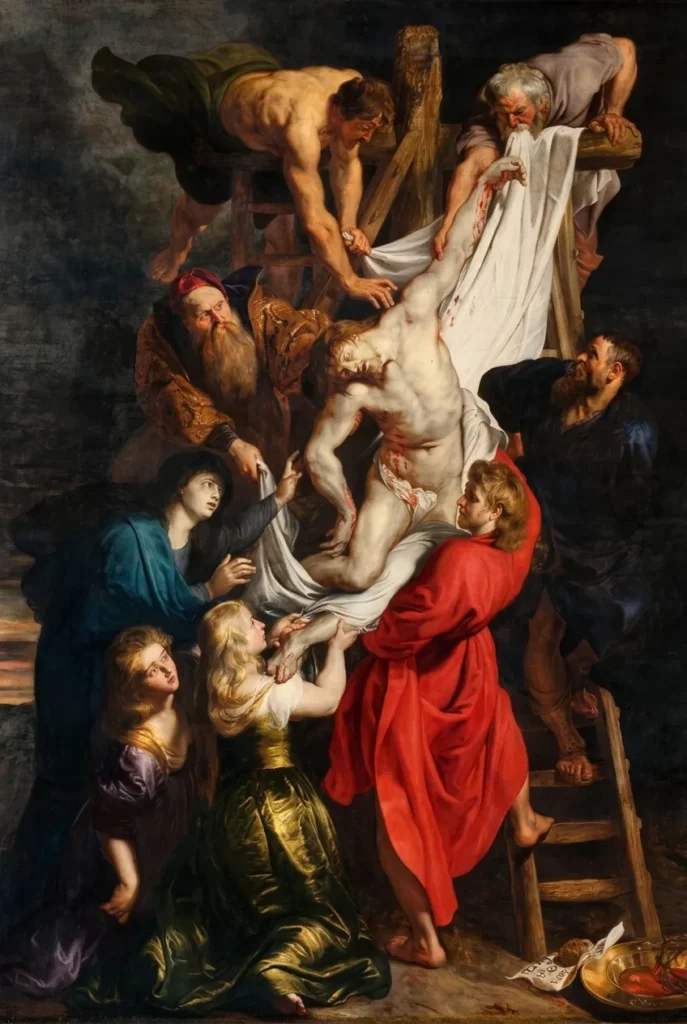
Rubens, Descent from the Cross
📍Church of Our Lady, Antwerp
In Antwerp, you can admire four of Peter Paul Rubens’ monumental altarpieces. The best known is The Descent from the Cross, one of the defining masterpieces of the Baroque.
The central panel of a magnificent triptych depicts the dramatic moment when Christ’s body is lowered from the cross. His lifeless figure is carefully supported by St. John and Joseph of Arimathea, while the grieving Virgin Mary and the holy women look on in anguish.
This isn’t a quiet or contemplative painting, and you wouldn’t expect one from Rubens. Everything is in motion. Muscular bodies strain against ladders, white linen billows through the composition, and the eye is pulled from one emotional face to the next.
Rubens was a master of theatrical storytelling. His luminous colors, dynamic composition, and almost sculptural figures transform a familiar biblical episode into an emotionally charged spectacle.
Whether or not you’re generally a Rubens fan (I’m generally not), it’s hard not to admire the sheer ambition and technical brilliance of the painting.

Pieter Bruegel the Elder, The Fall of the Rebel Angels
📍 Royal Museums of Fine Arts, Brussels
If this painting reminds you of Hieronymus Bosch, that’s no accident. Bruegel clearly admired Bosch’s fantastical imagination, filling the canvas with bizarre monsters, hybrid creatures, and nightmare visions. Many may also have been inspired by the exotic plants, animals, and curiosities arriving in Europe from the New World.
The painting’s subject comes from the Book of Revelation. It depicts the dramatic moment when the rebel angels, led by Satan, are defeated and cast out of Heaven.
At the center, the armored Archangel Michael confronts a seven-headed dragon as angels and demons collide in a chaotic battle. The painting is packed with grotesque creatures. You could spend an hour examining all the strange details.
But this isn’t just a display of artistic invention. Beneath the spectacle lies a darker message. Painted during a period of intense religious upheaval, the painting reflects a world that felt increasingly unstable.
Many historians see the struggle between the heavenly host and the rebel angels as an echo of the bitter conflict between Catholics and Protestants that was beginning to tear Europe apart.

Pieter Bruegel the Elder, Landscape with the Fall of Icarus
📍 Royal Museums of Fine Arts, Brussels
At first glance, this looks like an idyllic landscape. But look more closely.
Landscape with the Fall of Icarus marks a turning point in Western art. For perhaps the first time, the landscape isn’t just a setting for a story. It’s the main event.
The painting is inspired by Ovid’s Metamorphoses and is the only surviving mythological work associated with Bruegel. It tells the story of Icarus, who ignored his father’s warning, flew too close to the sun, and plunged into the sea when the wax holding his wings together melted.
Yet Bruegel treats this legendary catastrophe almost as an afterthought. Icarus is easy to miss. All you see are two flailing legs disappearing beneath the water in the lower corner of the painting.
Meanwhile, life carries on. A farmer plows his field. A shepherd watches his flock. A merchant ship sails calmly toward the horizon. No one seems to notice, or care, that a mythological hero has just fallen from the sky.
That’s what gives the painting its bite. Bruegel quietly suggests that even our grandest ambitions, greatest triumphs, and most spectacular failures barely interrupt the ordinary rhythms of everyday life. It’s a surprisingly modern message.

Michelangelo, Madonna and Child
📍Church of Our Lady, Bruges
The only Michelangelo sculpture in Belgium is at the Church of Our Lady. It’s one of the artist’s earliest sculptures and the only work by Michelangelo in Belgium.
The statue was purchased by two wealthy Bruges merchants while Michelangelo was still alive, making it one of the few of his works to leave Italy during his lifetime.
If you’ve seen the sublime Pietà in St. Peter’s Basilica, you may find this sculpture a bit less dazzling. But it still offers a fascinating glimpse of a young Michelangelo developing the style that would make him famous.
Mary is portrayed not as an idealized young mother, but as a thoughtful, almost introspective figure. Rather than clinging to her, the Christ Child appears ready to step away into the world, an unusually independent pose that hints at his future destiny.
The sculpture now sits on an elaborate Baroque altar, a setting that feels rather at odds with Michelangelo’s restrained Renaissance aesthetic. Even so, it’s well worth seeking out. Seeing an authentic Michelangelo outside Italy is a rare treat.
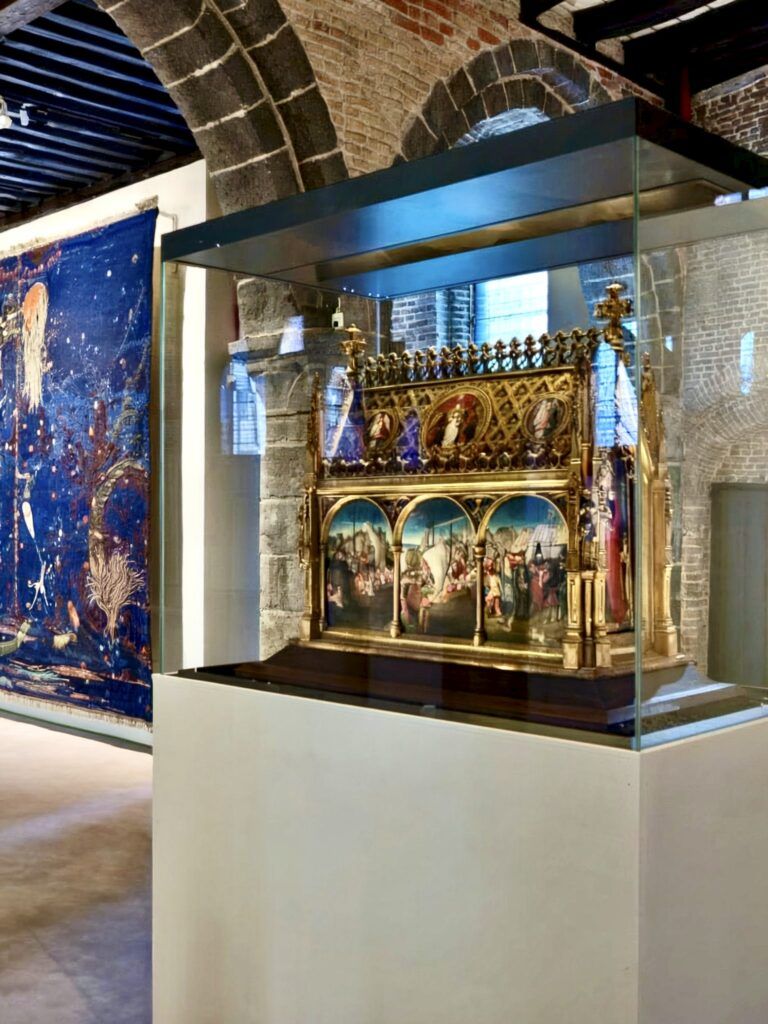
St. Ursula Shrine
📍 Sint-Janshospitaal Museum, Bruges
One of the museum’s true treasures is the Shrine of St. Ursula, an extraordinary reliquary created by Hans Memling in the late 1480s. Shaped like a miniature Gothic chapel, it was crafted from carved oak and lavishly gilded to house the saint’s relics.
The sides of the shrine are fitted with tiny painted panels that resemble stained-glass windows. In them, Memling recounts the legend of St. Ursula and her 11,000 virgin companions, following their pilgrimage across Europe to Rome and ultimately to their martyrdom at Cologne.
Each panel is a miniature masterpiece, packed with architectural landmarks, bustling cityscapes, ships, and colorful figures. The scenes almost feel like an illustrated travel diary as much as a religious narrative.
Look closely at the background of one panel and you’ll spot a well-dressed Bruges couple with their children. Some scholars have suggested these may be portraits of Memling and his own family, quietly inserted into one of his most celebrated works.

Jacques-Louis David, The Death of Marat
📍 Royal Museums of Fine Arts, Brussels
Few paintings capture the drama of the French Revolution as powerfully as The Death of Marat. It’s both a masterpiece of Neoclassicism and one of history’s most effective pieces of political propaganda.
David depicts the radical journalist and revolutionary Jean-Paul Marat moments after he was stabbed to death in his bath by the young royalist Charlotte Corday. Marat suffered from a painful skin disease and often worked from the bathtub, making it the unlikely setting for one of history’s most famous political assassinations.
David knew Marat personally and was one of the last people to see him alive. This painting was his tribute to a fallen friend and fellow revolutionary.
Every detail serves David’s purpose. Marat’s blood gently stains the bathwater as he loosely holds the note that supposedly gained Corday entry to his room.
The letter wasn’t copied faithfully from life. David altered it to portray Marat as compassionate and generous, while making Corday’s betrayal seem even more calculated.
David transforms Marat into a secular martyr. His pale body recalls images of the dead Christ, while the dramatic light and almost empty setting strip away every distraction. There are no signs of the chaos outside, only the quiet dignity of a man who appears to have died in service to his ideals.
And yet the painting never loses its humanity. Marat’s head slips gently to one side. His ink-stained fingers still clutch the quill he had been using moments before. The rough wooden crate serves as both desk and memorial.
David removed almost everything except what mattered to his message. The result is a painting that’s both deeply moving and carefully calculated.
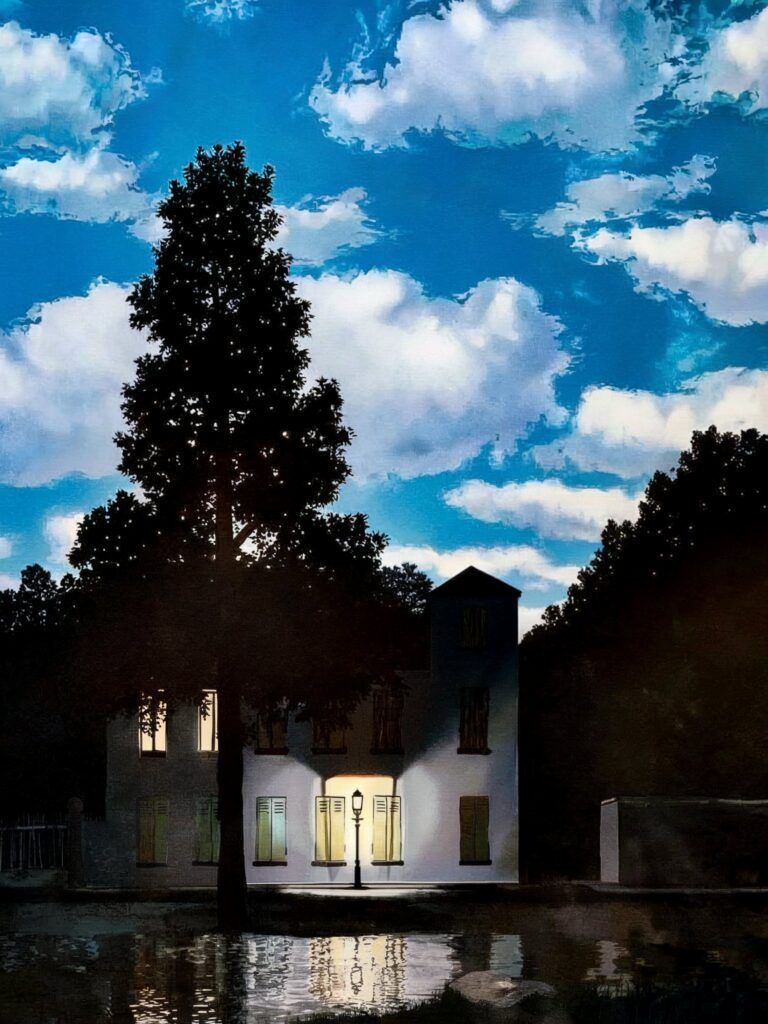
René Magritte, The Empire of Light
At the Magritte Museum, you’ll find one of the largest versions of The Empire of Light, arguably René Magritte’s most iconic image. He painted 27 variations of this haunting composition between the late 1940s and the 1960s, in both oil and gouache.
This monumental 1954 canvas presents one of art’s greatest visual paradoxes. A quiet suburban street lies in darkness, illuminated only by a glowing streetlamp and the lights of a house. Yet above it stretches a brilliant blue daytime sky dotted with fluffy white clouds.
The scene feels both ordinary and deeply unsettling. Nothing appears out of place, yet everything is wrong.
Magritte loved these kinds of contradictions. He challenged viewers to question what they were seeing and to accept that opposites can exist side by side.
For him, day and night, light and darkness, the familiar and the mysterious weren’t opposites at all. They were simply different facets of reality.
It’s one of the museum’s biggest attractions, so don’t be surprised if you have to wait a few minutes for a chance to admire it up close.
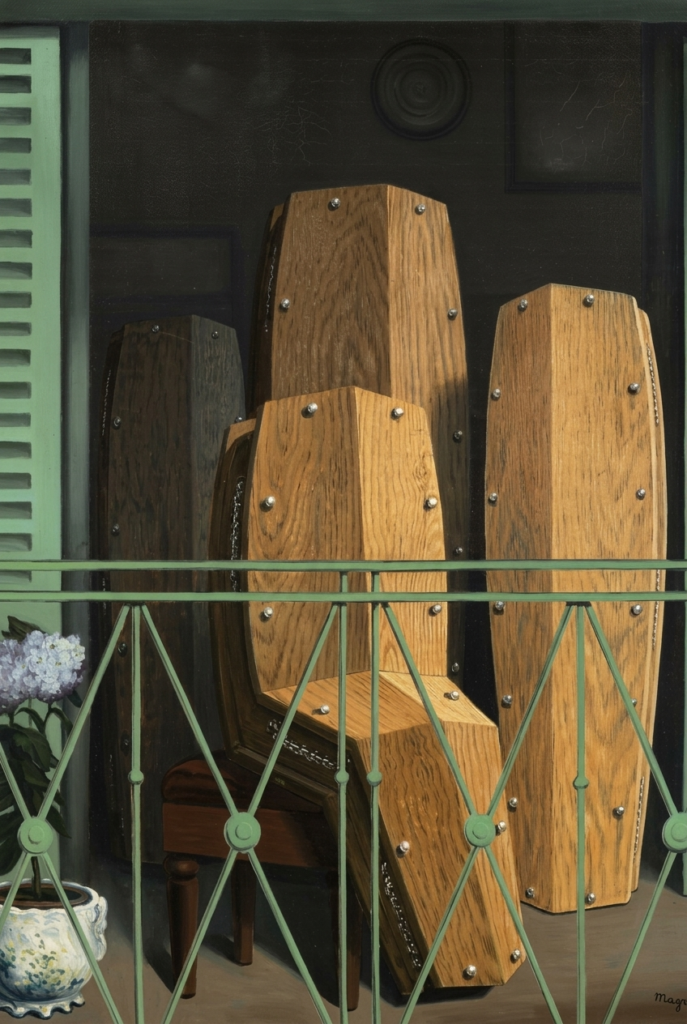
René Magritte, Perspective II: Manet’s Balcony
📍 Museum of Fine Arts Ghent (MSK), Ghent
Like much of Magritte’s later work, Perspective: Manet’s Balcony is both an homage to and a sly critique of an earlier masterpiece.
The painting is based on the Édouard Manet painting The Balcony housed in the Musee d’Orsay.
But instead of the fashionable Parisians who occupy Manet’s balcony, Magritte substitutes four upright coffins arranged in exactly the same poses.
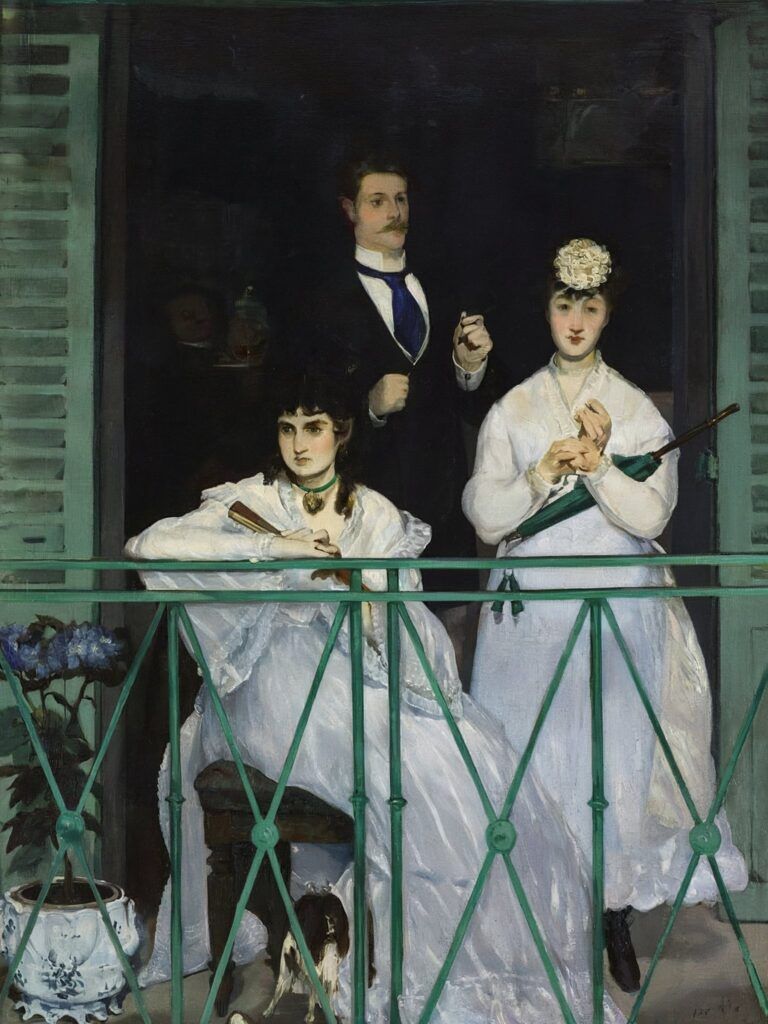
The effect is instantly unsettling. By replacing living people with lifeless objects, Magritte transforms a familiar 19th century social scene into something macabre and absurd.
The painting also raises larger questions about mortality and the passage of time. Manet’s elegant figures, once symbols of modern life, have literally become monuments to death.
It’s a dark joke, but also a reminder that beneath the appearances of everyday life lies an inescapable reality.
As always, Magritte refuses to explain exactly what it means. Instead, he invites you to sit with the contradiction, finding humor, irony, and a touch of existential unease in one of his cleverest reworkings of an art historical icon.
>>> Click here to book a fine arts museum ticket

Francis Bacon, Study after Velázquez’s Portrait of Pope Innocent X
📍 Royal Museums of Fine Arts, Brussels (1953)
The seated pope was likely inspired by Velázquez’s Portrait of Pope Innocent X, a painting Bacon considered one of the greatest ever made. Although he admired the original, Bacon never painted directly from it. Instead, he created dozens of haunting reinterpretations from photographs.
Here, the pope sits stiffly in a throne-like chair, his hands clenched near his chest in a gesture that suggests anxiety rather than authority. The formal pose conveys power, but Bacon undermines it with smeared paint, distorted features, and an almost palpable sense of psychological torment.
Two owls perch behind the figure, adding another layer of mystery. Traditionally associated with wisdom, they instead seem to act as silent witnesses, watching the pope with unsettling intensity. Whether they symbolize judgment, surveillance, or simply the absurdity of power is left for the viewer to decide.
Like many of Bacon’s paintings, Pope with Owls leaves you with a lingering sense of unease. It’s less a portrait than an exploration of fear, isolation, and the fragile nature of human authority.
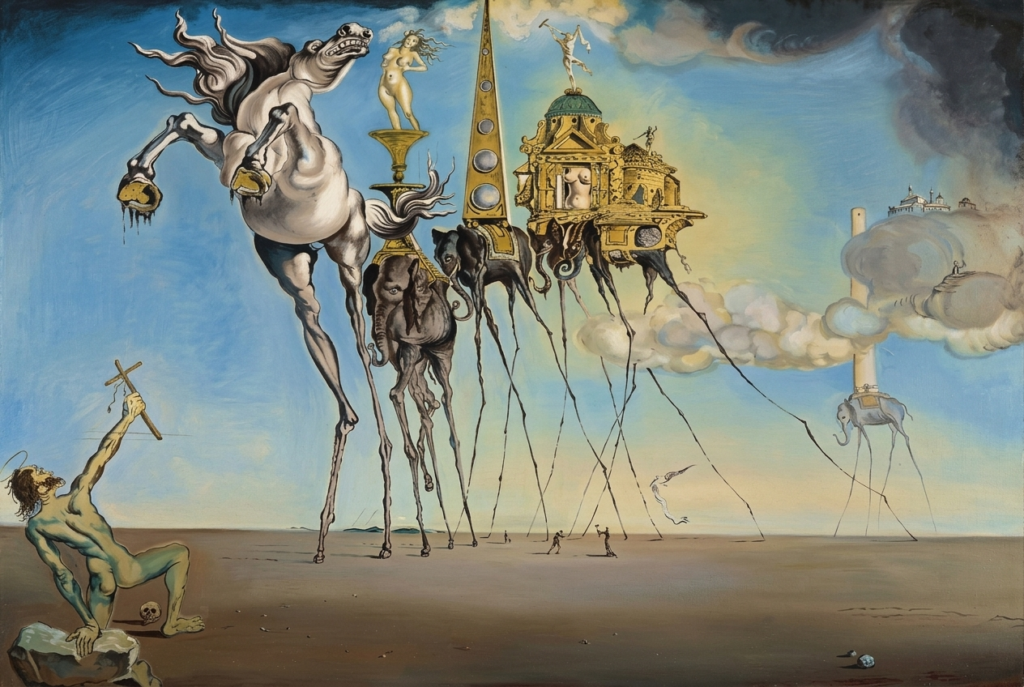
Dali, Temptation of St. Anthony
📍 Royal Museums of Fine Arts, Brussels
Dali painted this image in 1946 for a competition organized by a film producer who wanted an image of the temptation of St. Anthony for a film adaptation of Bel Ami.
Dalí didn’t win the competition (that honor went to Max Ernst). But his painting became by far the more famous work.
The imagery is classic Dalí: the emaciated, towering elephants with impossibly long legs symbolize the fragility of temptation, a horse represents power and sensuality, and buildings carried on the elephants’ backs evoke wealth, pride, and worldly ambition.
The nude figure represents lust. And St. Anthony, clutching a cross, trying to ward off the parade of temptations.
I hope you’ve enjoyed my guide to the must see masterpieces in Belgium. You may find these other Belgium travel guides useful:
- One week in Belgium itinerary
- Best things to do in Ghent
- One day Ghent itinerary
- Best things to do in Bruges
- 1 day in Bruges itinerary
- 2 days in Bruges itinerary
- 1 day in Brussels itinerary
- 2 days in Brussels itinerary
Pin it for later.

