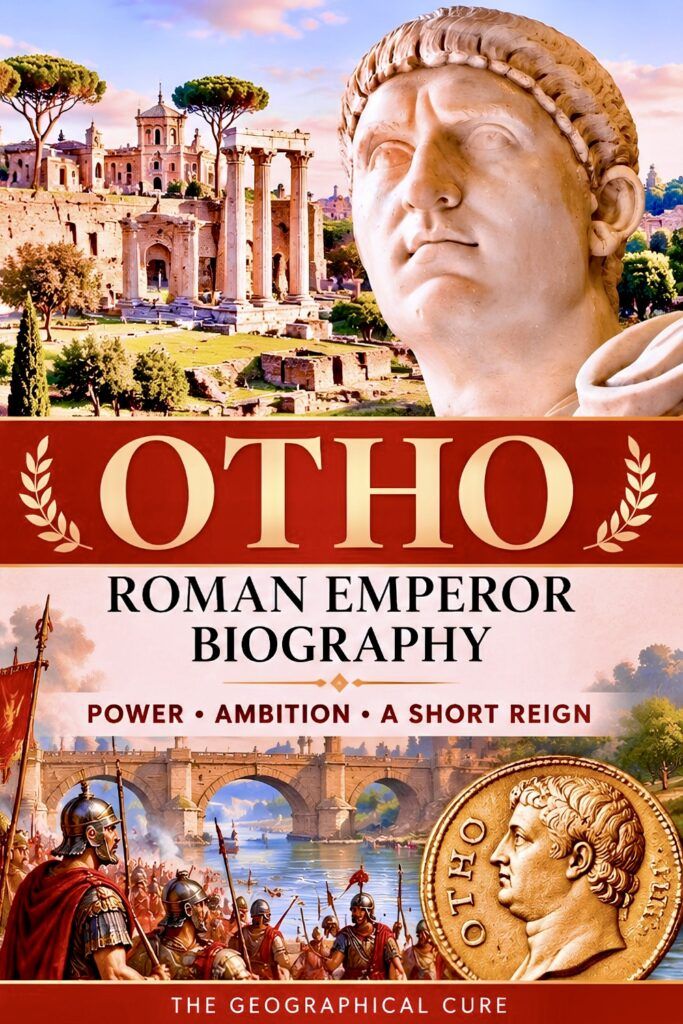
Otho looked like exactly the wrong man to save Rome from chaos.
He was a pampered court dandy, Nero’s drinking buddy, and a man who seized the throne through murder. Otho looked frivolous, venal, and morally unserious.
Yet, when the crisis came, he behaved better than expected. He somehow ended his life with one of the most selfless acts of any Roman emperor.
Here is the story of his short reign.
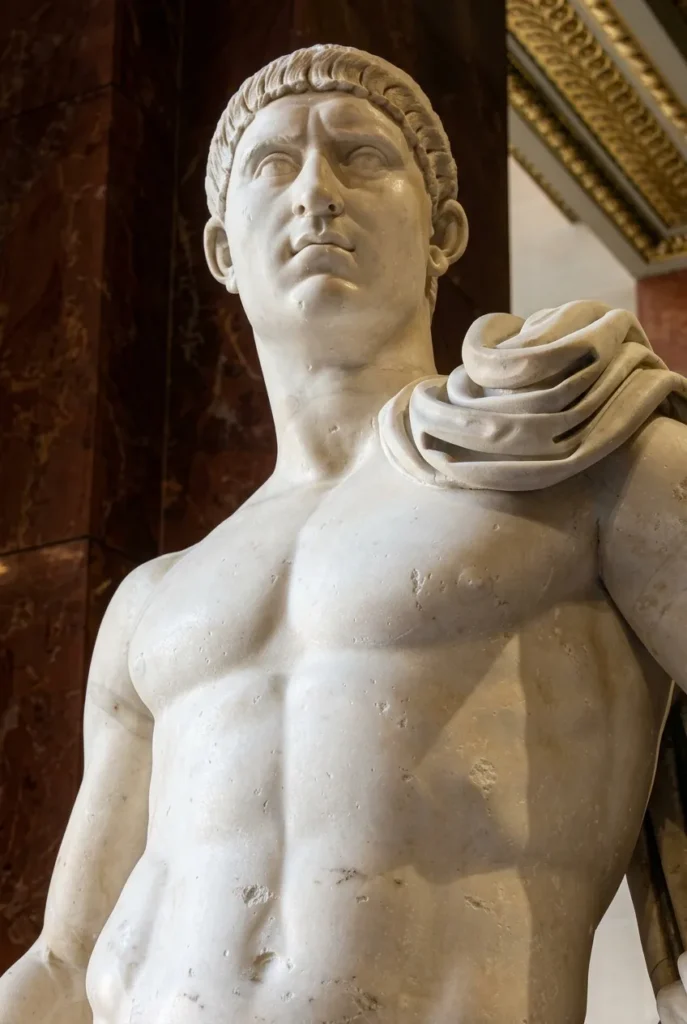
Otho Biography: The Three Month Emperor
Otho’s Family
Otho was born in 32 CE, in the final years of Tiberius’s reign.
Otho came from a wealthy family established at Ferentium in Etruria. Teh historian Suetonius claimed that his ancestors descended from ancient Etruscan princes, though that impressive pedigree might be contrived and is impossible to verify.
His parents were patricians, Lucius Salvius Otho and Albia Terentia.
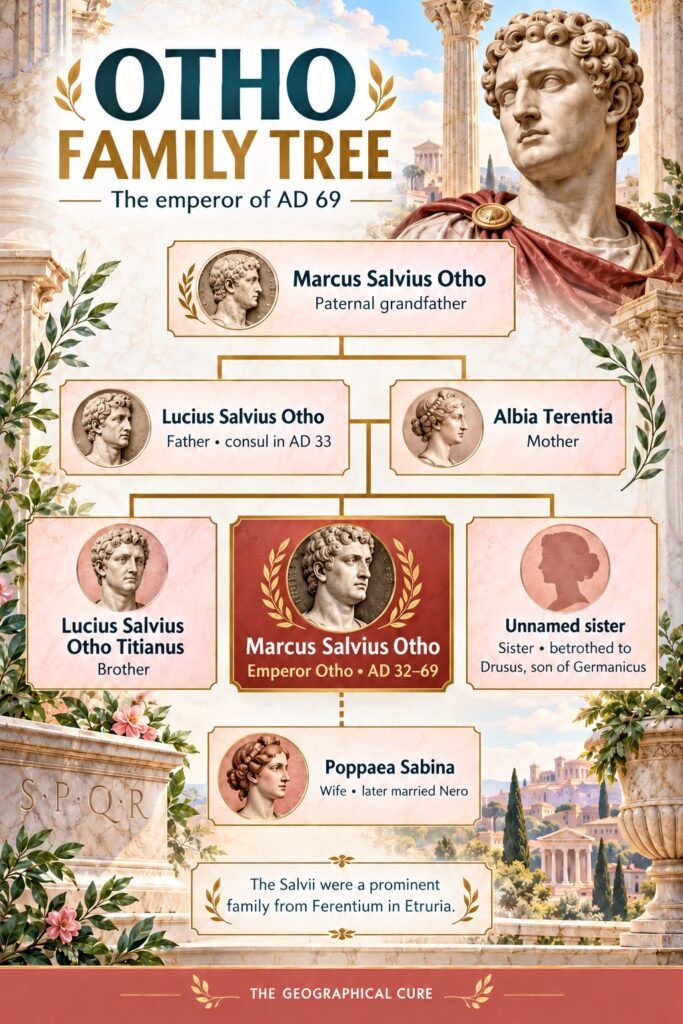
His father, Lucius Salvius Otho, was a prominent Roman senator and courtier. He served as consul in AD 33 and later as governor of Africa.
Suetonius presents him as a capable, respected man who was close to Tiberius and later favored by Claudius.
His mother, Albia Terentia, came from a respectable aristocratic family, but we know much less about her.
Otho’s family got him into the inner circles of high society. Did Otho thank them? No, he traded in his family’s prestige for wine, women, and song.
Otho and Nero: The Courtier Who Became the Emperor’s Friend
Naturally, this made him a good fit for Nero’s court.
The two young men became close friends and companions in excess. Otho attached himself to Nero’s inner circle, joining the emperor in drinking, sexual escapades, and the kind of sordid nighttime misbehavior that Suetonius delighted in recording.
In other words, Otho was not merely some hanger-on at court. He was one of Nero’s buddies.

That friendship gave him access, status, and influence. It also meant that Otho’s fortunes were tied to a man whose whims could change very quickly.
Unlike Nero, Otho acquired a particular reputation as an effeminate libertine.
Suetonius says he plucked his body hair, shaved obsessively, wore a carefully fitted wig, and pampered his appearance in ways Roman moralists associated with feminine vanity. The wig apparently covered his bald spots.
None of this bothered Nero. If anything, Otho’s taste for luxury and dissipation made him a very agreeable companion indeed.
Unfortunately for Otho, there was one thing Nero liked even more than his friend. Otho’s wife.


The Strange Love Triangle
Nero was married to Octavia, Claudius’ daughter, in a dynastic match arranged while Nero was still a teenager.
Nero seems to have detested the marriage. By the late 50s, he was infatuated with the beautiful and ambitious Poppaea Sabina, Otho’s wife.
Exactly how this triangle began depends on which ancient source you believe.
According to Suetonius, Nero had already taken an interest in Poppaea and encouraged Otho to marry her as a convenient cover for the affair. Otho was supposed to be the “beard” who provided Nero access to his secret mistress to avoid public scandal.
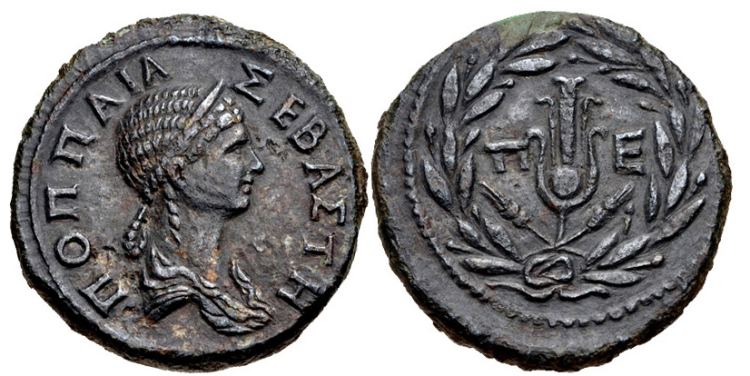
The arrangement went off the rails when Otho became genuinely attached to Poppaea.
Suetonius even claims that he once refused to let Nero into the house, leaving the emperor outside demanding that Otho return what had essentially been “entrusted” to him.
Tacitus tells a somewhat different, and perhaps even more ridiculous, story. In his version, Otho couldn’t stop boasting about Poppaea’s beauty and charms. Whether he was merely showing off or deliberately trying to intrigue Nero, it worked. Nero wanted her.
Poppaea played the two men skillfully against each other. She reminded Nero that she was a respectable married woman and praised Otho while Nero’s infatuation grew.

Eventually, Otho became an inconvenience.
Nero first froze him out of the imperial circle. Then, he solved the problem by “promoting” him to governor of Lusitania, modern Portugal and part of western Spain.
Tacitus makes the purpose perfectly clear: Otho was being removed from Rome so that he could no longer compete with the emperor for Poppaea.
It was an elegant form of exile.

Governor of Lusitania: A Different Side of Otho
On paper, it was one of the highest posts in the empire. That sounds impressive, but Lusitania was about as far west as Rome could send him.
Still, a provincial governorship brought prestige, authority, and plenty of opportunities for self-enrichment. Given Otho’s reputation, no one would have expected him to be especially scrupulous.
Much to everyone’s surprise, he turned out to be a conscientious and competent administrator.

He governed firmly but fairly and earned a reputation for good judgment.
It was the first real sign that beneath the drinking, vanity, and courtly excess, Otho had inherited some of his family’s political ability after all.
Most provincial commands were temporary. Otho’s was not.
He remained in Lusitania for roughly a decade. Year after year, he carryied out the dull business of government while Nero stayed in Rome with Poppaea.
The exile that was meant to get Otho out of the way had an unintended consequence. It gave him experience and standing.

The Fall of Nero and Otho’s Return
Meanwhile, Otho was still brooding about Nero. He wasn’t alone. Nero’s antics had finally pushed things too far in Rome. The Senators hated him.
In 68, Galba, governor of Hispania Tarraconensis, revolted against Nero. Otho saw his chance for a measure of revenge and quickly declared for him. Before either man reached Rome, Nero was dead by suicide.
Galba, however, proved deeply unpopular. He was austere, high-handed, and moralizing. It was precisely the wrong combination for a regime that needed to win people over.
Worse, he refused to pay the Praetorian Guard the donative they expected. That was asking for trouble.

For his loyalty, Otho hoped to be named Galba’s successor. Galba was already in his 70s, so the question of who came next mattered enormously.
But Galba passed him over. Instead, he adopted Lucius Calpurnius Piso Licinianus, a young aristocrat from one of Rome’s grandest families.
Otho was furious. Poor, unappreciated Otho.
Once again, he’d been useful right up until the moment someone else got what they wanted. He’d been Nero’s convenient friend, Poppaea’s inconvenient husband, and Galba’s useful supporter. And now apparently nothing at all.

He was tired of being the imperial stepping stone for other men’s ambitions. So, Otho began cultivating the already disgruntled Praetorians with money, promises, and attention. It worked.
On January 15, 69, the Praetorian Guard proclaimed Otho emperor. Galba was murdered in the Roman Forum, and Piso was hunted down and killed as well.
Mission accomplished. After all the humiliation, exile, resentment, and scheming, Otho was finally emperor.
The Senate quickly confirmed him, showing how fast Roman institutions adapted to a fait accompli.

Otho’s Brief Reign: A Man Trapped by Circumstance
If his governorship was any indication, Otho might actually have been up to the job. The early returns were reasonably positive, and he appears to have been a capable administrator.
Otho also understood that Nero still had admirers, especially among the urban crowd. He allowed Nero’s statues to reappear, restored some of his old officials, and was even hailed by soldiers and spectators as “Nero Otho.”
Rather than distance himself from his old friend, Otho seems to have flirted with the idea of presenting himself as Nero’s political heir.
Otho apparently had matrimonial plans too. Suetonius says he intended to marry Statilia Messalina, Nero’s widow. He never got the chance.

Indeed, he barely had time to settle onto the throne.
The legions stationed on the Rhine had already proclaimed another emperor: Aulus Vitellius. His generals, Caecina and Valens, led their veteran armies south toward Italy while Vitellius followed behind.
Otho scrambled to meet the threat. His forces included Praetorians, regular legionaries, and even some 2,000 gladiators.
This was not quite the hopeless rabble later accounts can make it sound like. Otho’s troops actually won several preliminary engagements. But Vitellius’ Rhine legions were hardened soldiers, and the decisive confrontation was still coming.
Otho apparently tried to negotiate before committing Rome to a full-scale civil war. Nothing came of it.
So it was to war.

The two armies finally collided at the First Battle of Bedriacum in April 69. Otho’s forces fought hard, but Vitellius’ men prevailed.
His surviving soldiers were far from finished. Reinforcements were still approaching, and Otho’s commanders and troops urged him to keep fighting.
He could have.
Otho’s death
But Otho had had enough.
He decided that preserving his throne wasn’t worth another round of Romans slaughtering Romans. He wrote farewell letters, settled his affairs, and ordered his followers to save themselves.

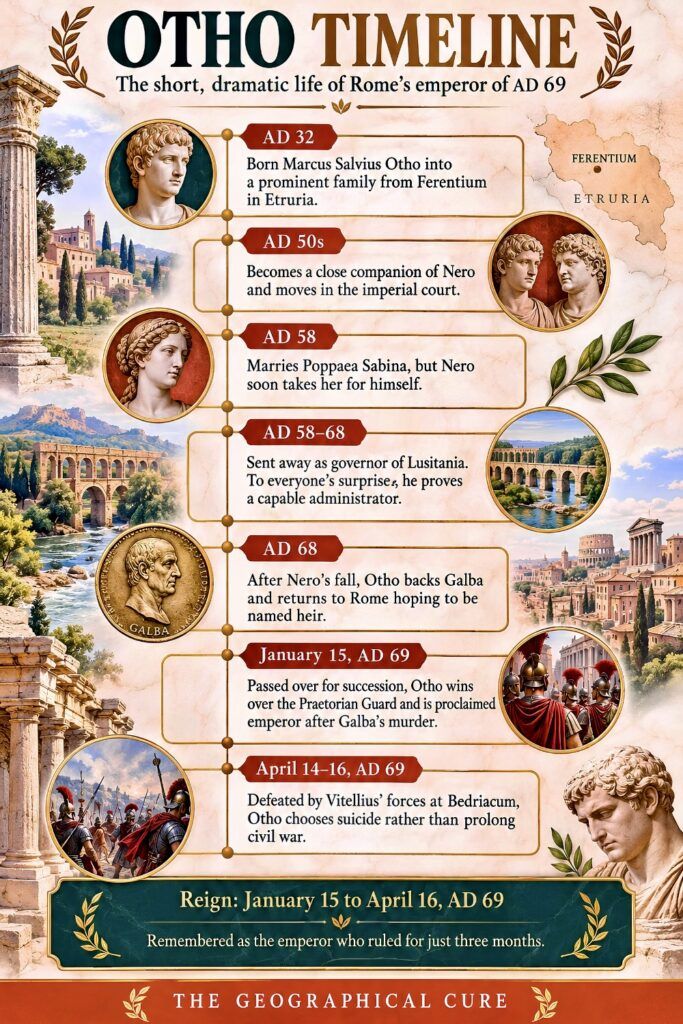
Then, at dawn, he stabbed himself in the chest. He was only 36 or 37, depending on how the ancient sources calculated his age. He’d been emperor for just three months, reigning from January 15 to April 16, 69 AD.
His death stunned contemporaries. The dissolute courtier who had drunk and whored his way through Nero’s Rome suddenly displayed a degree of restraint that far more respectable emperors lacked.
Tacitus regarded the end as remarkably noble. Otho’s soldiers mourned him passionately, and some reportedly killed themselves beside his funeral pyre.
Not that his sacrifice brought Rome much peace. Vitellius took the throne, only to find another, far more formidable rival waiting in the wings: Vespasian.

The Real Otho: Monster, Martyr, or Misunderstood Emperor?
Rome remembered Otho as the emperor of three months. But in that time, the former court dandy accomplished something rare among Roman rulers: he knew when power was no longer worth the price.
There’s an uncomfortable irony in his story. Otho gained the throne through violence, bribing the Praetorians who murdered Galba and proclaimed him emperor. Yet only three months later, when keeping that throne threatened to consume more Roman lives, he refused to continue the fight.
He was ruthless enough to seize power, but not ruthless enough to cling to it.
Still, Otho had helped set a terrible precedent. Galba’s murder showed that an emperor could be disposed of by his own soldiers and replaced with the man who promised them something better. The throne had become something armies could bestow, sell, and take away.
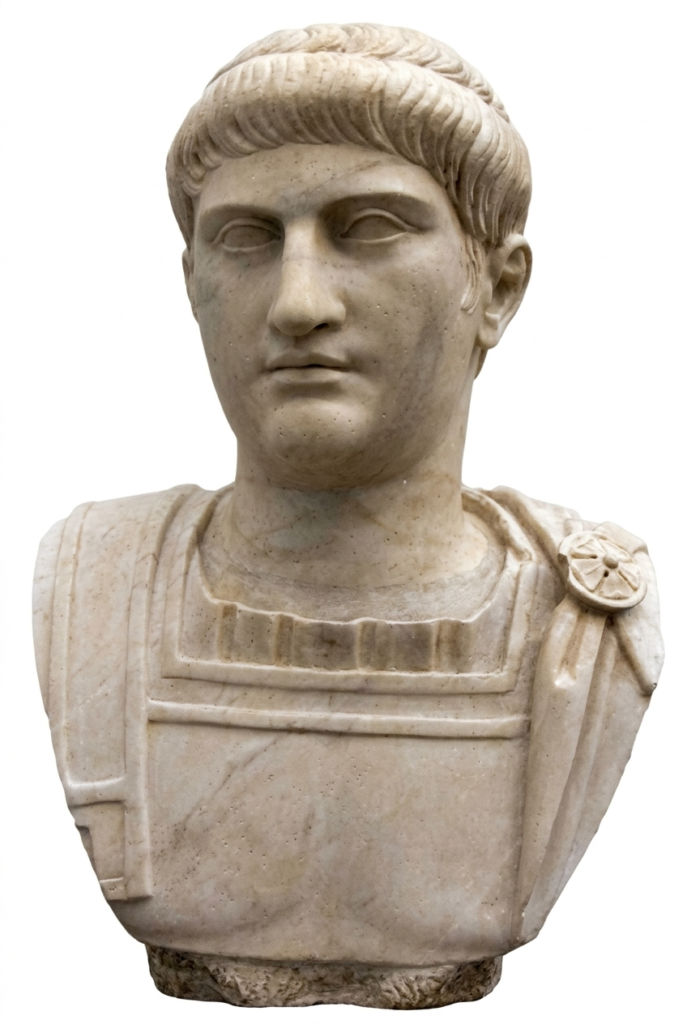
The consequences were immediate. Vitellius replaced Otho. Vespasian replaced Vitellius. By the end of the Year of the Four Emperors, Rome had received a brutal lesson in just how fragile imperial power could be.
Otho may have ended his own reign. But he helped open the door to a far more violent age of imperial succession.
I hope you’ve enjoyed my Otho biography. You may find these other Roman histories interesting:
- History of the Rise and Fall of Rome
- History of the Roman Emperors
- Historical Facts about Rome
- History of Nero
- History of Julius Caesar
- History of Augustus
- History of Caligula
- History of Hadrian
- History of Claudius
- History of Tiberius
Pin it for later.