
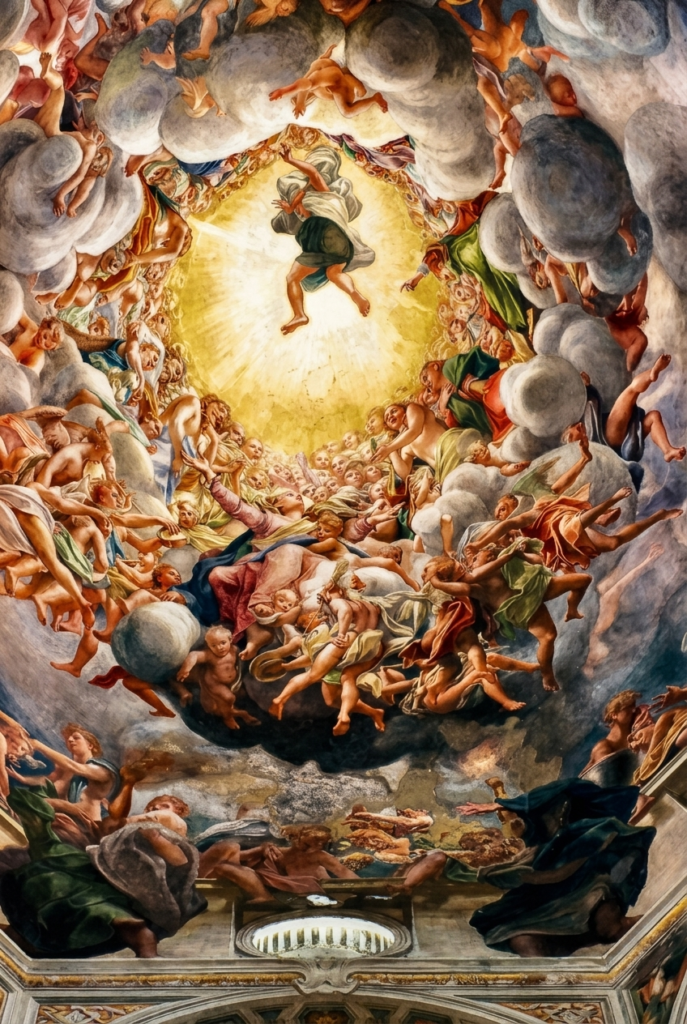
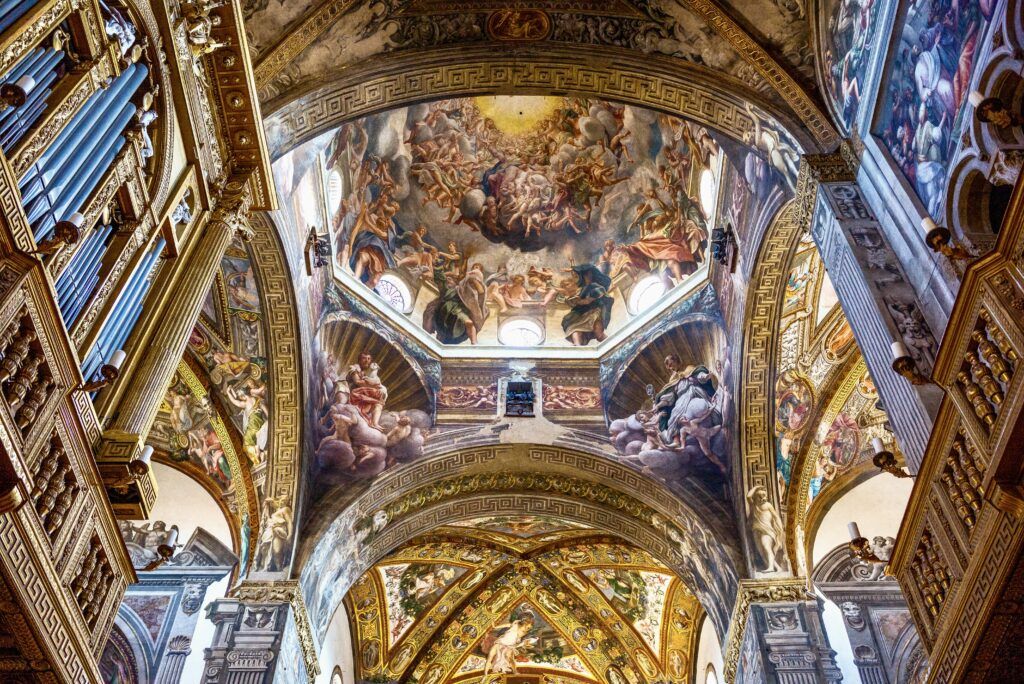
Correggio’s dome fresco in Parma Cathedral is one of the great triumphs of the High Renaissance. It’s a breathtaking illusion that seems to dissolve the architecture itself, opening the dome to the heavens.
The extraordinary fresco depicts the Assumption of the Virgin, one of the Renaissance’s favorite subjects. Monumental apostles ring the base of the dome, gazing upward as the Virgin is swept into a swirling vortex of clouds, angels, and radiant light.
The result is a spectacular vision of heaven in motion. Correggio transformed a static dome into a living, celestial space.
He creates an illusion so daring that it paved the way for the great Baroque ceiling frescoes of the following century.
Guide to Correggio’s Assumption of the Virgin
Quick Tips
- Tickets: The cathedral itself is free to visitors. If you want to visit the Baptistery (a must!) and the Diocesan Museum, the ticket price is €12.
- Bring binoculars if you have them. Correggio’s dome is nearly 100 feet overhead.
- Hours: Monday-Saturday: 7:45 am to 7:20 pm. Sunday: 7:45-10:45 am and 12:10-7:20 pm (closed to visitors during the late morning Mass).
- How long? Plan to spend 45-60 minutes.
And where is the dome in the cathedral?
Well, when you walk down the nave, you’ll come to the elevated presbytery area. This is the space almost directly under the dome, where you’ll have a partial view of Mary in the lower part of the fresco.
If you walk up the stairs on the right side of the nave (the only upper area open to the public), you’ll have a better view of the dome. But you’re still looking at it from the side, and it appears a bit slanted.
Who Was Correggio?
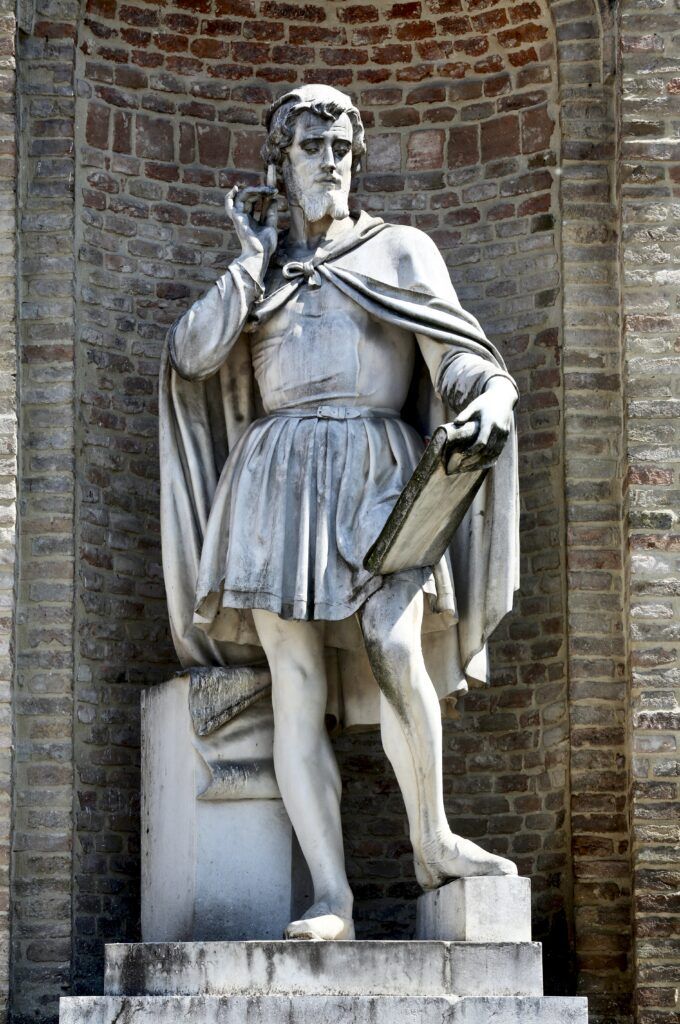
Antonio Allegri, better known as Correggio (1489-1534), was one of the most inventive painters of the High Renaissance.
He worked primarily in and around Parma. But his innovative use of light, illusion, and perspective had a profound influence on later European art.
He exploded onto the art scene in 1519, when he painted the Camera di San Paolo in Parma.
That was the first of Correggio’s breathtaking dome frescoes, in which architecture seems to dissolve into open sky. His dramatic compositions inspired generations of Baroque painters, including Pietro da Cortona, Andrea Pozzo, and Giulio Romano.
The Assumption of the Virgin in Parma Cathedral is widely considered his greatest achievement and is one of the most influential ceiling frescoes of the Renaissance.
Mini History of Correggio’s Dome
Parma Cathedral is a Romanesque cathedral built in the 11th through 13th centuries. It was dedicated to Saint Mary of the Assumption.
In 1522, Correggio was commissioned to decorate the dome. He was busy with another dome at the time. But, in 1530, he began painting and it took him four years to complete.
The commission came shortly after Parma returned to papal control following French occupation. Decorating the principal dome wasn’t just an artistic project. It also reaffirmed the city’s Catholic identity at a moment of political and religious change.
Correggio was also supposed to paint the intrados and the choir of Parma Cathedral.
In the end, however, he only painted the dome and its supporting pendentives. Fortunately, they proved to be among the most influential frescoes of the Renaissance.
Was Correggio’s fresco unprecedented? There’s a few prior examples: the Florence Baptistery fresco, Mantegna’s Camera degli Sposi, and Michelangelo’s Sistine Chapel frescos which Correggio might have seen. But Correggio’s illusions had no real precursor and were really next level.
According to tradition, not everyone appreciated the fresco when it was first unveiled. The foreshortened figures looked distorted from the floor.
There’s a famous anecdote that one critic remarked it looked like a “frog stew” (un guazzetto di rane).
Whether the story is apocryphal or not, it captures how radically different Correggio’s illusionism was from what people expected.
Correggio’s Dome Fresco Decoded
The dome fresco is truly one of the most brilliant artworks of the Renaissance. It’s well worth making a special trip to Parma to see it.
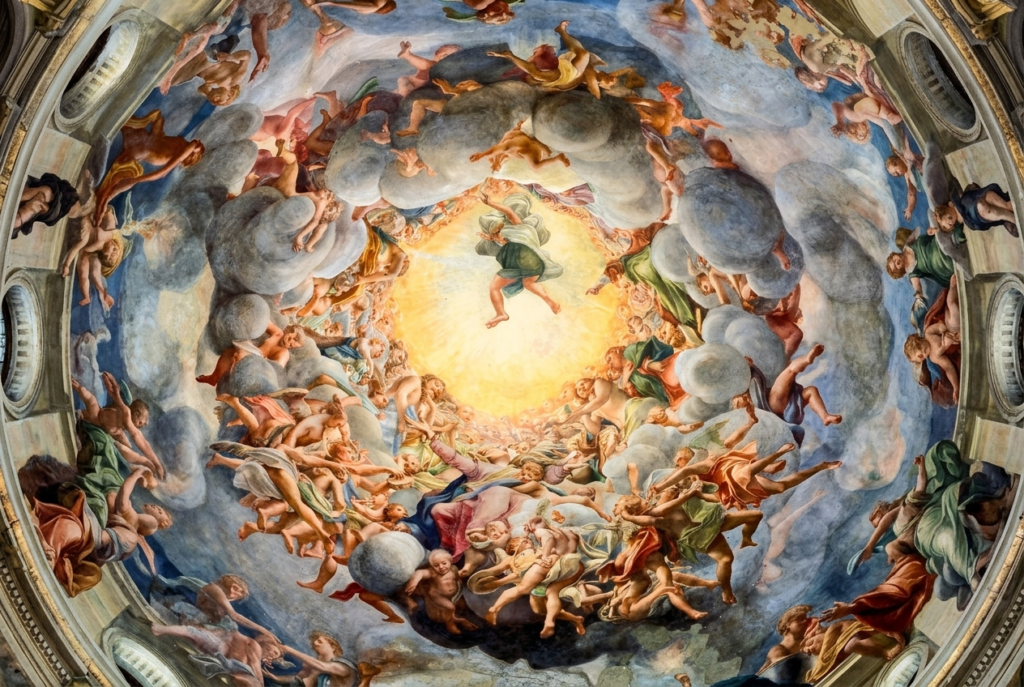
The central theme of the octagonal fresco is the Assumption of the Virgin Mary, the moment when Mary enters heaven body and soul.
This is not the same thing as an Ascension. In an Ascension, Christ rises to heaven under his own power. Mary’s Assumption is passive. She’s drawn upward by divine power, almost as if she’s being vacuumed into heaven.
The entire composition is caught in a swirling vortex of clouds, angels, and saints, with every figure moving upward.
Mary appears in the lower register, dressed in her traditional red and blue robes. She cranes her head upward as she is drawn into the heavenly vision.
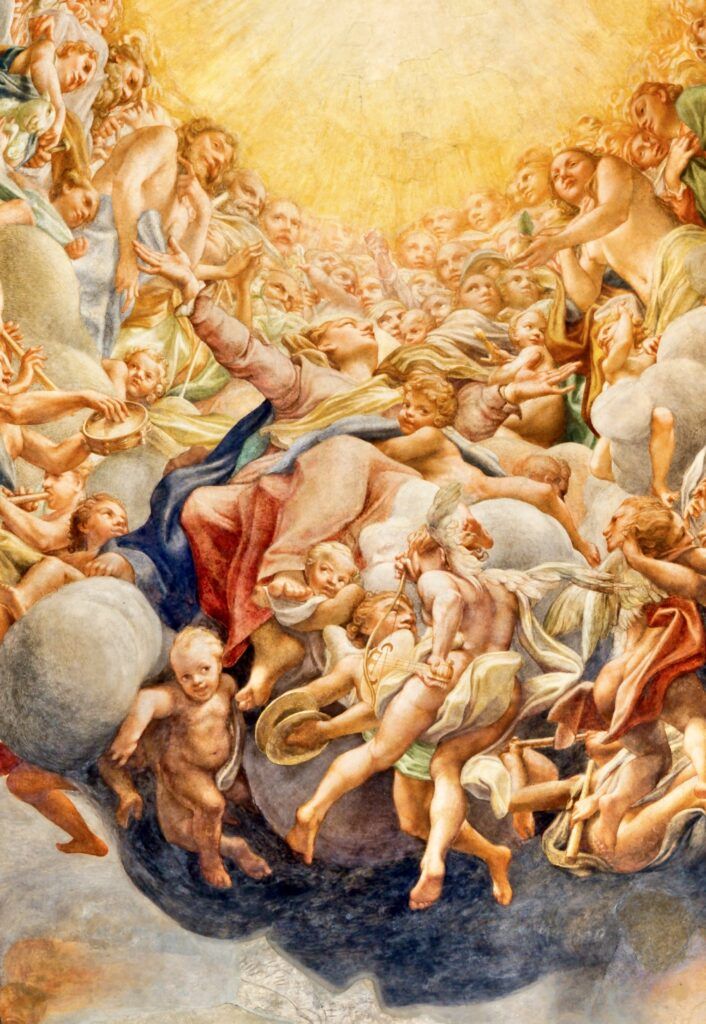
Above her is a glowing celestial space with an anonymous figure who seems to be either falling downward or soaring upward. It’s impossible to tell. And who is it?
Well, it’s not God, although he appears in many depictions of the assumption. It could be Christ.
But the absence of a beard makes that identification uncertain. It may instead be an angel acting as the divine agent who ushers Mary into heaven.
Whoever the mystery figure is, Correggio places him in an astonishing celestial space at the top of a glowing orb.
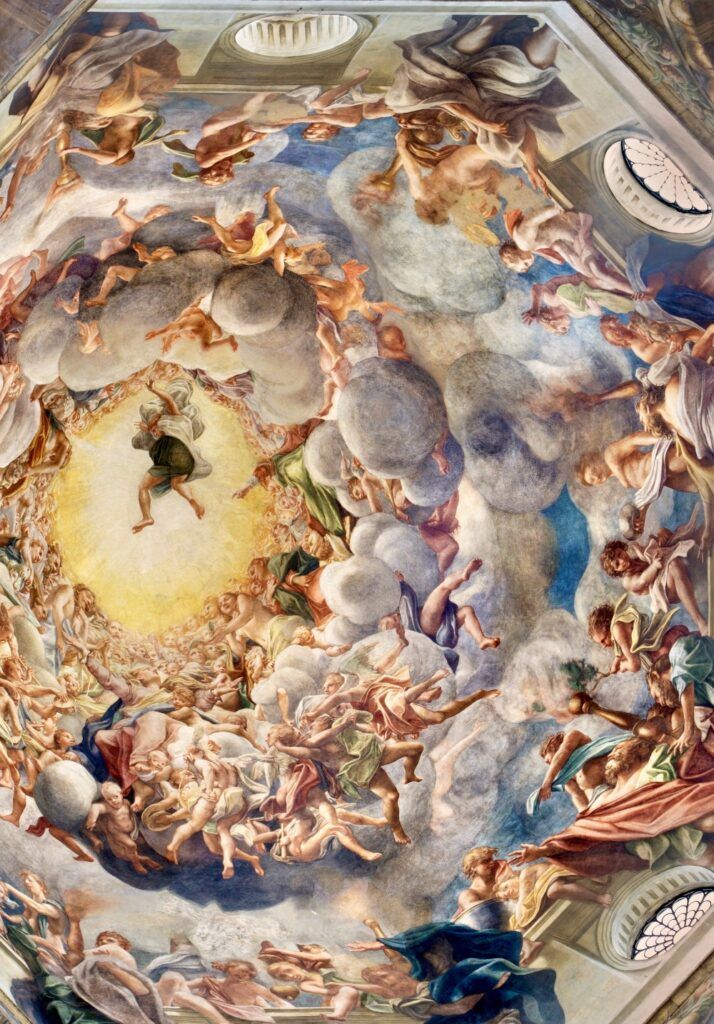
Just below the dome proper are the pendentives, the upside-down triangular spaces that support the dome. They too deserve a careful look.
Inside them are the four patron saints of Parma: St. John the Baptist, St. Hilary (Sant’Ilario), St. Joseph, and St. Bernard.
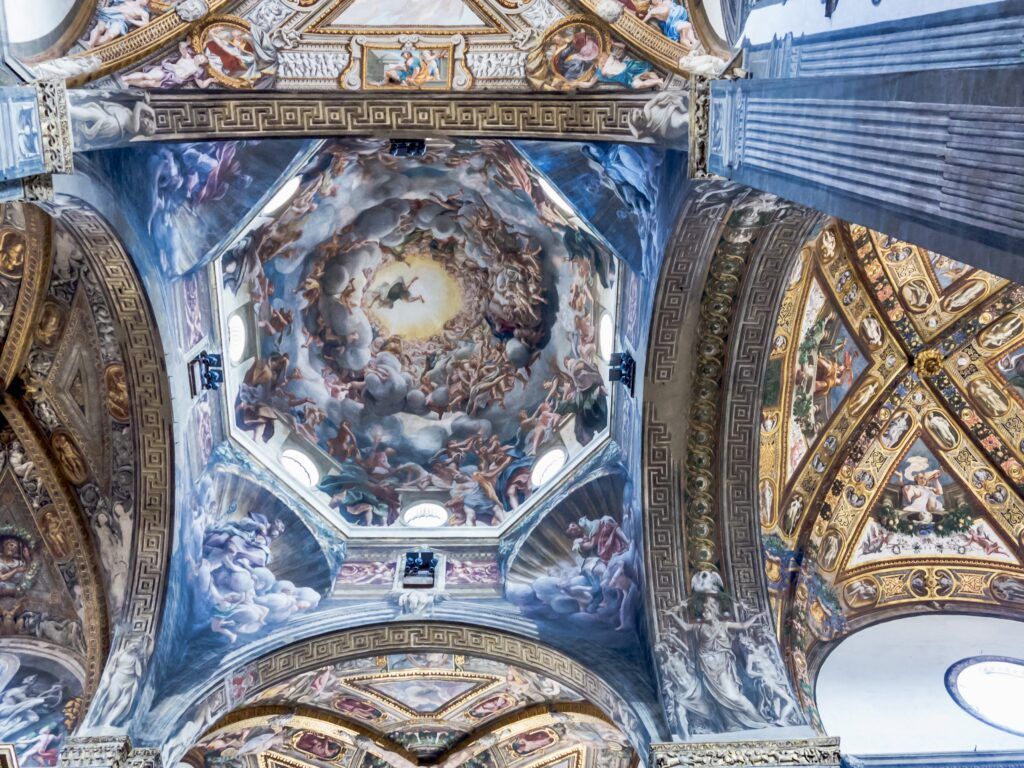
Above the saints runs a cornice occupied by monumental figures of the apostles, who gaze upward in awe and wonder. Correggio wasn’t particularly interested in making the apostles easy to identify. Their role is less about portraiture than participation in the event.
Beyond that, unlike Michelangelo’s Sistine Chapel ceiling, there are no architectural divisions. Instead, soft, swelling clouds become the architecture itself.
The dome is all theater. It’s a proto-Baroque masterpiece organized into three distinct levels.
The first level is the balustrade occupied by the apostles. The second is filled with floating angels, perhaps inspired by Michelangelo’s ignudi, though far less muscular and more graceful. The uppermost level is the celestial realm, where angels celebrate Mary’s arrival with music.

It’s an entirely new concept of space and perspective. Correggio employs di sotto in sù (“seen from below”) perspective and dramatic foreshortening to dissolve the architecture and open the dome to heaven.
What grabs your attention is the swirling vortex of crowded figures. The impression is that they float effortlessly through an immense celestial space, with no solid ground beneath them. It’s as if they’re set on transparent glass.
Figures and clouds move in every direction. The dynamic poses create a powerful sense of movement and energy.
This isn’t merely visual spectacle. It’s meant to embody the theological idea of Mary’s assumption into heaven.
If you look carefully, or better yet bring binoculars, you can identify figures such as Adam, a semi-nude Eve, Judith carrying the head of Holofernes, Isaac, Jacob, and many others.
As I mentioned above, the dome was so audacious for its time that its dizzying illusion initially drew mixed reactions. Yet even critics recognized the extraordinary ambition and scale of the work.

Titian himself reportedly visited Parma and declared, “Turn the dome upside down and fill it with gold. That is its worth.” Stendhal, centuries later, was said to have been moved to tears.
Correggio’s daring illusion transformed the future of ceiling painting. Later Baroque masters would all create soaring heavenly visions that dissolved architecture in much the same way.
What became a hallmark of the Baroque began here, beneath the dome of Parma Cathedral.
Today, Correggio’s Assumption of the Virgin is recognized as one of the greatest achievements of Renaissance art. More than 500 years after it was painted, it still leaves visitors doing exactly what Correggio intended: standing beneath the dome, looking upward in amazement.
I hope you’ve enjoyed my guide to Correggio’s Assumption of the Virgin. You may find these other Italian art guides interesting:
- Italy art bucket list
- Most famous Italian artists
- Best museums in Italy
- Masterpieces in Venice
- Masterpieces in Florence
- Caravaggio trail in Rome
- Bernini trail in Rome
- Michelangelo trail in Florence
- Raphael masterpieces
Pin it for later.

